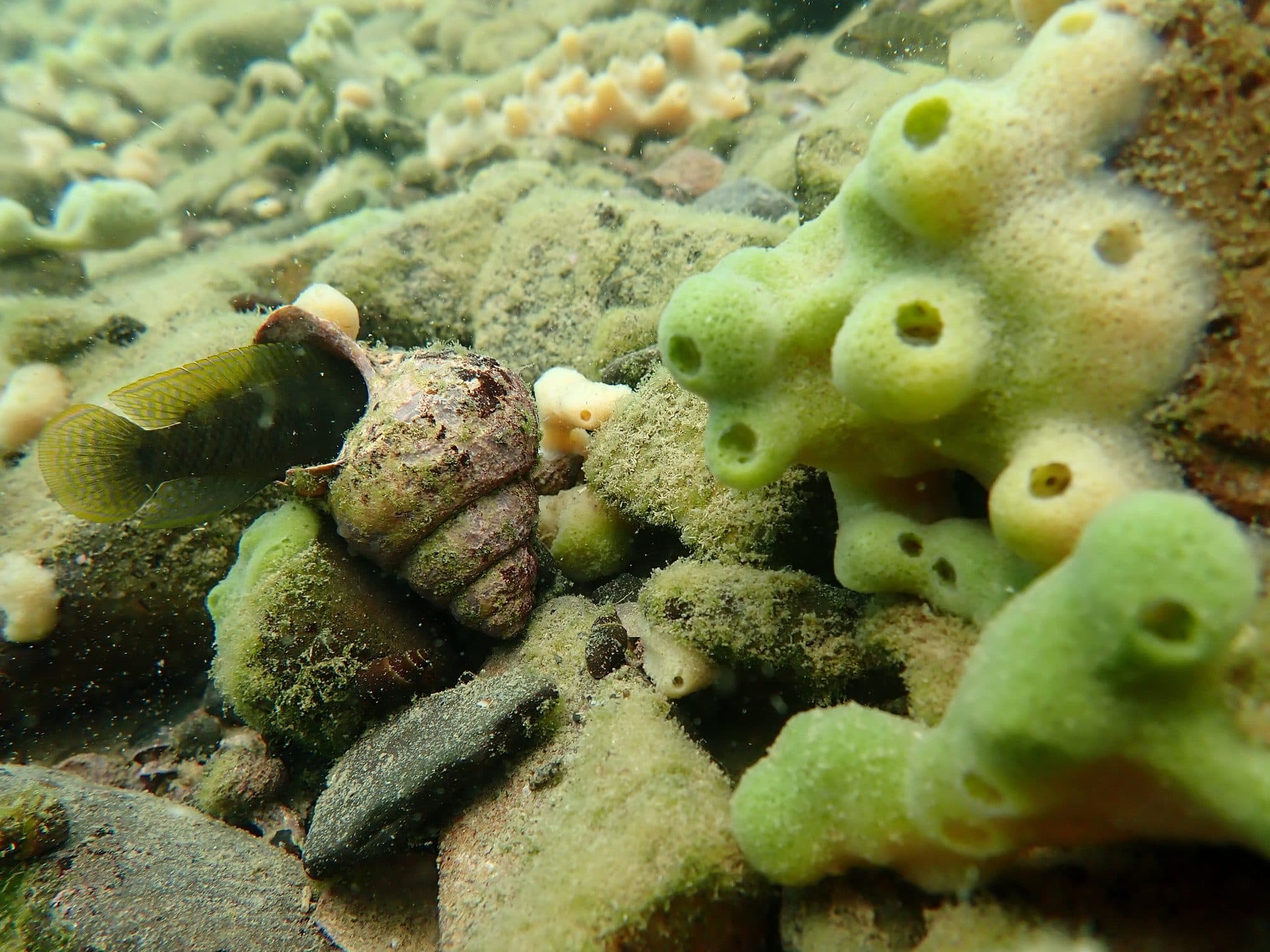
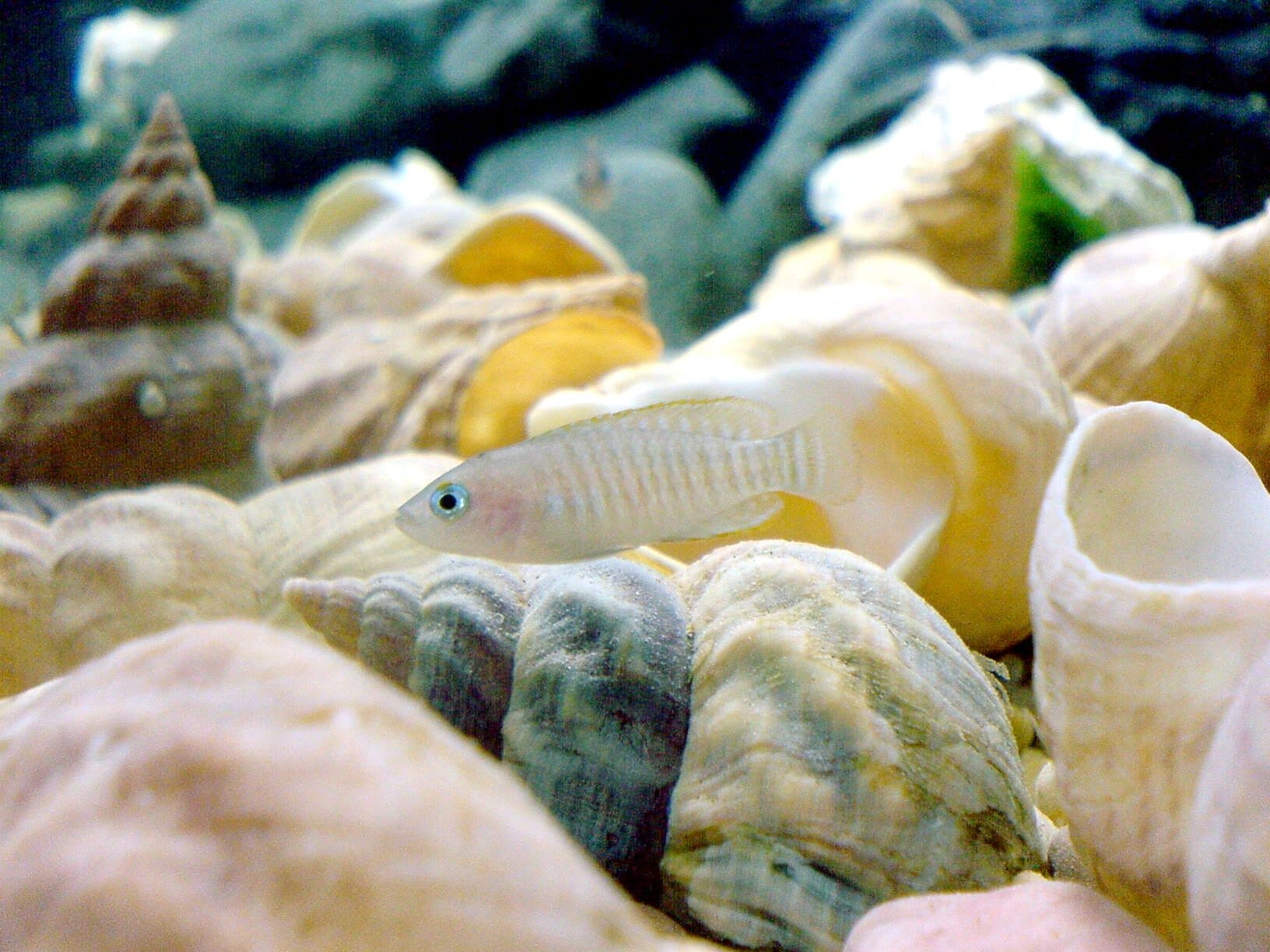
A small cichlid hiding in an empty snail shell among the sponges of the lake floor, in Zambia.
Photo: Charlotte E. T. Huyghe, CC BY 4.0, via Wikimedia Commons
Shell beds
Lake Tanganyika, the shell beds
Tanzania, DR Congo, Zambia
On the sandy floor of the lake, fields of empty snail shells serve as shelter and nest for tiny cichlids, the shell dwellers.
The habitat
Neothauma tanganyicense, a large snail endemic to the lake, leaves behind a thick shell that does not dissolve in the alkaline water. On some sandy bottoms, between about 10 and 45 m deep, these shells pile up into vast beds, where they are almost the only shelter.
Several lamprologines have specialised in these shells: they hide, spawn and raise their fry in them. Males of Lamprologus callipterus, a larger species, even carry shells to build heaps where their females spawn.
The water
It is Lake Tanganyika water: a conductivity of 606 to 620 µS/cm, 10.4 to 12.5 °dGH and 16.9 to 19.1 °dKH according to Talling and Talling (1965), and a pH close to 9 at the surface (Plisnier and colleagues, 1996).
The profiles of these fish give a pH of 7.5 to 9.5 and hard water: Rift lake water suits them.
Who lives here
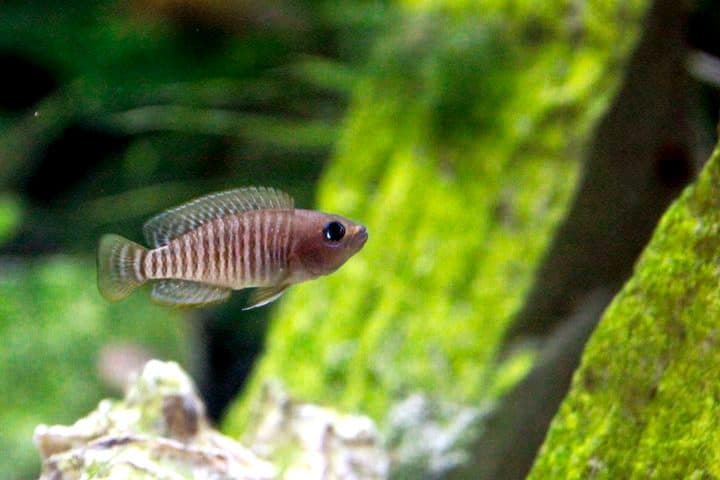
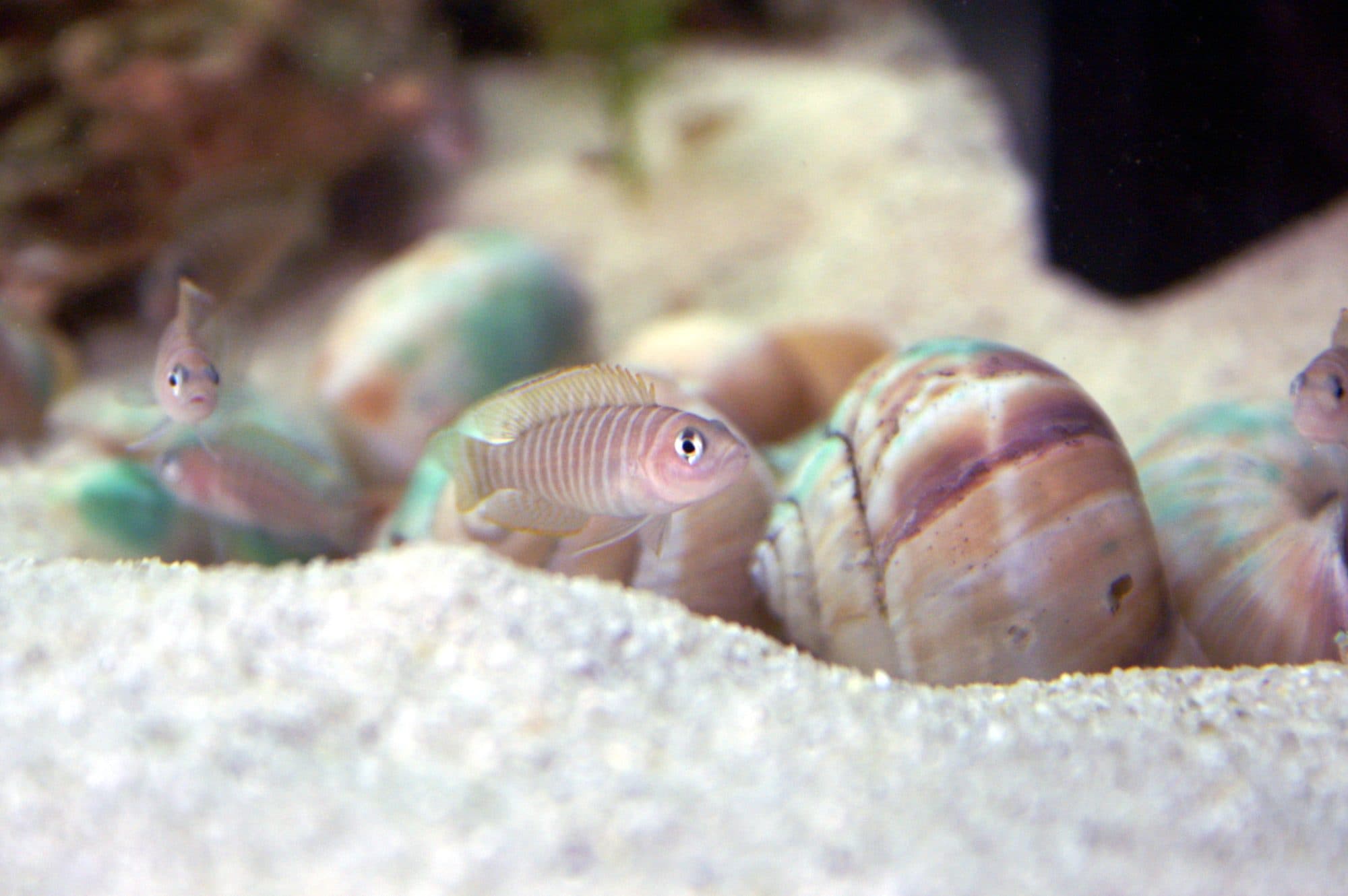
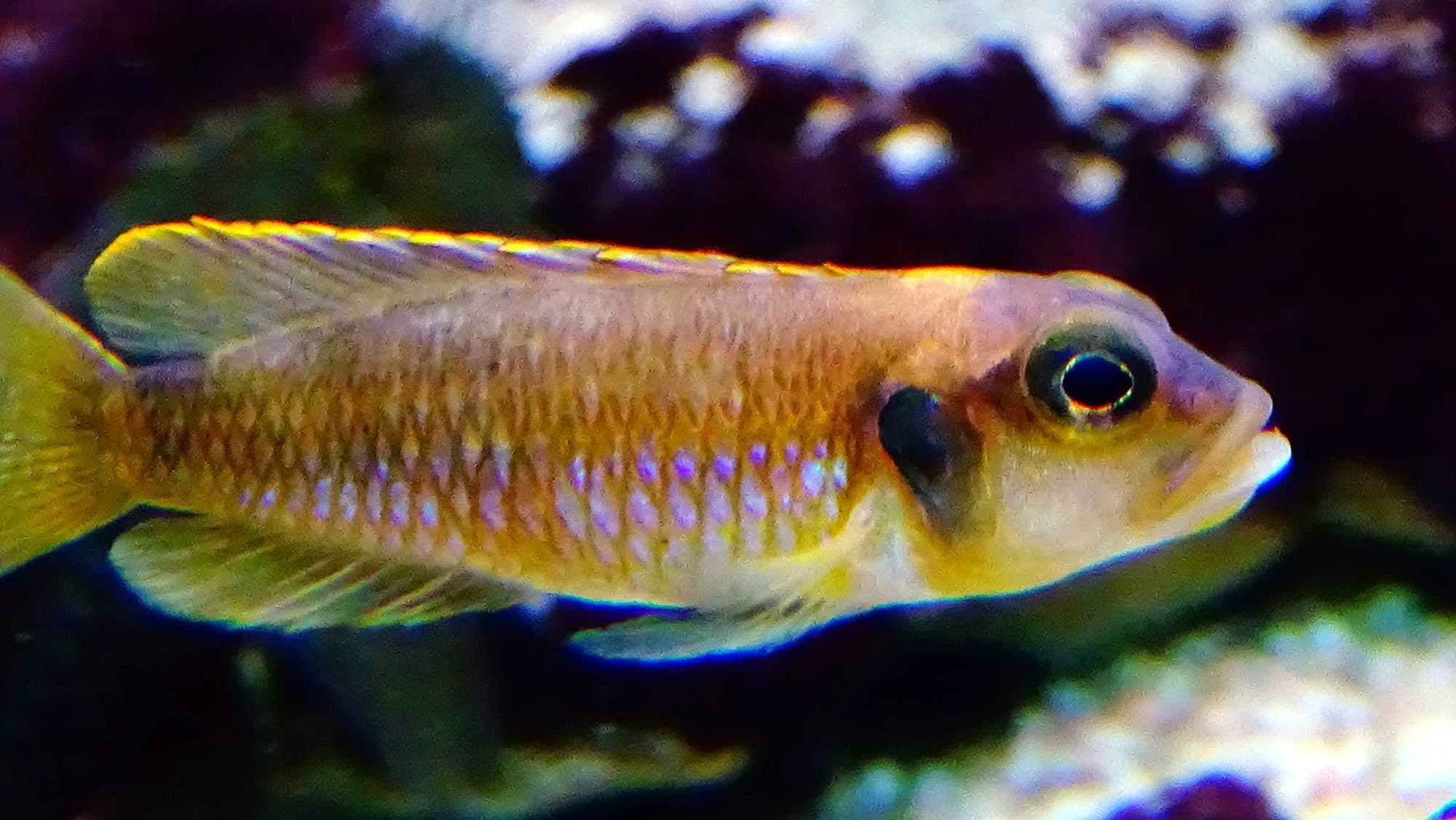
Neolamprologus multifasciatus, which does not exceed 4 cm, is among the smallest cichlids: its colonies cover entire beds, each fish defending a few shells and a few centimetres around them. N. similis, whose pale bars continue onto the head, lives the same way. The ocellated shell dweller (Lamprologus ocellatus) is more solitary: it buries its shell and fiercely defends the entrance.
No plant grows on these bottoms, and no invertebrate of the catalogue lives there.
Fish (3)
Recreating it in an aquarium
- A fairly deep layer of fine sand, which the fish dig constantly, and many more shells than fish; Roman snail (escargot) shells replace those of Neothauma.
- A small tank is enough: 80 to 100 L for a colony of a single species.
- Hard, alkaline water, pH 8 to 9, 24 to 27 °C.
- One shell-dwelling species per tank; in a larger tank, neighbours from other zones, such as Cyprichromis in open water.
- Live or frozen prey (brine shrimp, cyclops): dry food alone is not enough.
Example tank
- Volume
- 80 L
- pH
- 8.5
- GH
- 12°
- Temp.
- 25 °C
- 5 × Neolamprologus similis
An 80 L tank for a colony of five Neolamprologus similis, in water at pH 8.5 and 12 °dGH, with at least two shells per fish and more females than males.
Compatible stocking
Water shared by all species
- pH
- 7.5–9
- GH
- 8–25°
- Temp.
- 24–27 °C
Tanks recreating it
Neolamprologus multifasciatus among a heap of shells, in an aquarium.
Photo: Richard Andre Ingebrigtsen, Department of Aquatic Biosciences, University of Tromsø, Rex shock at en.wikipedia, Public domain, via Wikimedia Commons
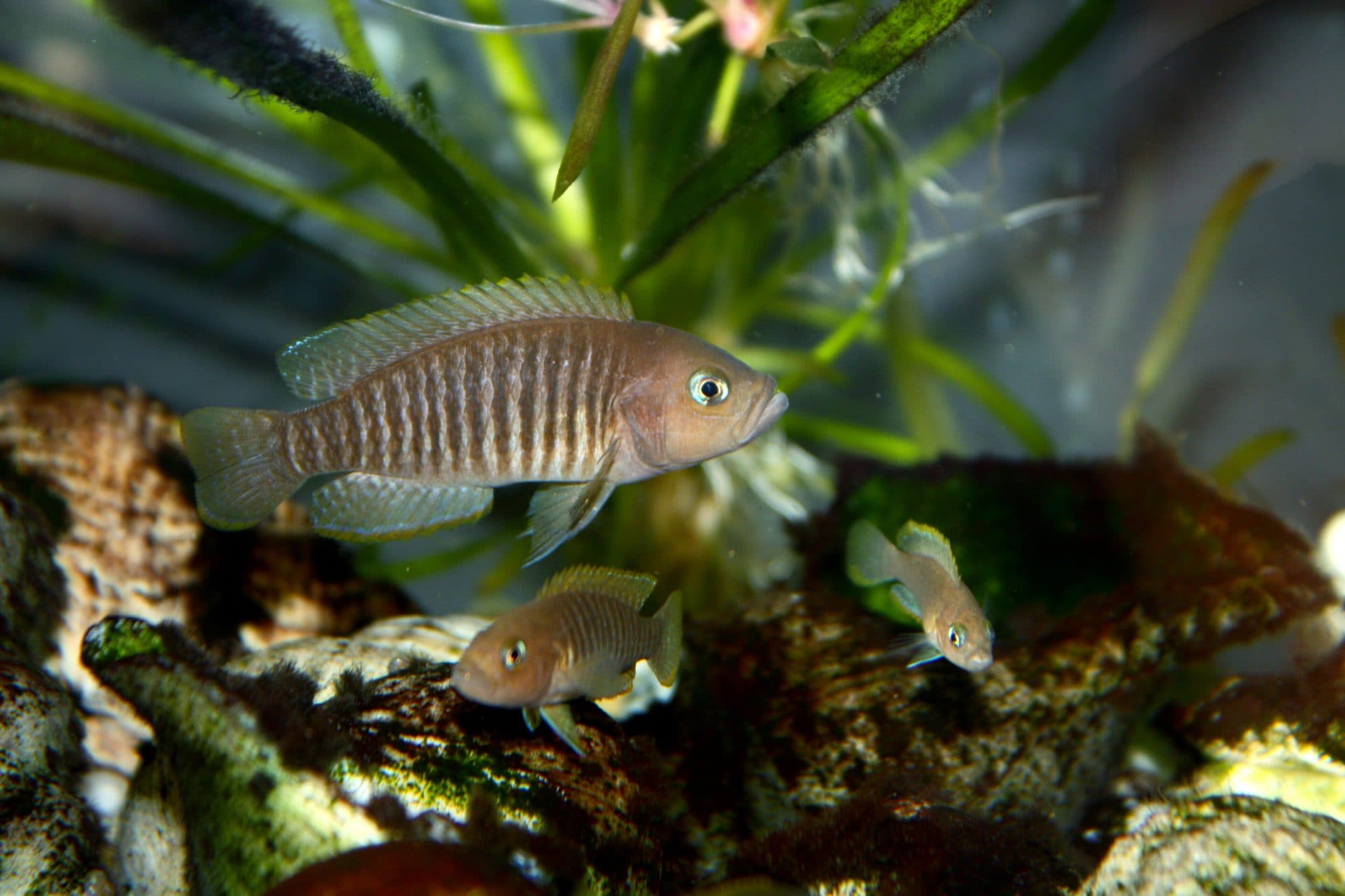
A male N. multifasciatus guarding its territory.
Photo: Richard A. Ingebrigtsen, CC BY-SA 3.0, via Wikimedia Commons
Aquarists present their tanks on video, often modelled on one precise site. The videos are hosted by YouTube, and the player only loads when you click.
Gab Aqua · YouTube
Jimmy Gimbal · YouTube
Sources
Species are listed from their profiles (FishBase, Seriously Fish) or, for plants, from GBIF records in the region; the example tank is checked by the simulator's rules.
- Talling & Talling (1965), The chemical composition of African lake waters. Internationale Revue der gesamten Hydrobiologie 50(3): 421-463, with the Lake Tanganyika pH of Plisnier et al. (1996, LTR Technical Document TD/46), tables reproduced by M. K. Oliver, Malawi Cichlid Homepage
- Seriously Fish: Neolamprologus similis
- Seriously Fish: Neolamprologus multifasciatus
- FishBase: Neolamprologus similis