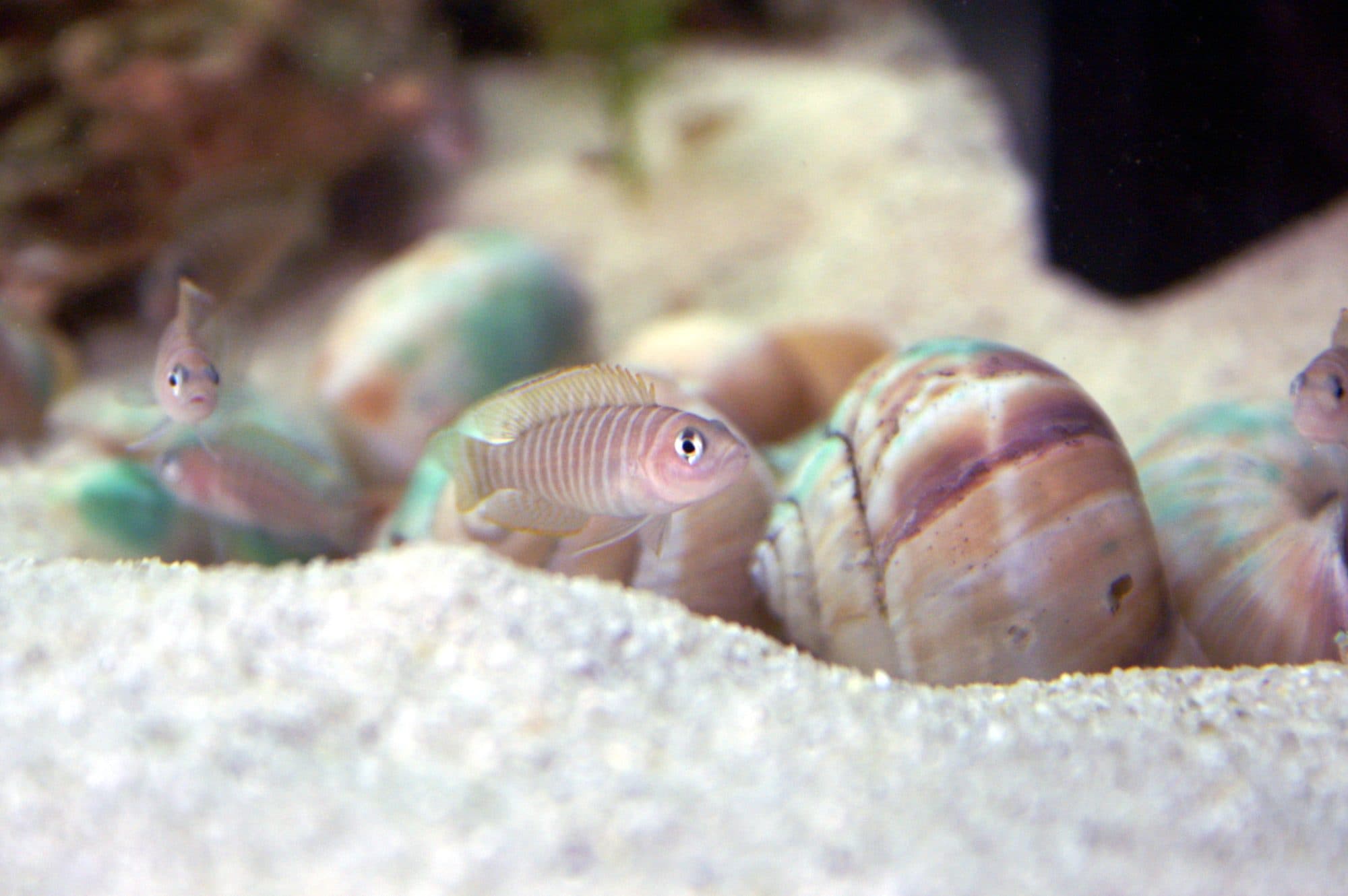
Photo: berzentei, Yvonne Turkans, CC BY-SA 3.0, via Wikimedia Commons
Neolamprologus similis
4.5 cm
Adult size
80 L
Minimum volume
5
Minimum group
5 years
Lifespan
Water parameters
Understand these values- Genus
- Neolamprologus
- Diet
- carnivore
- Social life
- small group
In the wild
Overview
Described in 1992 by the Swiss ichthyologist Heinz Büscher, this small lamprologine does not exceed 5 cm. Its copper body is crossed by pale vertical bars that continue onto the head and nape; this sets it apart from the smaller N. multifasciatus, whose bars look dark.
Males are clearly larger than females and sometimes develop a small nuchal hump. Each female spawns inside the entrance of an empty shell, then guards her eggs and fry on her own.
- Scientific name
- Neolamprologus similis Büscher, 1992
- Classification
- Cichliformes › Cichlidae
- IUCN Red List
- Not evaluated (NE)
Natural habitat
Endemic to Lake Tanganyika: southern part of the lake, along the coasts of the Democratic Republic of the Congo and Tanzania
Observations (GBIF) and localities Native countries Rivers and lakes
It lives on the large beds of empty snail shells (Neothauma) that cover the lake's sandy bottom between 10 and 45 m deep, and more rarely among rock rubble below 25 m. It clearly prefers shells to the gaps between stones.
The water is that of the lake: highly mineralised, alkaline (pH close to 9) and stable, between 24 and 27 °C. It feeds on tiny crustaceans (copepods, ostracods), insect larvae and strands of algae.
Behaviour
It lives in colonies: each fish fiercely defends a territory a few centimetres around its shell, to the point of biting the aquarist's hand. Provide many more shells than fish and more females than males; a male often mates with several females.
It can share a tank with Tanganyikans that use other zones: small rock dwellers (Neolamprologus brichardi, small Julidochromis) and open-water fish such as Cyprichromis. Live or frozen prey preferably; dry food alone is not enough.
Sources:FishBase Seriously Fish GBIF · Base map: Natural Earth