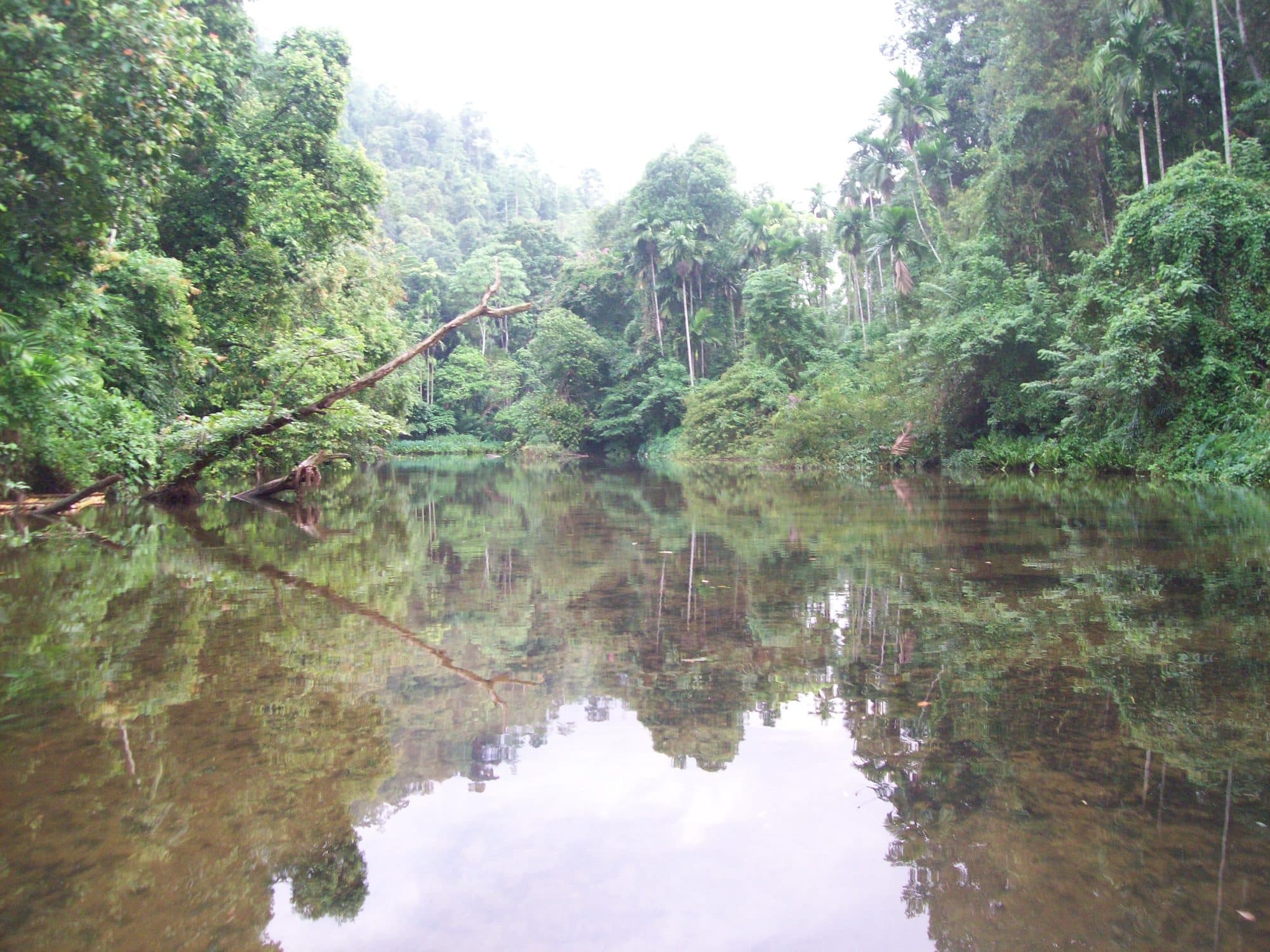
A small creek of the Kelani basin at Kitulgala: slow, stained water and forested banks.
Photo: Pol van den Scheetek…, CC BY 3.0, via Wikimedia Commons
Shaded streams
Wet zone streams of Sri Lanka
South-western Sri Lanka
Cool, shaded streams under the rainforest of the island's south-west, refuge of barbs and rasboras found nowhere else, and of Wendt's cryptocoryne.
The habitat
South-western Sri Lanka, the "wet zone", receives 2,000 to 3,000 mm of rain a year and was once covered by lowland rainforest. Its streams run down from the hills, such as those of the Sinharaja Forest Reserve, into the Kelani, Kalu, Gin and Nilwala basins.
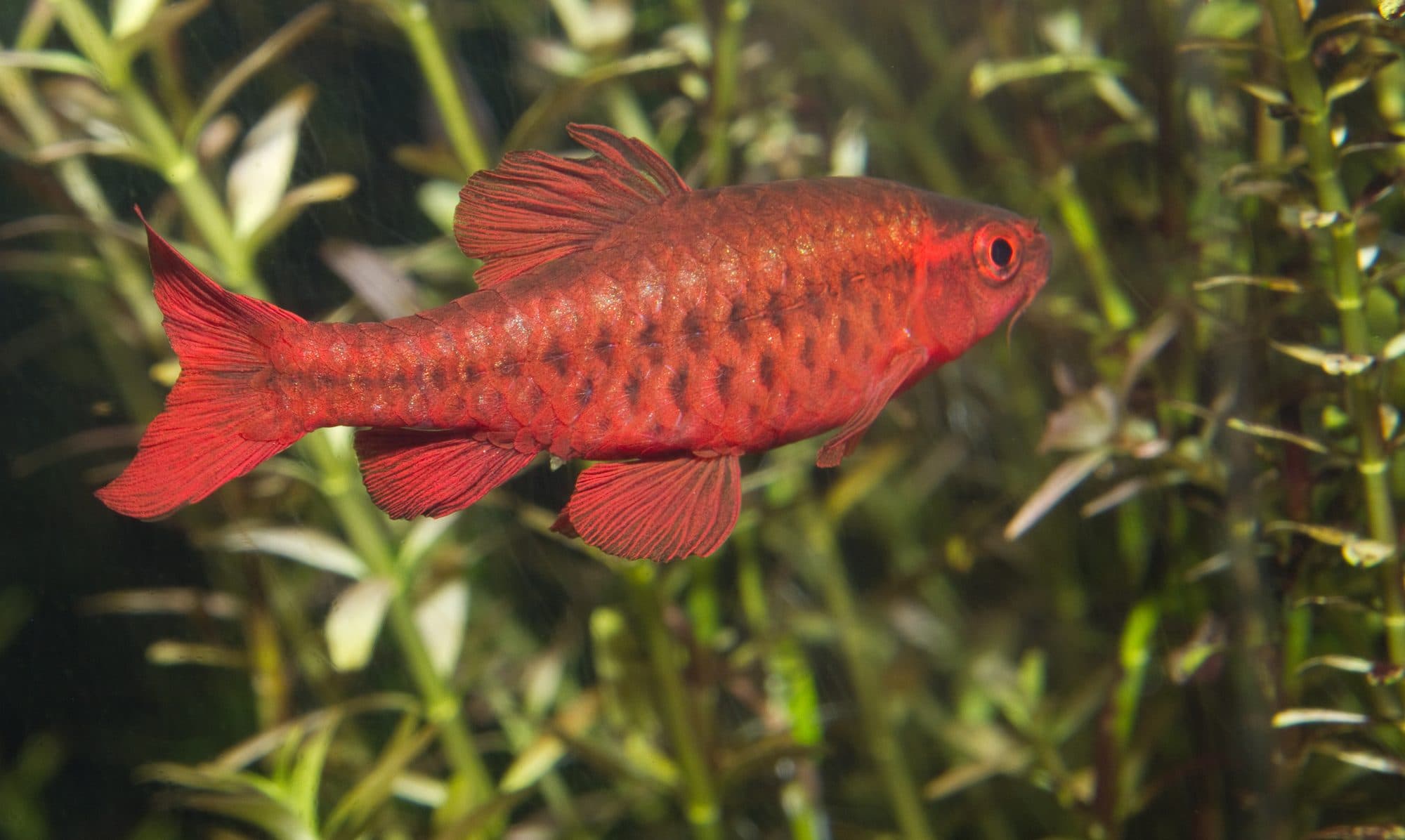
The cherry barb lives in heavily shaded, shallow, slow-flowing rivulets over silt covered with leaves; the vateria flower rasbora prefers clear, cool, calm streams, and the black ruby barb clear water over gravel or sand, up to 300 m above sea level.
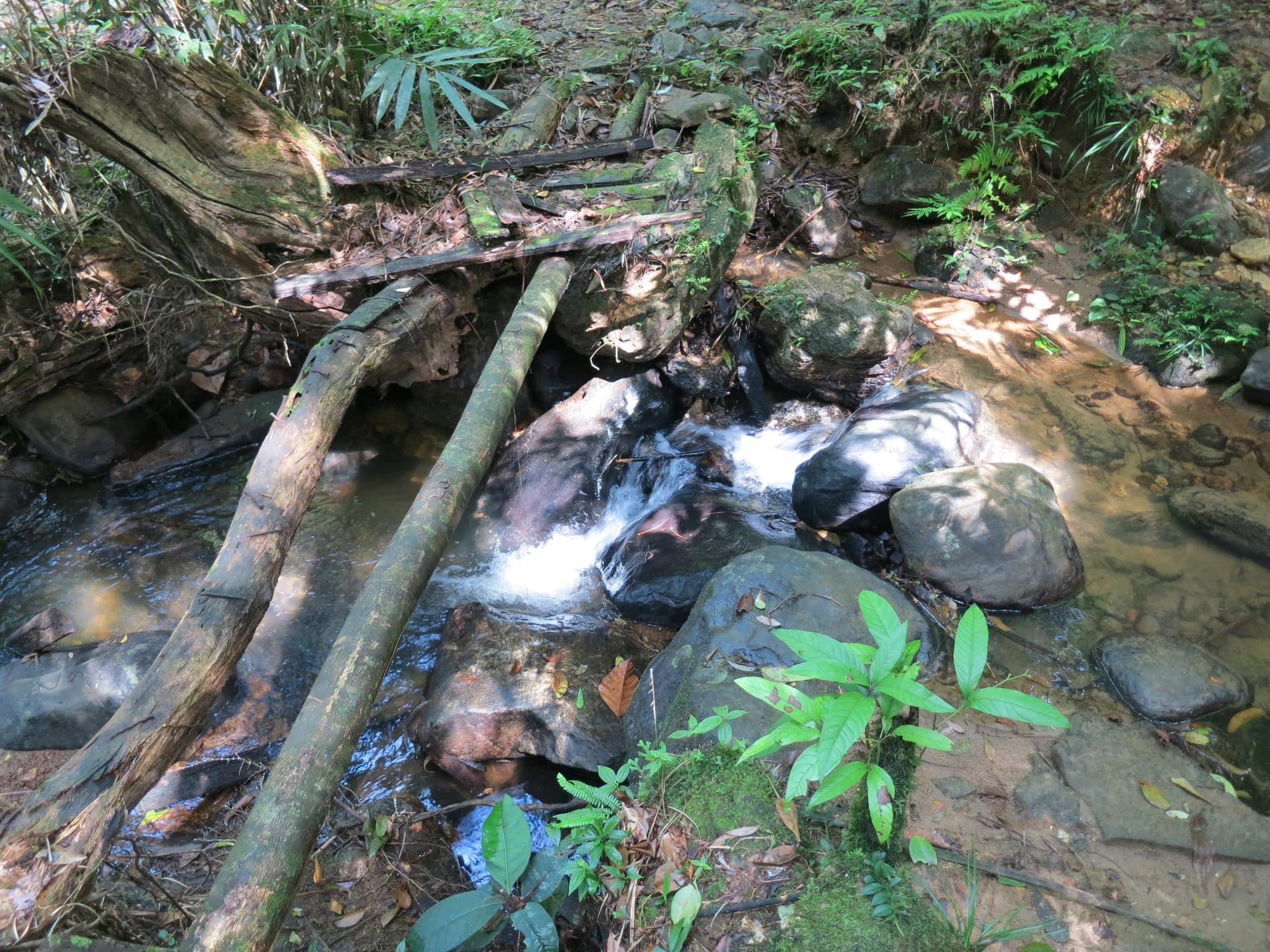
A stream in the Sinharaja Forest Reserve.
Photo: Saqib Qayyum, CC BY-SA 3.0, via Wikimedia Commons
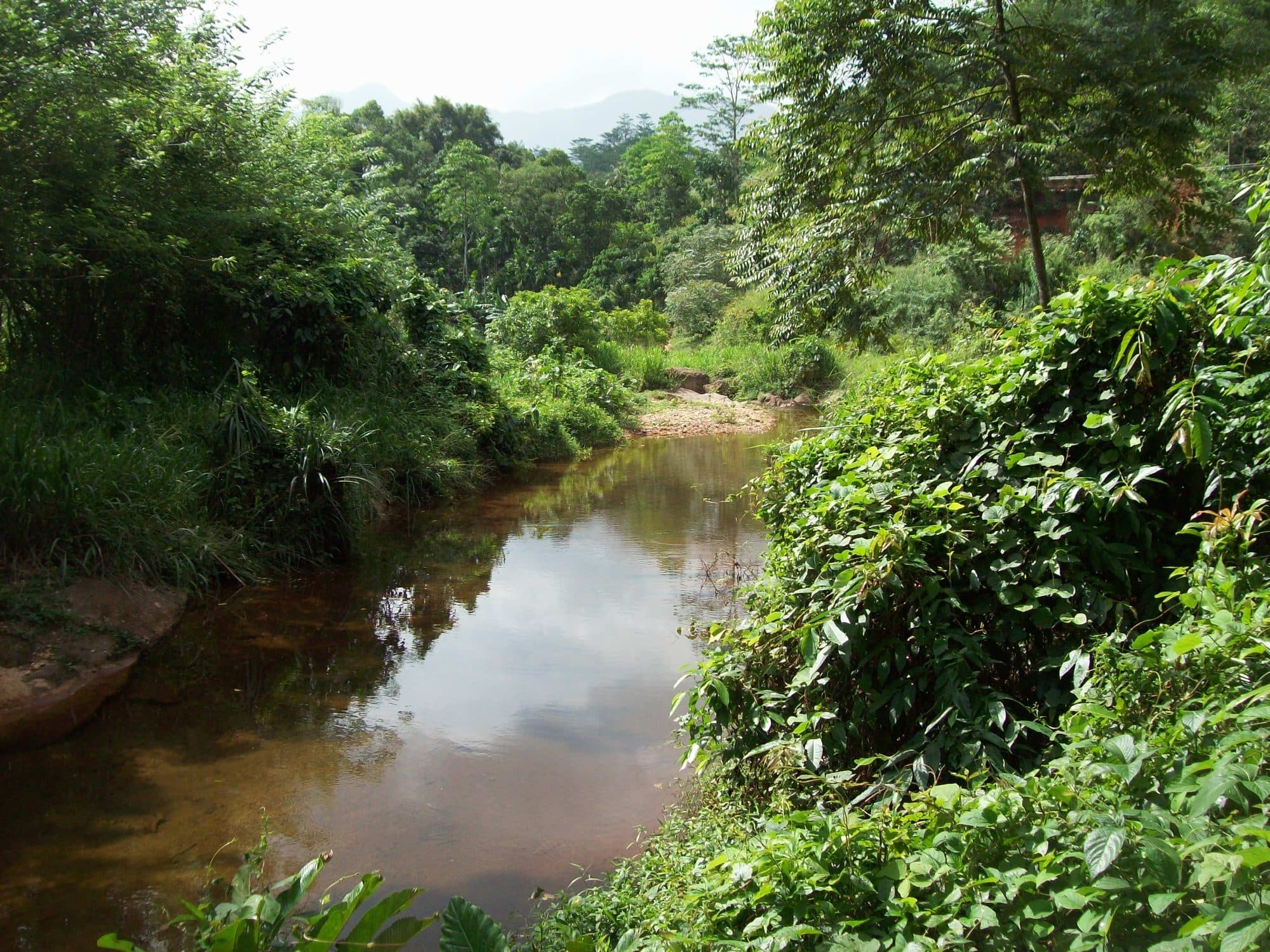
The Kataran Oya at Kitulgala, in the Kelani basin.
Photo: Pol van den Scheetek…, CC BY 3.0, via Wikimedia Commons
The water
The profiles of these fish describe clear, soft to moderately soft water, slightly acidic to neutral (pH 6 to 7 for the cherry barb) and rather cool for the tropics: 22 to 27 °C, in the shade of the forest.
Who lives here
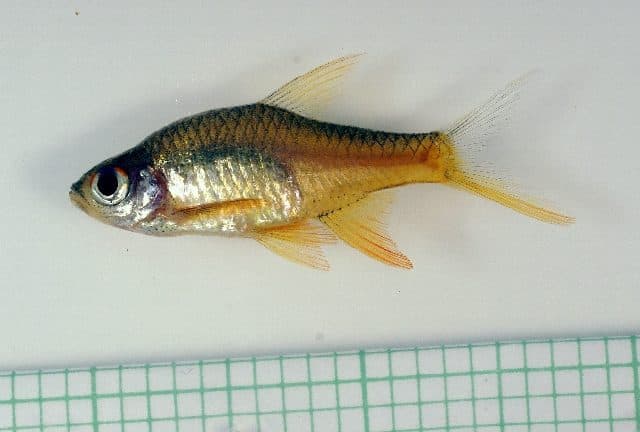
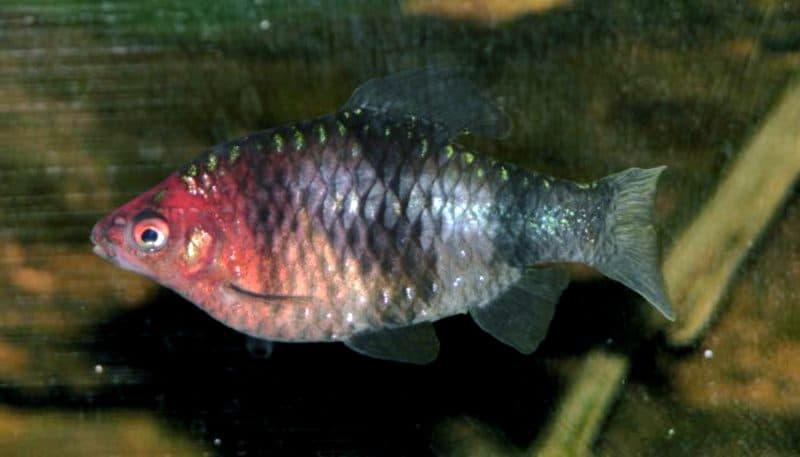
Three fish of the catalogue are endemic to this zone: the cherry barb (Puntius titteya), the vateria flower rasbora (Rasboroides vaterifloris) and the black ruby barb (Pethia nigrofasciata). They live in shoals; the vateria flower rasbora eats insects that fall into the water and detritus.
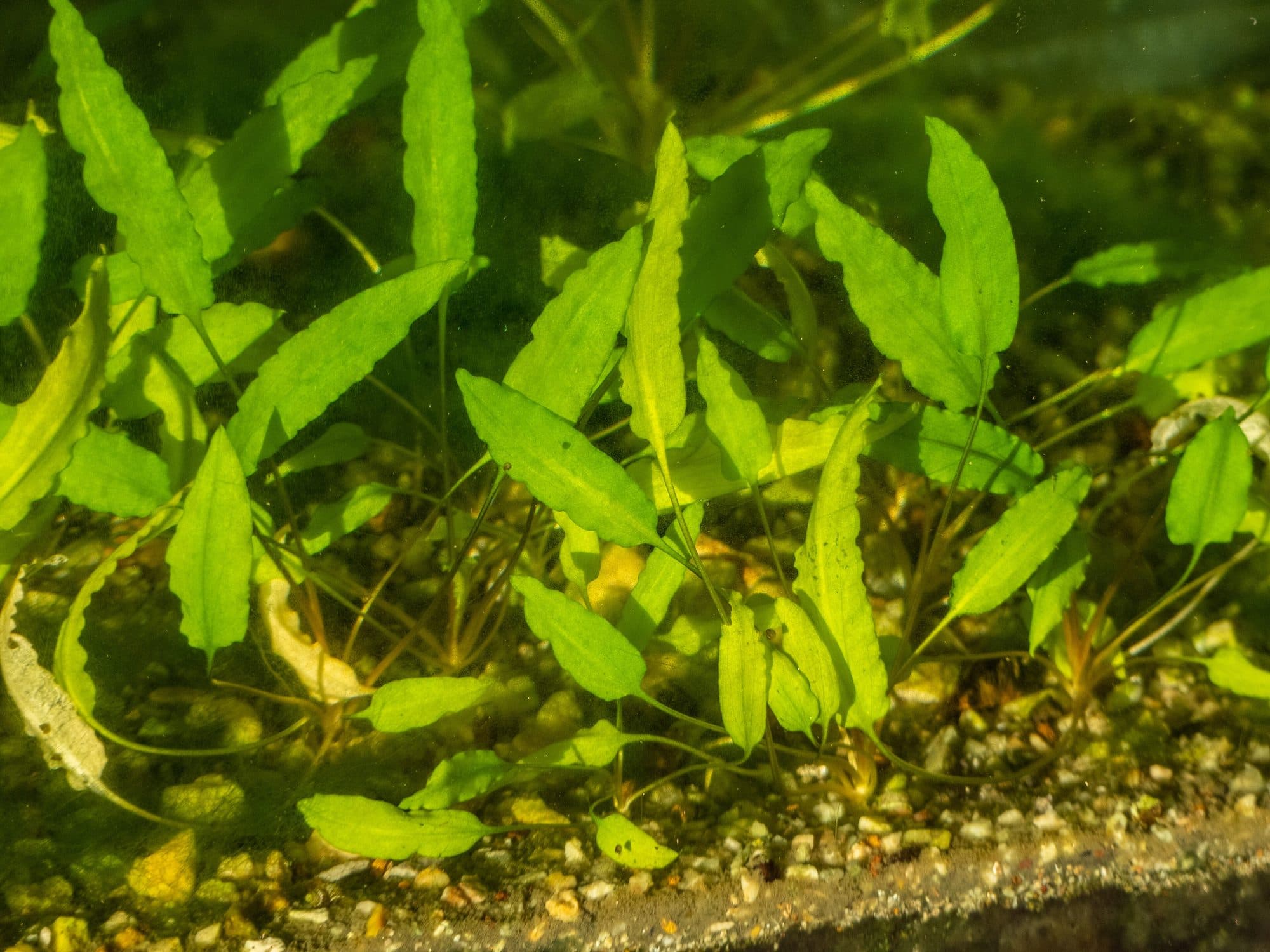
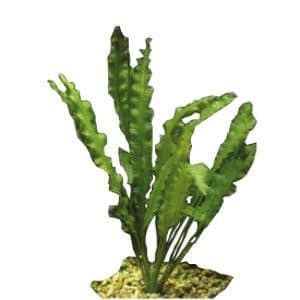
Wendt's cryptocoryne and Aponogeton crispus, a plant of seasonal pools, are native to the island, like other plants of its streams (Cryptocoryne beckettii, C. walkeri, Lagenandra thwaitesii) that do not yet have a free photo to enter the catalogue. No invertebrate of the catalogue lives there.
Fish (3)
Recreating it in an aquarium
- A bottom of sand and silt, dead leaves, roots and a few pebbles.
- Clumps of cryptocoryne in the foreground and an Aponogeton at the back; medium, diffused light.
- Soft to moderately soft water, pH 6 to 7, 23 to 26 °C, and a gentle current.
- Shoals of at least eight fish per species; the sensitive vateria flower rasbora needs a well-established tank.
Example tank
- Volume
- 150 L
- pH
- 6.5
- GH
- 7°
- Temp.
- 25 °C
- 8 × Cherry barb
- 8 × Fire rasbora
- 8 × Black ruby barb
- Wendt's water trumpet
- Crinkled aponogeton
A 150 L tank with the three endemic fish in shoals of eight, Wendt's cryptocorynes and an Aponogeton crispus.
Compatible stocking
Water shared by all species
- pH
- 6–7
- GH
- 6–8°
- Temp.
- 23–27 °C
Good to know
- Biotope tank: every species comes from Asia.
Tanks recreating it
Aquarists present their tanks on video, often modelled on one precise site. The videos are hosted by YouTube, and the player only loads when you click.
Biotope Aquarium · YouTube
Gab Aqua · YouTube
Sources
Species are listed from their profiles (FishBase, Seriously Fish) or, for plants, from GBIF records in the region; the example tank is checked by the simulator's rules.