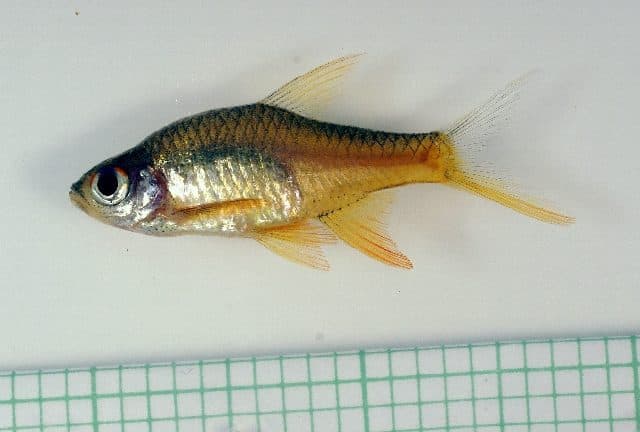
Photo: Rupert A. Collins, CC BY 3.0, via Wikimedia Commons
Fire rasbora
Rasboroides vaterifloris
4 cm
Adult size
70 L
Minimum volume
8
Minimum group
5 years
Lifespan
Water parameters
Understand these values- Genus
- Rasboroides
- Diet
- carnivore
- Social life
- shoal
In the wild
Overview
This small orange rasbora with a pearly sheen, nicknamed the “pearl of fire”, is uncommon in the trade: little bred commercially, it travels poorly, and Sri Lanka restricts the export of wild fish. It is listed as endangered: almost no forest remains in its range, and the water there is badly degraded.
- Scientific name
- Rasboroides vaterifloris (Deraniyagala, 1930)
- Classification
- Cypriniformes › Danionidae
- IUCN Red List
- Endangered (EN)
Natural habitat
Endemic to south-western Sri Lanka: Kalu, Bentota, Gin and Nilwala basins
Observations (GBIF) and localities Native countries Rivers and lakes
It lives in Sri Lanka's “wet zone”, which receives 2,000 to 3,000 mm of rain a year: shallow, cool, clear, calm and heavily shaded forest streams over silt, often rich in dead leaves. There it eats insects that fall into the water and detritus.
Behaviour
Discreet, it is intimidated or outcompeted at feeding time by larger or boisterous companions. Ideal companions: small cyprinids (Trigonostigma, Boraras, small Rasbora, some Pethia and Puntius) and peaceful loaches such as Pangio. A shoaling fish, at least 6 to 10. Easy to feed, with small live or frozen prey for condition and colour.
Sources:FishBase Seriously Fish GBIF · Base map: Natural Earth