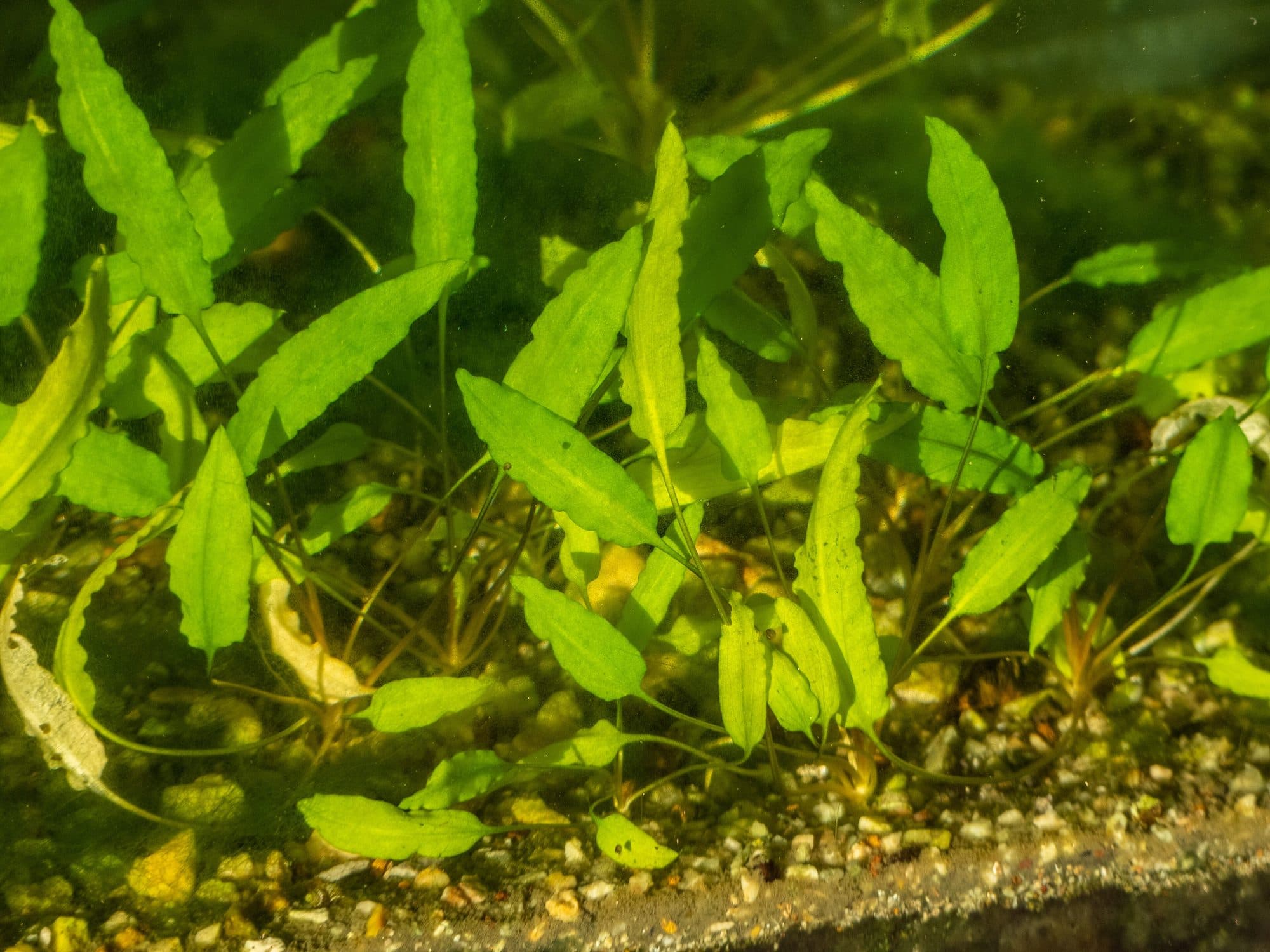
Photo: John Robert McPherson, CC BY-SA 4.0, via Wikimedia Commons
Wendt's water trumpet
Cryptocoryne wendtii de Wit
10–30 cm
Height in the aquarium
low to high
Light
low
CO₂ needs
22–26 °C
Ideal temperature
Water parameters
Understand these values- Position
- midground, foreground
- Propagation
- runners, rhizome division, separating offshoots
- Grows emersed
- yes
In the wild
Overview
An aroid from Sri Lanka, described in 1958 by the Dutch botanist Hendrik de Wit, who named it after the aquarist and author Albert Wendt. It is one of the hardiest and best-selling cryptocorynes.
It forms a rosette of lance-shaped leaves with wavy edges. The species is very variable and its cultivated forms differ mainly in colour: green (“Green”), brown or bronze (“Tropica”), or “Mi Oya”, named after the river in Sri Lanka where it was found.
- Scientific name
- Cryptocoryne wendtii de Wit
- Classification
- Alismatales › Araceae
- IUCN Red List
- Near threatened (NT)
Natural habitat
Sri Lanka; introduced in Florida
Observations (GBIF) and localities Native countries Rivers and lakes
- Native countries
- Introduced by people
No introduction reported outside its native range.
Countries: Kew World Checklist of Vascular Plants (WCVP). Dots: GBIF observations in the native countries.
In the aquarium
Growing in the aquarium
Easy, it makes do with low light and, like most Sri Lankan cryptocorynes, grows well in hard water. It is planted in groups in the foreground or midground; on its own, with no neighbours, it spreads its leaves almost flat on the ground.
Cryptocorynes cope badly with sudden changes (transplanting, moving from emersed nursery growing to the aquarium): the plant sometimes loses all its leaves, which “melt”, then regrows from the rhizome within about a month. It is best placed in an aquarium that has been running for a few months. It spreads by runners.
Sources:Flowgrow Tropica GBIF POWO (Kew) Wikipédia (en) : Cryptocoryne wendtii Wikipédia (en) : Cryptocoryne, « Crypt melt » · Base map: Natural Earth