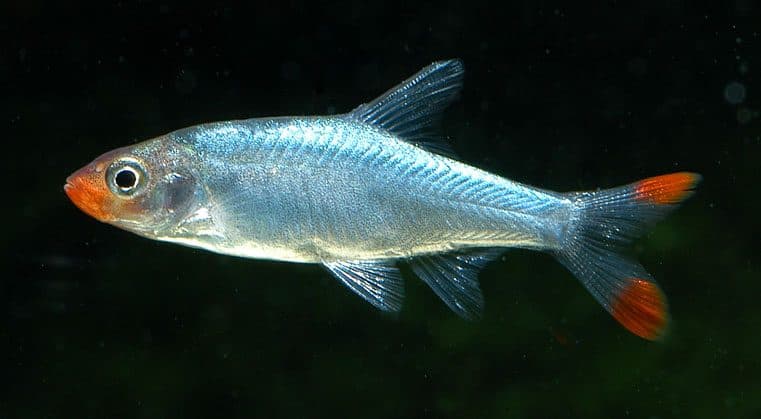
Photo: The Man On The Street at English Wikipedia, CC BY 3.0, via Wikimedia Commons
Sawbwa barb
Sawbwa resplendens
4 cm
Adult size
60 L
Minimum volume
10
Minimum group
10 years
Lifespan
Water parameters
Understand these values- Genus
- Sawbwa
- Diet
- omnivore
- Social life
- shoal
In the wild
Overview
Described in 1918 by Nelson Annandale, the Asian rummy-nose is the only member of the genus Sawbwa, from the title borne by the Shan princes. Its Latin name resplendens means “resplendent”: the male has a red head and tail tips and flanks with a blue sheen. Its body has no scales.
The IUCN lists it as endangered. The lake lost more than 30% of its area between 1935 and 2000 through silting, eutrophication and agricultural pollution, and non-native predators have been introduced.
- Scientific name
- Sawbwa resplendens Annandale, 1918
- Classification
- Cypriniformes › Cyprinidae
- IUCN Red List
- Endangered (EN)
Natural habitat
Endemic to Lake Inle and its basin, Shan State (Myanmar)
Observations (GBIF) and localities Native countries Rivers and lakes
It lives in Lake Inle, perched at almost 900 m above sea level on the Shan Plateau, and in the surrounding marshes. The lake water is clear and shallow, but muddy and murky at the edges.
The species is found throughout the lake, in clear and peaty water alike, but mainly along vegetated shores, among weed beds and the roots of the Intha people's floating gardens. It forms large groups there; the water is rather hard, alkaline and fairly cool.
Behaviour
Peaceful towards other species, it is not ideal in a community aquarium because of its small size and the constant fights between males for dominance. It forms loose groups rather than shoals.
The best answer is to keep more females than males, ideally four to one; the pale olive females are nevertheless rare on sale because exporters prefer the colourful males. It feeds on small invertebrates and zooplankton, and lays its eggs among vegetation or filamentous algae.
Sources:FishBase Seriously Fish GBIF · Base map: Natural Earth