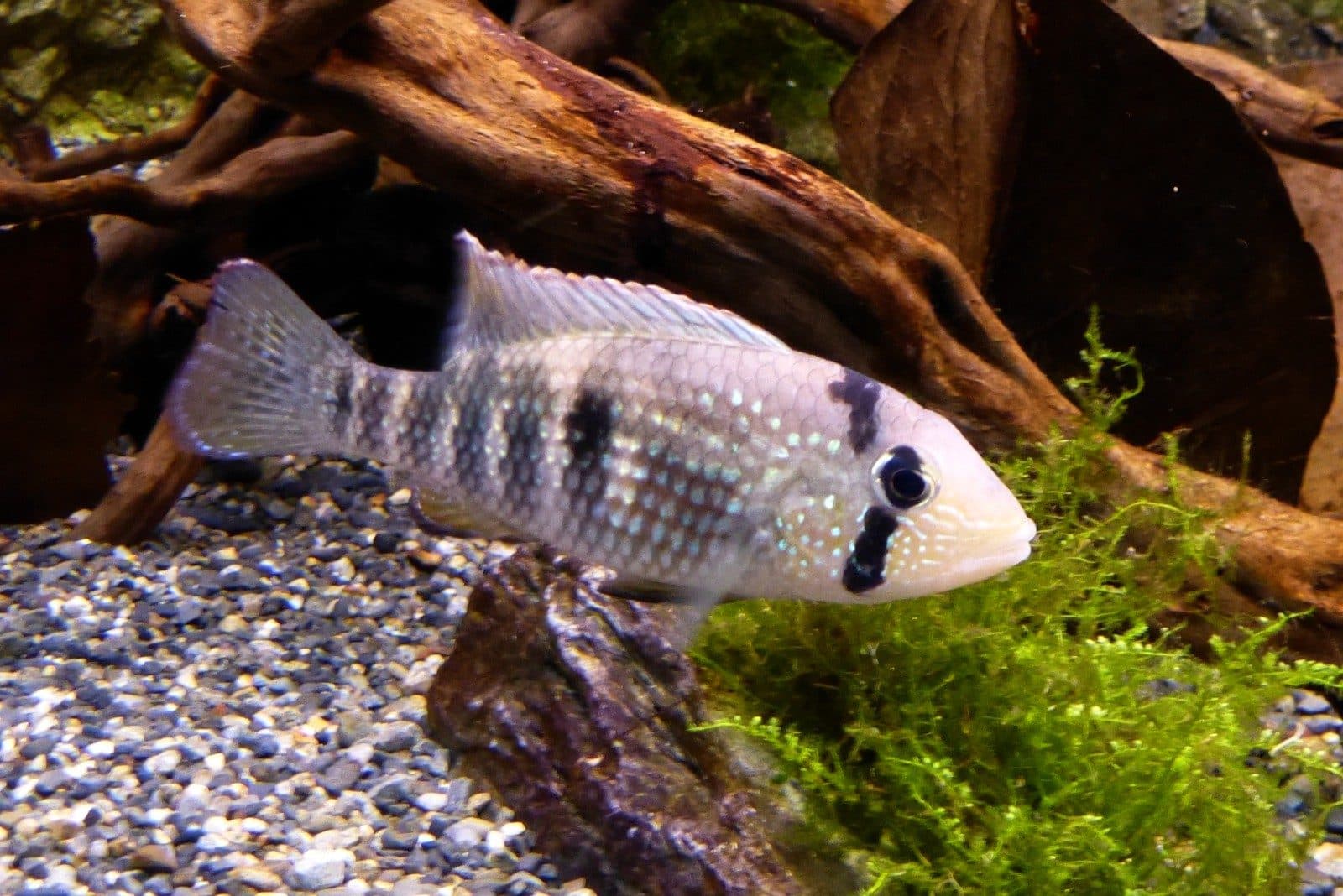
Inca stonefish
Tahuantinsuyoa macantzatza
10 cm
Adult size
250 L
Minimum volume
2
Minimum group
7 years
Lifespan
Water parameters
Understand these values- Genus
- Tahuantinsuyoa
- Diet
- carnivore
- Social life
- pair
In the wild
Overview
Described in 1986 by the Swede Sven Kullander, this cichlid has a genus name taken from Tawantinsuyu, the Quechua name for the Inca Empire, hence its English nickname “Inca stonefish”. Its species name, borrowed from a local language, means “stone fish”, referring to the rocky bottoms of its habitat.
It reaches about 12 cm; both sexes have a dark midline band and iridescent markings on the head, and the male takes on orange tones on the face and fins. The IUCN lists it as data deficient.
- Scientific name
- Tahuantinsuyoa macantzatza Kullander, 1986
- Classification
- Cichliformes › Cichlidae
- IUCN Red List
- Data deficient (DD)
Natural habitat
Río Aguaytía basin, a tributary of the Ucayali, at the foot of the Andes (Peru)
Observations (GBIF) and localities Native countries Rivers and lakes
It is known only from the Río Aguaytía basin, a tributary of the Ucayali at the foot of the Peruvian Andes.
It lives in rivers and streams with stony and pebbly bottoms. Measurements indicate very soft water, close to neutral (pH 6.3 to 7.7) and warm (25 to 28 °C).
Behaviour
Fairly peaceful for a cichlid, it lives in pairs; it is best to avoid very small tetras or barbs, which may become prey.
Its breeding is unusual: the pair spawns on a movable surface (leaf, thin flat stone) that it moves to keep the eggs safe, then, at hatching, both parents brood the larvae in their mouths. It is a so-called “delayed” mouthbrooder, fairly easy to breed in the aquarium.
Sources:FishBase GBIF Quality Marine · Base map: Natural Earth