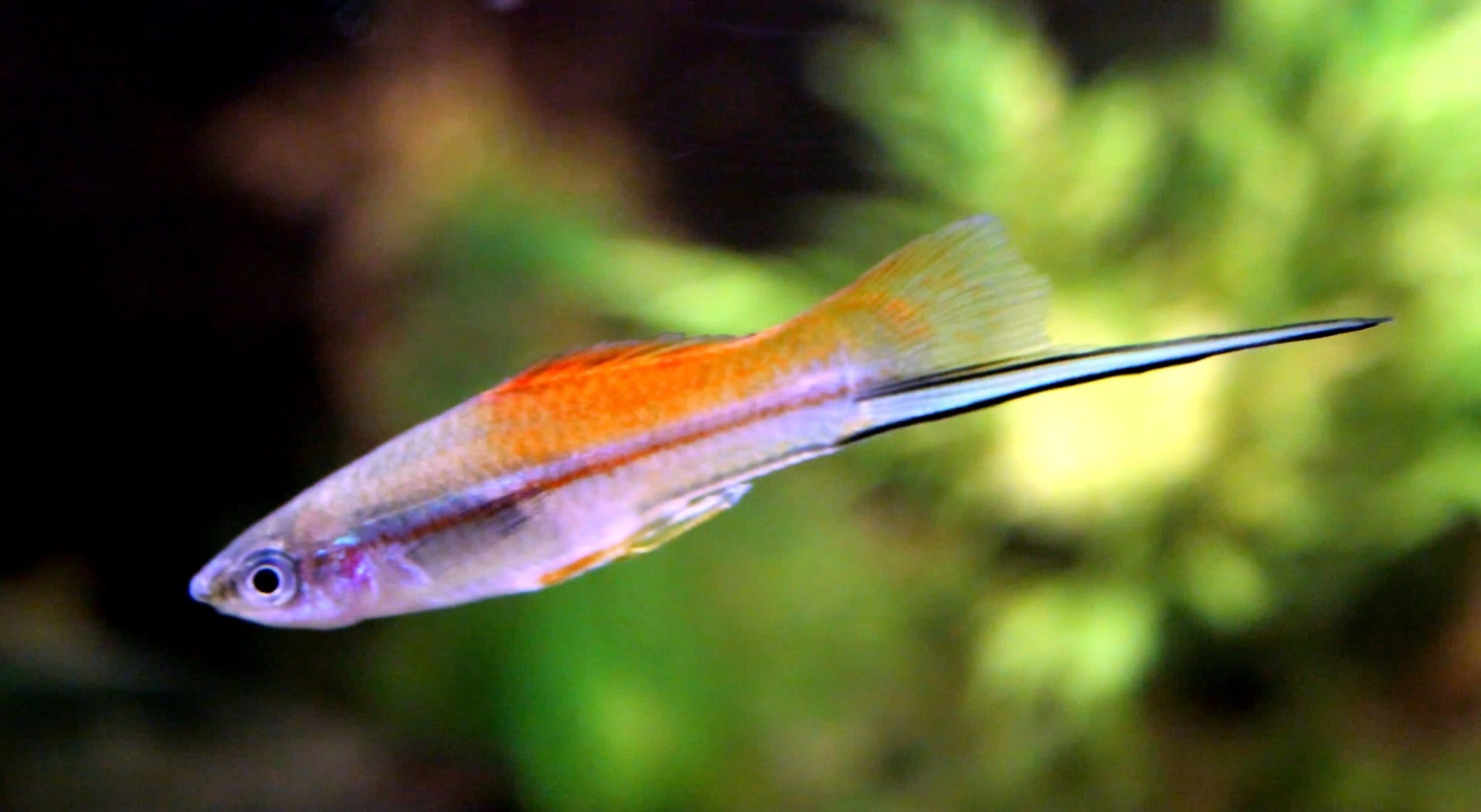
Green swordtail
Xiphophorus hellerii
12 cm
Adult size
120 L
Minimum volume
4
Minimum group
5 years
Lifespan
Water parameters
Understand these values- Genus
- Xiphophorus
- Diet
- omnivore
- Social life
- harem
In the wild
Overview
Described in 1848 by the Austrian ichthyologist Johann Jakob Heckel, the swordtail is named after the Austrian botanist Karl Bartholomaeus Heller, who explored Mexico from 1845 to 1848 and brought back the first specimens; the name is spelled with two i's, hellerii. The male is recognised by the “sword” extending the lower lobe of its tail fin.
It is one of the best-known aquarium fish in the world, available in a host of varieties, some resulting from hybridisation with the platy. Like the platy, it is a model in genetics and cancer research.
- Scientific name
- Xiphophorus hellerii Heckel, 1848
- Classification
- Cyprinodontiformes › Poeciliidae
- IUCN Red List
- Least concern (LC)
Natural habitat
South-eastern Mexico, Guatemala, southern Belize and north-western Honduras
Observations (GBIF) and localities Native countries Rivers and lakes
Its natural range runs from the Río Nautla, in Veracruz state, to the Usumacinta basin in Guatemala, the Río Sarstún on the Belize border and the Copán and Chamelecón rivers in Honduras; the type locality is Orizaba. It has been introduced to every continent except Antarctica, often to the detriment of local species.
It lives from sea level up to 1,500 m: rocky torrents, springs, ditches, pools and clear or murky rivers, often without plants. Adults stay in the current, young fish in the calm margins.
Behaviour
Peaceful with other species, it is livelier and larger than the platy. In a confined space, males establish a hierarchy and spend much time defending their rank: a fairly long tank and several females per male limit tensions.
A generalist omnivore, it eats aquatic and terrestrial invertebrates, detritus, algae and plant matter. A livebearer, it breeds easily; females choose males partly by the length of their sword, a classic example of sexual selection.
Sources:FishBase Seriously Fish GBIF · Base map: Natural Earth