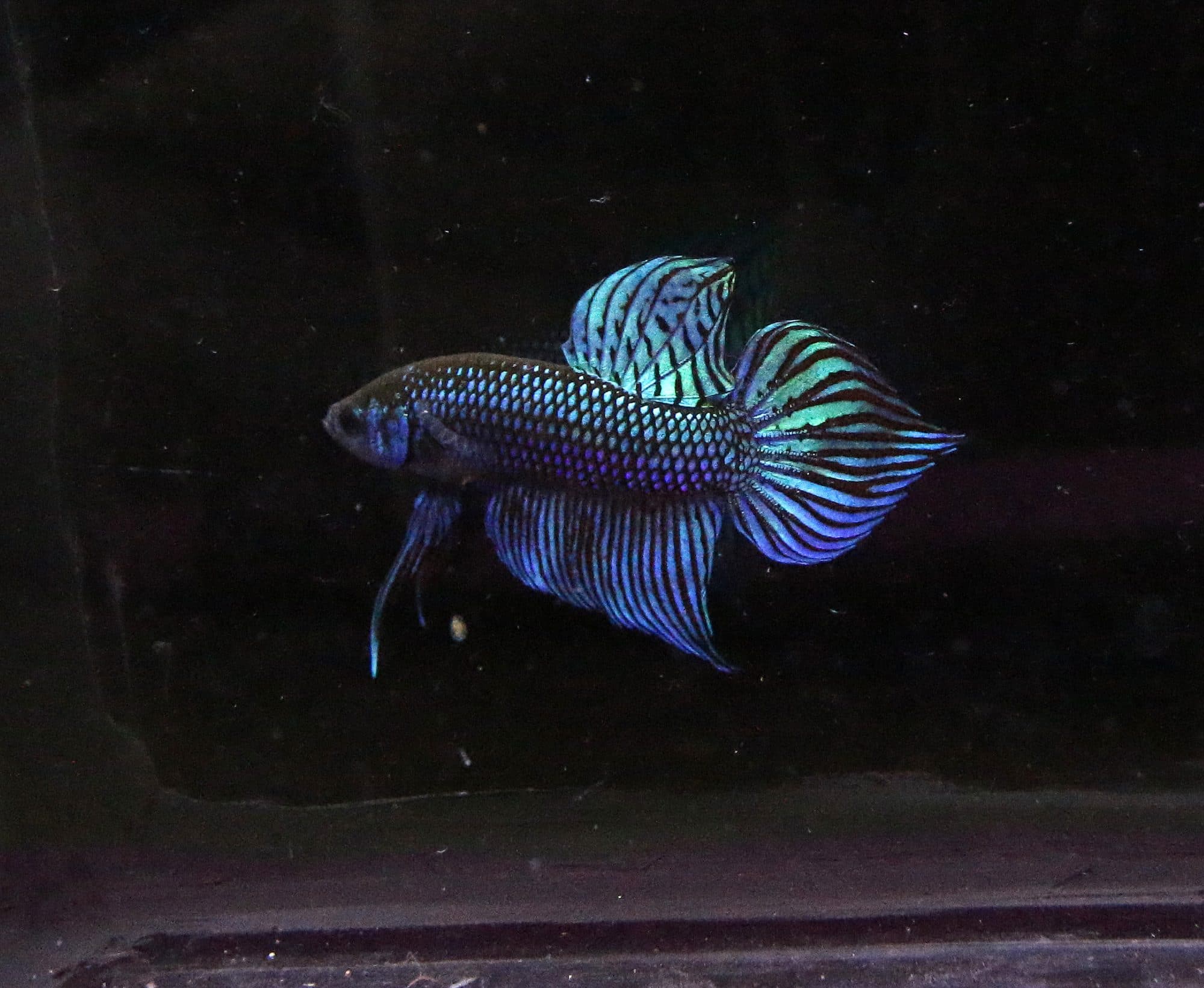
Photo: StarboundBettas, CC BY-SA 4.0, via Wikimedia Commons
Mahachai betta
Betta mahachaiensis
5 cm
Adult size
30 L
Minimum volume
1
Minimum group
4 years
Lifespan
Water parameters
Understand these values- Genus
- Betta
- Diet
- carnivore
- Social life
- solitary
In the wild
Overview
Described in 2012 by Chanon Kowasupat and colleagues, this fighter is named after the coastal subdistrict of Mahachai, in Samut Sakhon province just south of Bangkok. It was long taken for a hybrid, before morphological and genetic analyses confirmed it as a species in its own right.
It is recognised by its brown to black body covered with iridescent blue-green scales and two vertical green bars on the gill cover. It has not yet been assessed by the IUCN.
- Scientific name
- Betta mahachaiensis Kowasupat, Panijpan, Ruenwongsa & Sriwattanarothai, 2012
- Classification
- Anabantiformes › Osphronemidae
- IUCN Red List
- Not evaluated (NE)
Natural habitat
Gulf of Thailand coast around Bangkok (Samut Sakhon and neighbouring provinces)
Observations (GBIF) and localities Native countries Rivers and lakes
It is the only Betta that lives exclusively in brackish water: it inhabits tidal coastal marshes associated with the nipa palm (Nypa fruticans), the only palm adapted to estuaries. Males build their bubble nests between the fronds or in the water held at the base of the bracts.
Measurements in Samut Sakhon province show a pH of 6.9 to 7.8 and a salinity of 1 to 10 g/l. It lives there alongside the croaking gourami, blue gourami, climbing perch and panchax.
Behaviour
Not suited to a community aquarium: it does better alone or with a few very peaceful species of slightly brackish water. With enough hiding places and visual barriers several males can live together, but pairs are separated for breeding.
It hunts insects and small invertebrates. The male builds a bubble nest; a tight-fitting lid keeps above the water the warm, humid air needed for the fry's labyrinth organ to develop. Populations from different localities should not be crossed.
Sources:FishBase Seriously Fish GBIF · Base map: Natural Earth