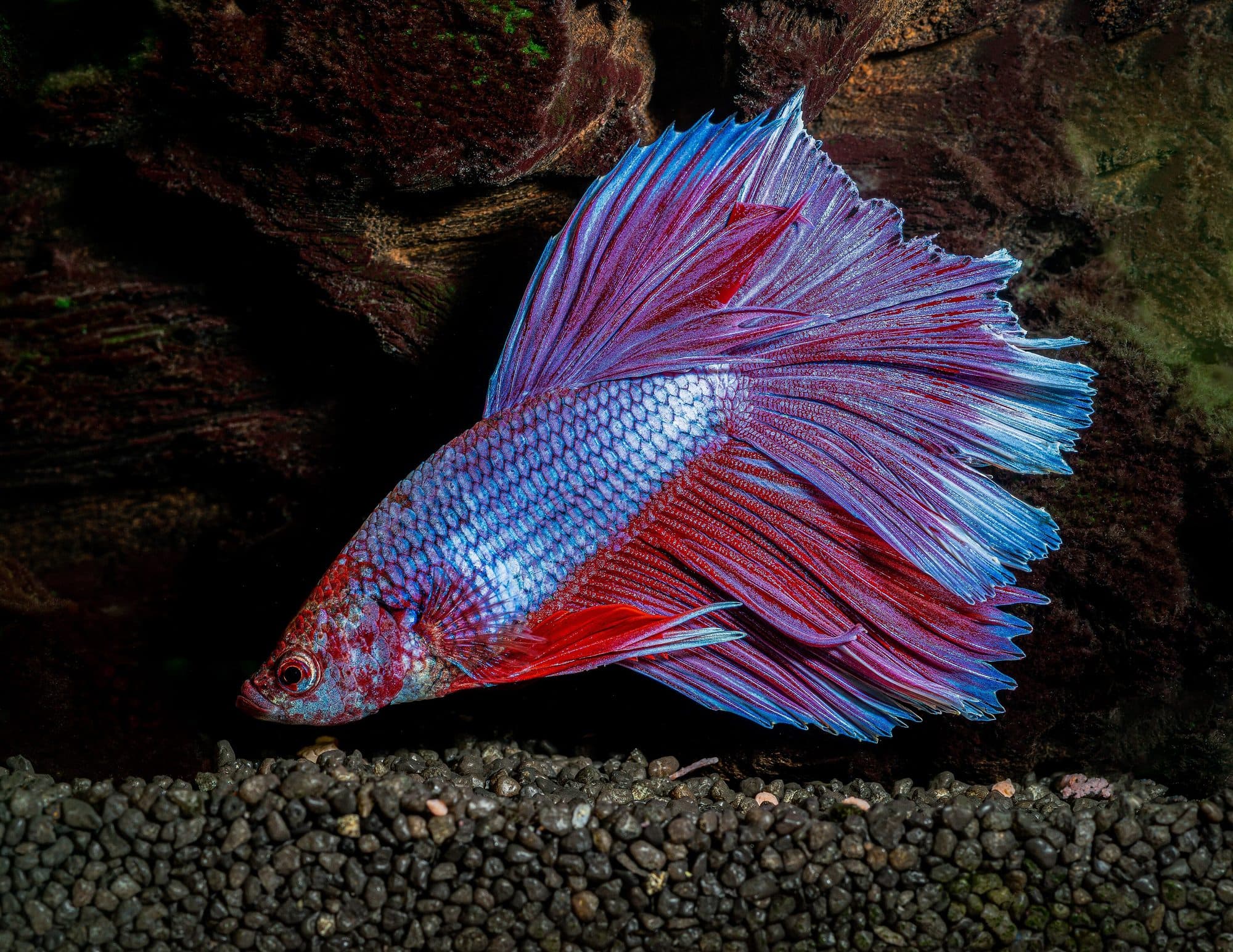
Photo: Henryk Niestrój, CC BY 4.0, via Wikimedia Commons
Siamese fighting fish
Betta splendens
5 cm
Adult size
20 L
Minimum volume
1
Minimum group
5 years
Lifespan
Water parameters
Understand these values- Genus
- Betta
- Diet
- carnivore
- Social life
- solitary
In the wild
Overview
Described in 1910 by Charles Tate Regan of the British Museum, the fighting fish owes its name to a Thai tradition: males are bred to face each other in fights that are bet on. Betta comes from ikan betah, the Malay name of these fish, and splendens means “brilliant”.
The short-finned wild form is rare in the hobby; there are countless aquarium lines with extreme colours and fins, sometimes hybridised with related species. It is listed as vulnerable by the IUCN: habitat destruction and the release of aquarium forms threaten wild populations.
- Scientific name
- Betta splendens Regan, 1910
- Classification
- Anabantiformes › Osphronemidae
- IUCN Red List
- Vulnerable (VU)
Natural habitat
Central Thailand, from Chiang Rai to the Isthmus of Kra (Chao Phraya basin)
Observations (GBIF) and localities Native countries Rivers and lakes
According to Seriously Fish, it naturally lives in central Thailand, from Chiang Rai to the provinces of Surat Thani and Phang Nga; records from the Mekong basin probably concern other species or introduced populations. It has become established in Singapore, Malaysia, Indonesia, Brazil, Colombia and the Dominican Republic.
It frequents still or slow water: rice fields, marshes, ditches and ponds, often shaded by vegetation and poor in oxygen. It breathes air at the surface through an accessory organ, the labyrinth.
Behaviour
Males are extremely aggressive towards each other and attack any long-finned fish they take for a rival: one male per tank, avoiding veil-finned companions. Females are kept apart outside breeding.
It feeds on zooplankton and insect larvae, mosquitoes in particular. The male builds a bubble nest at the surface, places the eggs in it after spawning and watches over them; the female must have plenty of hiding places. A tight-fitting lid keeps warm, humid air above the water, which it needs to breathe.
Sources:FishBase Seriously Fish GBIF · Base map: Natural Earth