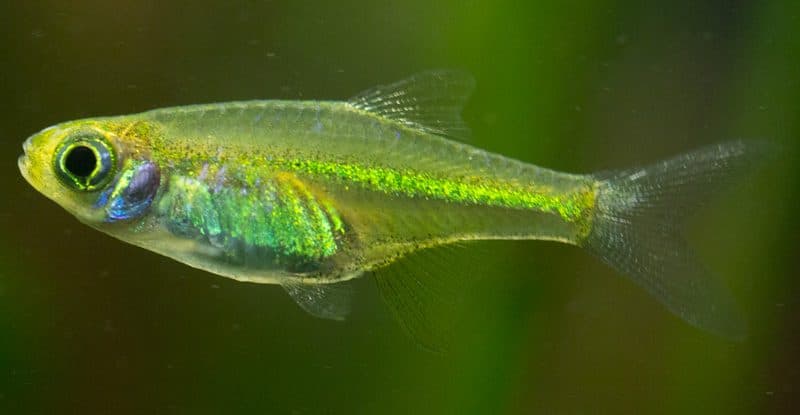
Photo: BottomDog, CC BY-SA 3.0, via Wikimedia Commons
Neon green rasbora
Microdevario kubotai
2 cm
Adult size
40 L
Minimum volume
10
Minimum group
5 years
Lifespan
Water parameters
Understand these values- Genus
- Microdevario
- Diet
- carnivore
- Social life
- shoal
In the wild
Overview
Described in 1999 by Maurice Kottelat and Kai-Erik Witte, this tiny neon-green cyprinid is named after Katsuma Kubota, who helped the authors in the field in Thailand. It is sold as the “neon green rasbora” or “Microrasbora kubotai”.
The genus Microdevario was created in 2009 after phylogenetic analyses showed that some Microrasbora were actually closer to Devario. The species is recognised by its transparent dorsal and anal fins.
- Scientific name
- Microdevario kubotai (Kottelat & Witte, 1999)
- Classification
- Cypriniformes › Danionidae
- IUCN Red List
- Least concern (LC)
Natural habitat
Western peninsular Thailand (Ranong, Phang Nga) and Salween basin down to southern Myanmar
Observations (GBIF) and localities Native countries Rivers and lakes
It is known from Ranong and Phang Nga provinces, on the north-western side of the Thai peninsula, and from the basin of the Ataran River, a tributary of the Salween in southern Myanmar; an introduced population exists in the upper Khwae Noi basin.
Its rivers have clear, well-oxygenated water, a bottom of branches, leaves, gravel and rocks, and heavily vegetated banks; Cryptocoryne crispatula and Pogostemon helferi grow in the calm stretches.
Behaviour
Very peaceful, in the wild it lives in shoals of 20 to 50 fish. In the aquarium it is kept alone or with species of similar size (Boraras, harlequins, small loaches), in a group of at least 8 to 10.
It feeds on small invertebrates and zooplankton; fine live or frozen prey suit it better than dry food alone. An egg scatterer with no parental care, it has been bred in the aquarium. Males are more compact and more colourful than females.
Sources:FishBase Seriously Fish GBIF · Base map: Natural Earth