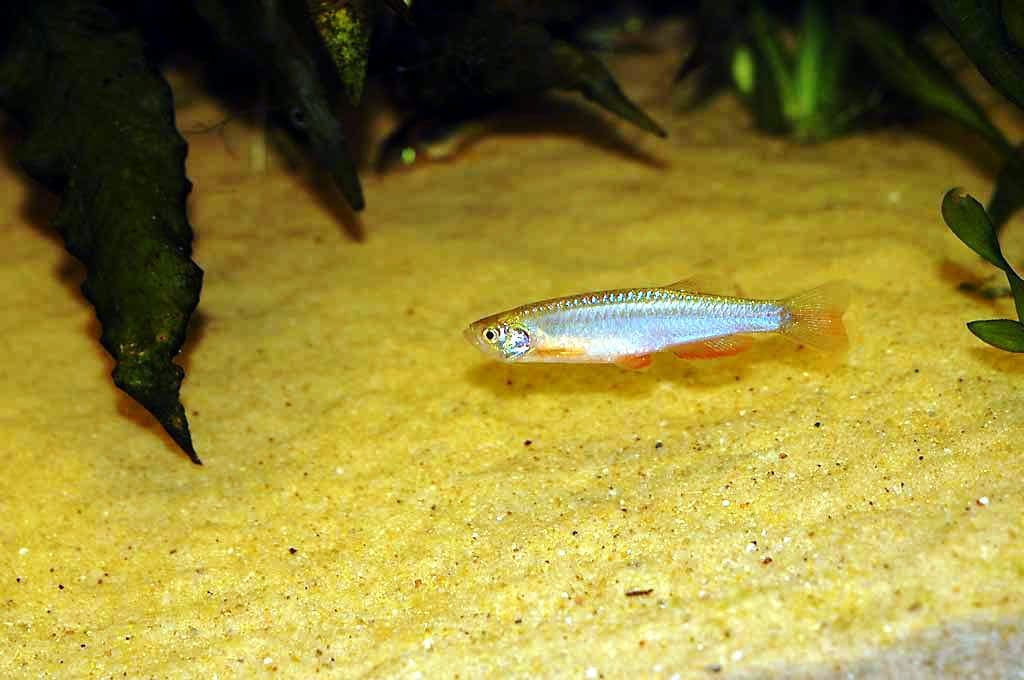
Photo: Sc99cs at English Wikipedia ( Original text: Steven Coburn sc99cs ), Public domain, via Wikimedia Commons
Pearl danio
Danio albolineatus
6 cm
Adult size
80 L
Minimum volume
10
Minimum group
5 years
Lifespan
Water parameters
Understand these values- Genus
- Danio
- Diet
- carnivore and omnivore
- Social life
- shoal
In the wild
Overview
Described in 1860 by the English zoologist Edward Blyth from fish from the “Tenasserim provinces” (southern Myanmar today), the pearl danio owes its Latin name, “white-lined”, to its pearly sheen. Some authors place it in the genus Brachydanio.
Its populations vary markedly in colour depending on their origin: orange on the back in western Thailand, blue in the centre of the country, a pinker form in Yunnan. It may in fact be a complex of several closely related species. Old records from Sri Lanka and India are mistaken.
- Scientific name
- Danio albolineatus (Blyth, 1860)
- Classification
- Cypriniformes › Danionidae
- IUCN Red List
- Least concern (LC)
Natural habitat
Mainland Southeast Asia and Sumatra: Irrawaddy, Salween, Mekong, Chao Phraya and Mae Klong basins
Observations (GBIF) and localities Native countries Rivers and lakes
Very widespread, it is known from Myanmar, Thailand, Laos, Cambodia, Vietnam, Peninsular Malaysia and Sumatra, in the Irrawaddy, Salween, Mekong, Chao Phraya and Mae Klong basins.
It occupies varied habitats: clear, well-oxygenated hill streams over rocky bottoms in forest, but also pools, ditches and rice paddies. It stays near the surface, where it catches insects that fall into the water.
Behaviour
Very peaceful, lively and undemanding, it suits most community aquariums. A shoaling fish, it is kept in a group of at least 8 to 10, in a tank long enough to swim in.
It feeds mainly on aquatic and terrestrial insects and their larvae, with a little algae and zooplankton. An egg scatterer with no parental care, it often spawns when in good condition; females are rounder and slightly larger than males.
Sources:FishBase Seriously Fish GBIF · Base map: Natural Earth