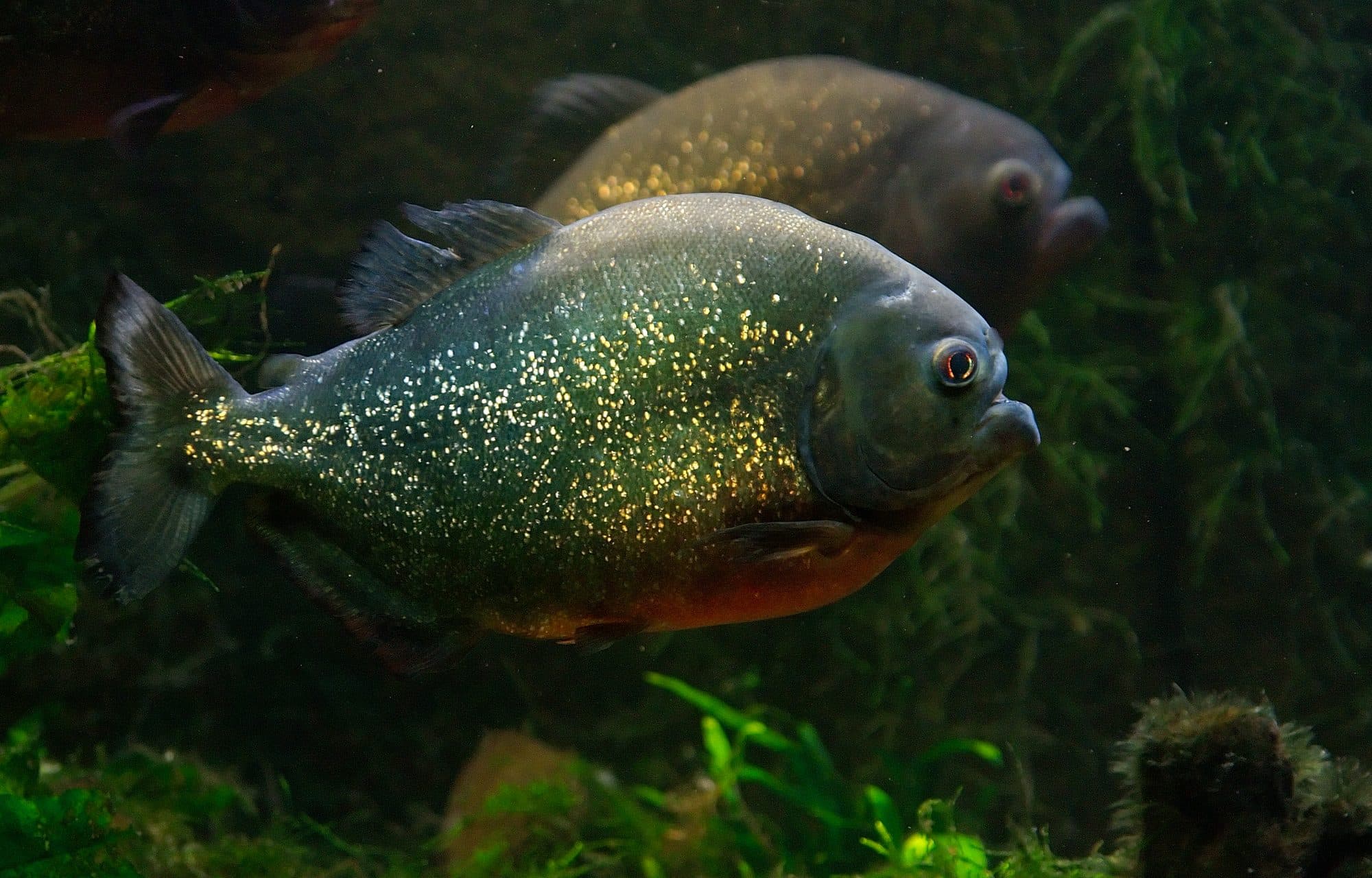
Photo: Luc Viatour, CC BY-SA 3.0, via Wikimedia Commons
Red-bellied piranha
Pygocentrus nattereri
40 cm
Adult size
800 L
Minimum volume
8
Minimum group
10 years
Lifespan
Water parameters
Understand these values- Genus
- Pygocentrus
- Diet
- carnivore
- Social life
- shoal
In the wild
Overview
Described in 1858 by Rudolf Kner, the red-bellied piranha is named after the Austrian naturalist Johann Natterer, who explored Brazil for eighteen years. Pygocentrus means “spiny rump”, for the serrated keel on its belly. Its sharp triangular teeth are replaced in sets, alternately on each side of the jaw.
Its reputation as a man-eater is largely a myth, born notably during Theodore Roosevelt's journey to Brazil in 1913–1914: piranhas that had been starved for weeks in a closed-off river arm devoured a cow before his eyes. It also produces sounds, a kind of barking, with its swim bladder.
- Scientific name
- Pygocentrus nattereri Kner, 1858
- Classification
- Characiformes › Serrasalmidae
- IUCN Red List
- Least concern (LC)
Natural habitat
Amazon basin, Essequibo, coastal rivers of north-eastern Brazil, Paraná and Uruguay basins
Observations (GBIF) and localities Native countries Rivers and lakes
It occupies much of the Amazon basin, the Essequibo, coastal rivers of north-eastern Brazil and the Guianas, and further south the Paraná and Uruguay basins; the type locality is Cuiabá, in Mato Grosso.
It lives in almost every habitat: large channels, tributaries, oxbows, floodplain lakes and even reservoirs. It breeds twice a year, among the vegetation of flooded banks.
Behaviour
Young fish form shoals, mainly to protect themselves from their own predators; adults live in loose groups with a hierarchy. Keep a single fish or a group of 5 or more, in a very large tank, with no other fish.
An opportunist rather than a strict carnivore, it eats fish, invertebrates, insects, seeds and fruit. Large individuals hunt mainly at dawn, late afternoon and night, lying in wait then rushing at their prey. Its bite can be serious: take care during maintenance.
Sources:FishBase Seriously Fish GBIF · Base map: Natural Earth