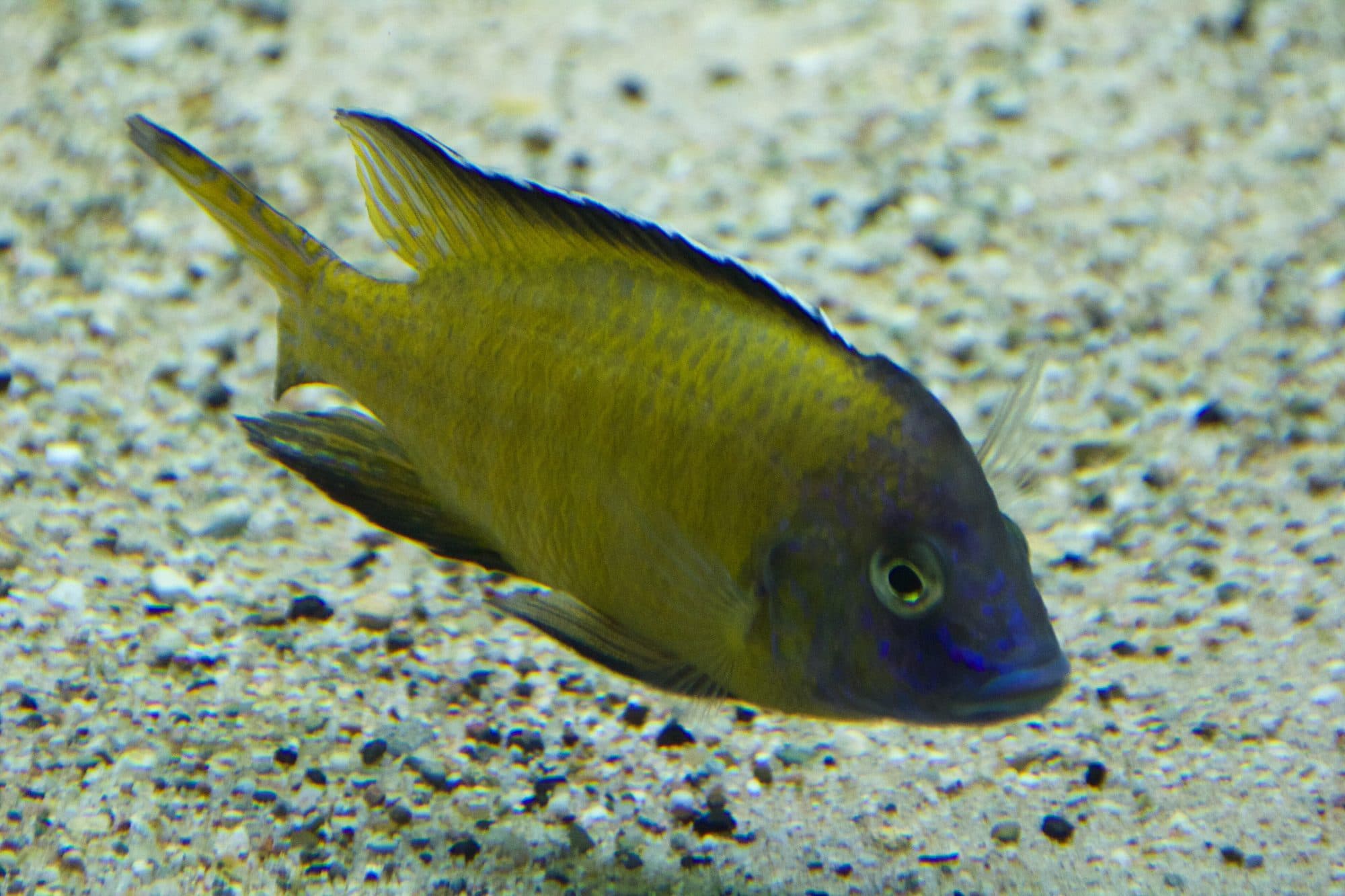
Photo: Photograph by Mike Peel ( www.mikepeel.net )., CC BY-SA 4.0, via Wikimedia Commons
Grant's peacock cichlid
Aulonocara stuartgranti
13 cm
Adult size
300 L
Minimum volume
4
Minimum group
8 years
Lifespan
Water parameters
Understand these values- Genus
- Aulonocara
- Diet
- carnivore
- Social life
- small group
In the wild
Overview
Described in 1985 by Manfred Meyer and Rüdiger Riehl, this Aulonocara is named after Stuart M. Grant (1937–2007), the legendary exporter of Lake Malawi fish. Aulonocara means “flute head” in Greek, for the highly developed system of sensory canals in its skull.
It is a very variable species: many local populations have been given trade names (“flametail” from Ngara, “Chitimba”, wrongly sold as “A. masoni”…), and some forms have been described as separate species, such as A. baenschi.
- Scientific name
- Aulonocara stuartgranti Meyer & Riehl, 1985
- Classification
- Cichliformes › Cichlidae
- IUCN Red List
- Least concern (LC)
Natural habitat
Endemic to Lake Malawi: western and eastern coasts (Malawi, Tanzania, Mozambique)
Observations (GBIF) and localities Native countries Rivers and lakes
It is widely distributed along the western and eastern coasts of Lake Malawi; its type locality is Mpanga Rocks, at Chilumba.
It lives in intermediate zones, where rocky coasts give way to sand scattered with rocks. Some individuals stay hidden in caves, others form large shoals above the sand. The water is warm, hard and alkaline.
Behaviour
Fairly peaceful, it becomes aggressive towards fish of similar colours. Keep a single male with 4 to 6 females, without other Aulonocara (easy hybridisation) or boisterous mbuna.
It feeds on sand-dwelling invertebrates that it detects through the sensory pores on its head or extracts by sifting the sand. A mouthbrooder, the female keeps eggs and fry in her mouth.
Sources:FishBase Seriously Fish GBIF · Base map: Natural Earth