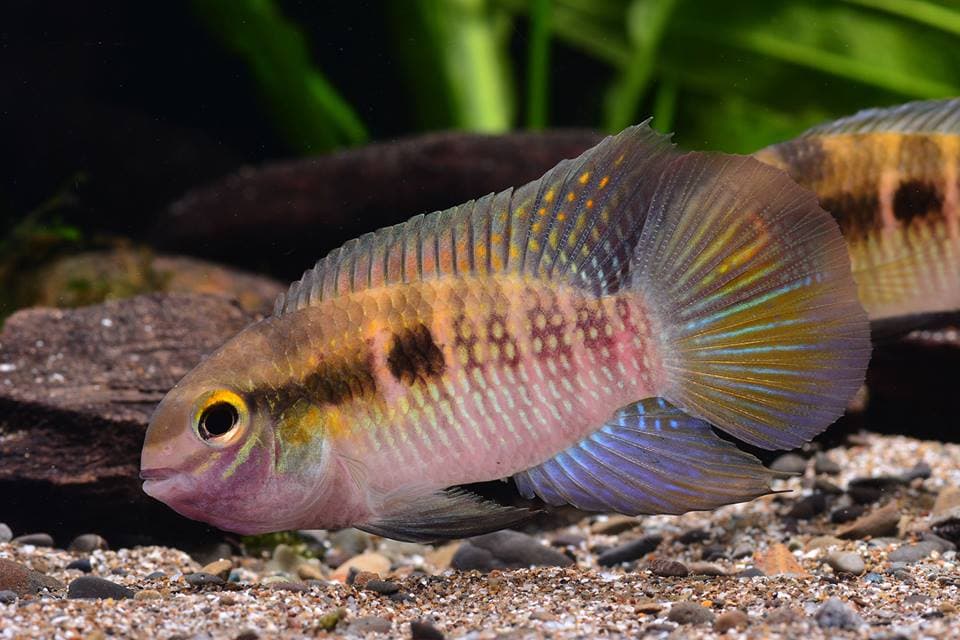
Orange-fin smiling acara
Laetacara fulvipinnis
7 cm
Adult size
200 L
Minimum volume
2
Minimum group
6 years
Lifespan
Water parameters
Understand these values- Genus
- Laetacara
- Diet
- omnivore
- Social life
- small group
In the wild
Overview
Known to hobbyists as Laetacara sp. “orangeflossen” (“orange fins”), this small cichlid was described in 2007 by Wolfgang Staeck and Ingo Schindler. Its name fulvipinnis means “with tawny fins”.
Laetacara combines the Latin laetus, “joyful”, and acará, the Amerindian name for cichlids: the markings around the mouth give these fish a smiling look. It reaches about 7.5 cm.
- Scientific name
- Laetacara fulvipinnis Staeck & Schindler, 2007
- Classification
- Cichliformes › Cichlidae
- IUCN Red List
- Least concern (LC)
Natural habitat
Upper and middle Orinoco, Casiquiare canal and Rio Negro (Venezuela, Brazil)
Observations (GBIF) and localities Native countries Rivers and lakes
It lives in the upper and middle Orinoco, the Casiquiare canal and the upper and middle Rio Negro, between Puerto Ayacucho in Venezuela and Barcelos in Brazil; the type locality is a lagoon near San Carlos de Río Negro.
It is a fish of clear, tea-coloured black water, extremely soft and acidic: a measurement in the Casiquiare gave a pH of 4.4. It stays along the edges of streams, in 10 to 50 cm of water, in the leaf litter or among flooded terrestrial vegetation.
Behaviour
Peaceful for a cichlid, it lives in pairs and suits a blackwater aquarium with calm fish. It sifts the leaf litter for algae, detritus, small insects, worms and crustaceans.
The pair spawns on a hard surface, often a leaf, and guards the eggs together; they hatch in about three days, and the fry swim freely a week later. In the breeding season both sexes take on red colouring; males have longer fins.
Sources:FishBase Seriously Fish GBIF · Base map: Natural Earth