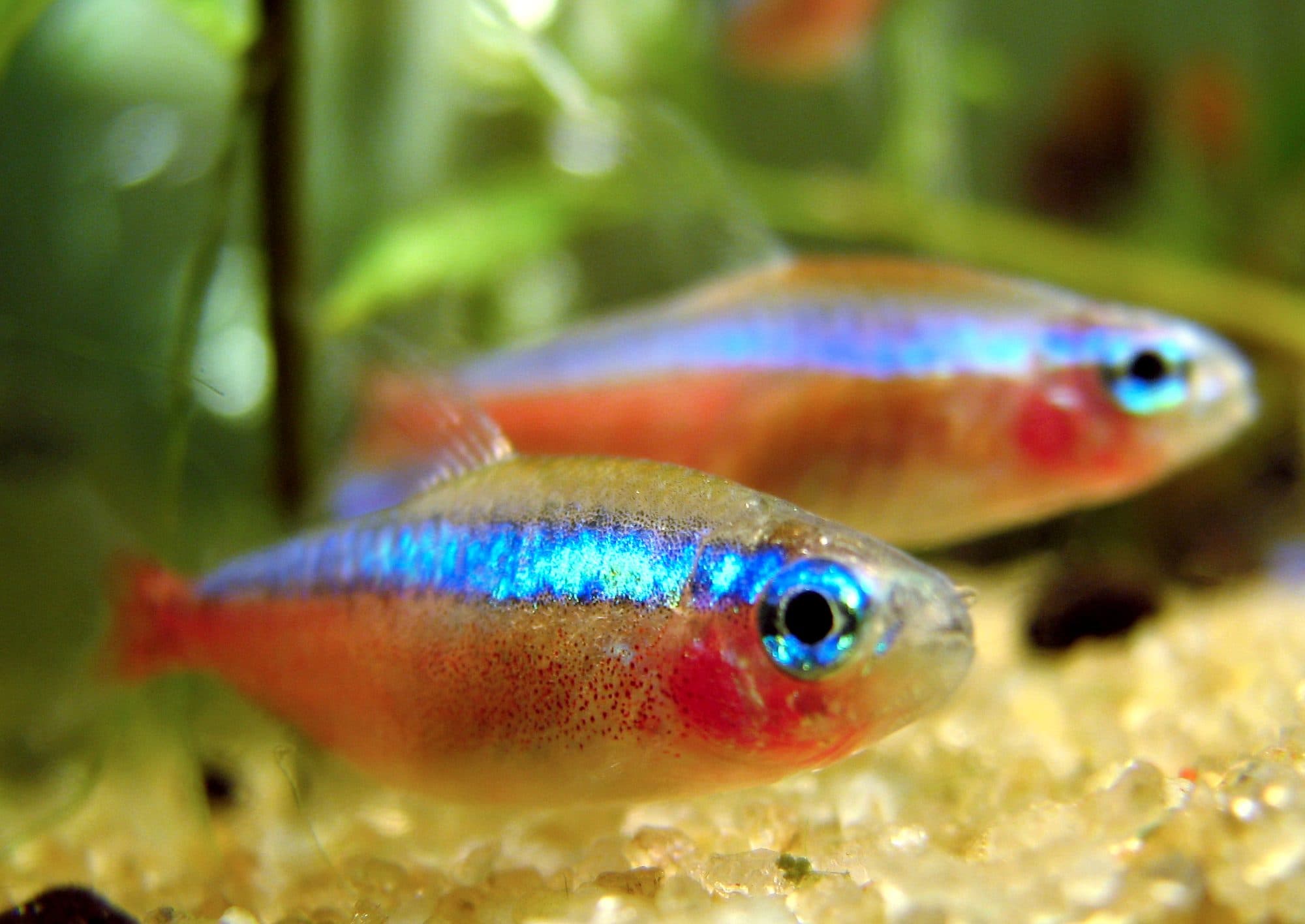
Photo: Henrique Pinto, CC BY 2.0, via Wikimedia Commons
Cardinal tetra
Paracheirodon axelrodi
4 cm
Adult size
100 L
Minimum volume
10
Minimum group
5 years
Lifespan
Water parameters
Understand these values- Genus
- Paracheirodon
- Diet
- omnivore
- Social life
- shoal
In the wild
Overview
The cardinal tetra was described in 1956 by the American ichthyologist Leonard P. Schultz in the aquarium magazine Tropical Fish Hobbyist, as Cheirodon axelrodi. George Myers and Stanley Weitzman were about to publish the same species as Hyphessobrycon cardinalis: the rule of priority kept Schultz's name, dedicated to Herbert R. Axelrod, the magazine's founder.
It differs from the neon tetra by its red band covering the whole underside, from head to tail. A revision of tetra classification published in 2024 now places it in the family Acestrorhamphidae, separate from the Characidae.
- Scientific name
- Paracheirodon axelrodi (Schultz, 1956)
- Classification
- Characiformes › Acestrorhamphidae
- IUCN Red List
- Least concern (LC)
Natural habitat
Middle and upper Rio Negro, Casiquiare canal and upper Orinoco (Brazil, Colombia, Venezuela)
Observations (GBIF) and localities Native countries Rivers and lakes
It frequents small forest streams and slow side channels. In the Rio Negro basin these are igapós and igarapés with black water: very acidic, almost without hardness, stained brown by humic substances from decaying leaves, under dense bank vegetation. In the Orinoco it lives rather in morichales, with clear water over sand.
The rhythm of the floods shapes its life: in the dry season the fish gather in large shoals in the channels, then disperse into the flooded forest as the water rises. Genetic studies have shown that the upper Rio Negro populations are ancient, distinct lineages, considered priorities for conservation.
Behaviour
Peaceful and gregarious, it swims in tight shoals in the middle water layer and feeds on worms, small crustaceans and plant debris. In the wild it is almost an annual fish: individuals over one year old are rare, whereas it lives several years in the aquarium.
A group of at least 8 to 10 gives it confidence and reveals natural shoaling behaviour. Its breeding in captivity remains tricky: many cardinals in the trade are still caught in the middle Rio Negro, notably through Project Piaba, a managed fishery that supports riverside communities.
Sources:FishBase Seriously Fish GBIF · Base map: Natural Earth