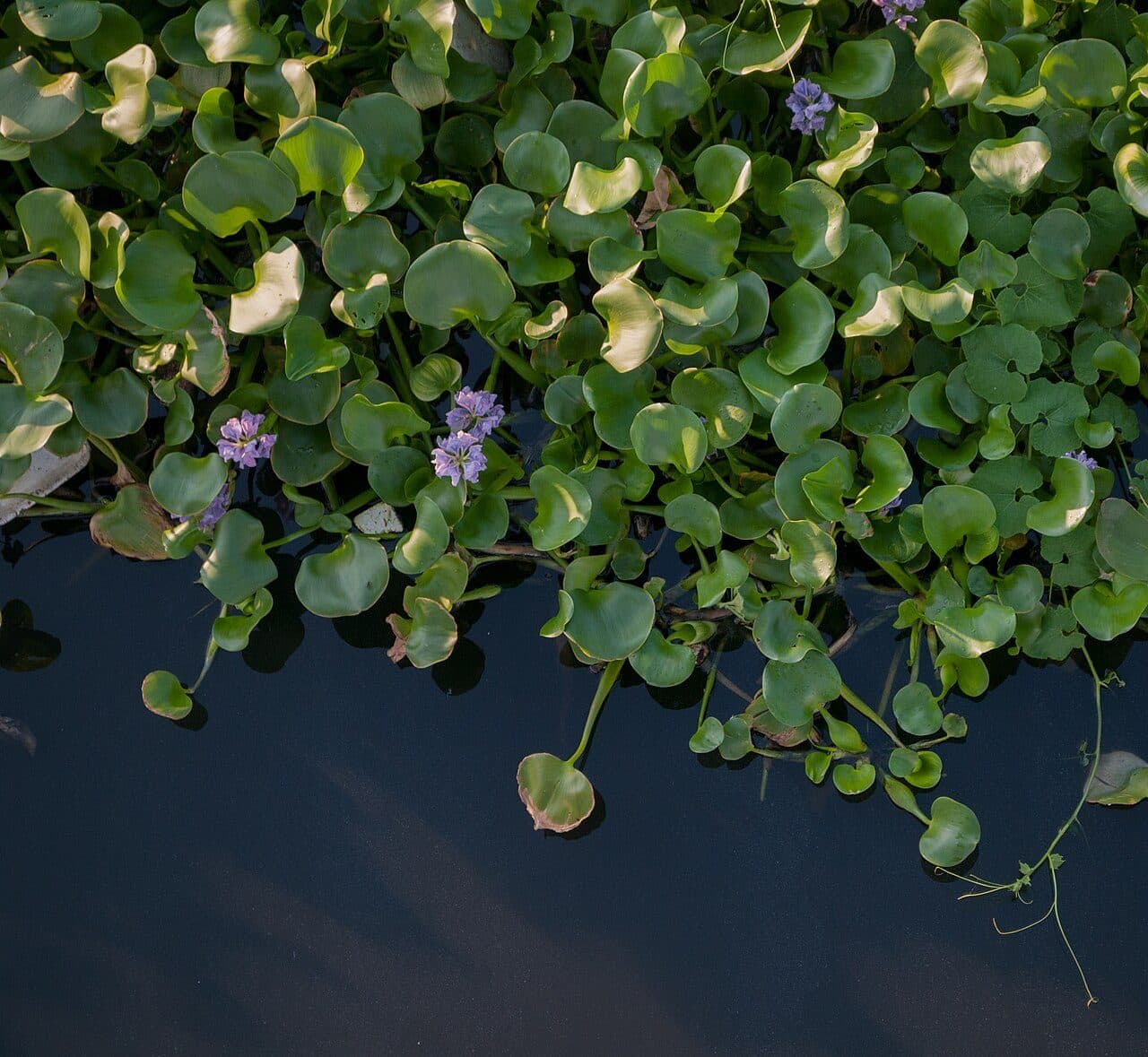
Photo: Wilfredor, CC BY-SA 3.0, via Wikimedia Commons
Water hyacinth
Eichhornia crassipes (Mart.) Solms
—
Height in the aquarium
high
Light
low
CO₂ needs
25–30 °C
Ideal temperature
Water parameters
Understand these values- Position
- floating
- Propagation
- runners
- Grows emersed
- yes
In the wild
Overview
The water hyacinth forms floating rosettes with swollen leaf stalks that act as floats. Long, dark roots hang beneath the leaves, while mauve flowers may appear above the water. It multiplies quickly by runners and soon covers a large area.
- Scientific name
- Pontederia crassipes Current valid name; in the hobby: Eichhornia crassipes
- Classification
- Commelinales › Pontederiaceae
- IUCN Red List
- Not evaluated (NE)
Natural habitat
Tropical South America
Observations (GBIF) and localities Native countries Introduced in Rivers and lakes
- Native countries
- Introduced by people
Outside its native range, in 136 countries:
An aquarium plant must never reach the wild: throwing away cuttings or emptying a tank into a stream can be enough to establish it.
Countries: Kew World Checklist of Vascular Plants (WCVP). Dots: GBIF observations in the native countries.
In the aquarium
Growing in the aquarium
It needs an open, spacious setup, strong light and nutrient-rich water. Growth can slow in the cold or when the plant lacks food. Thin out the rosettes to let light through below the surface. It does not survive frost and can become invasive when introduced outside its natural range.
Sources:Flowgrow GBIF POWO (Kew) · Base map: Natural Earth