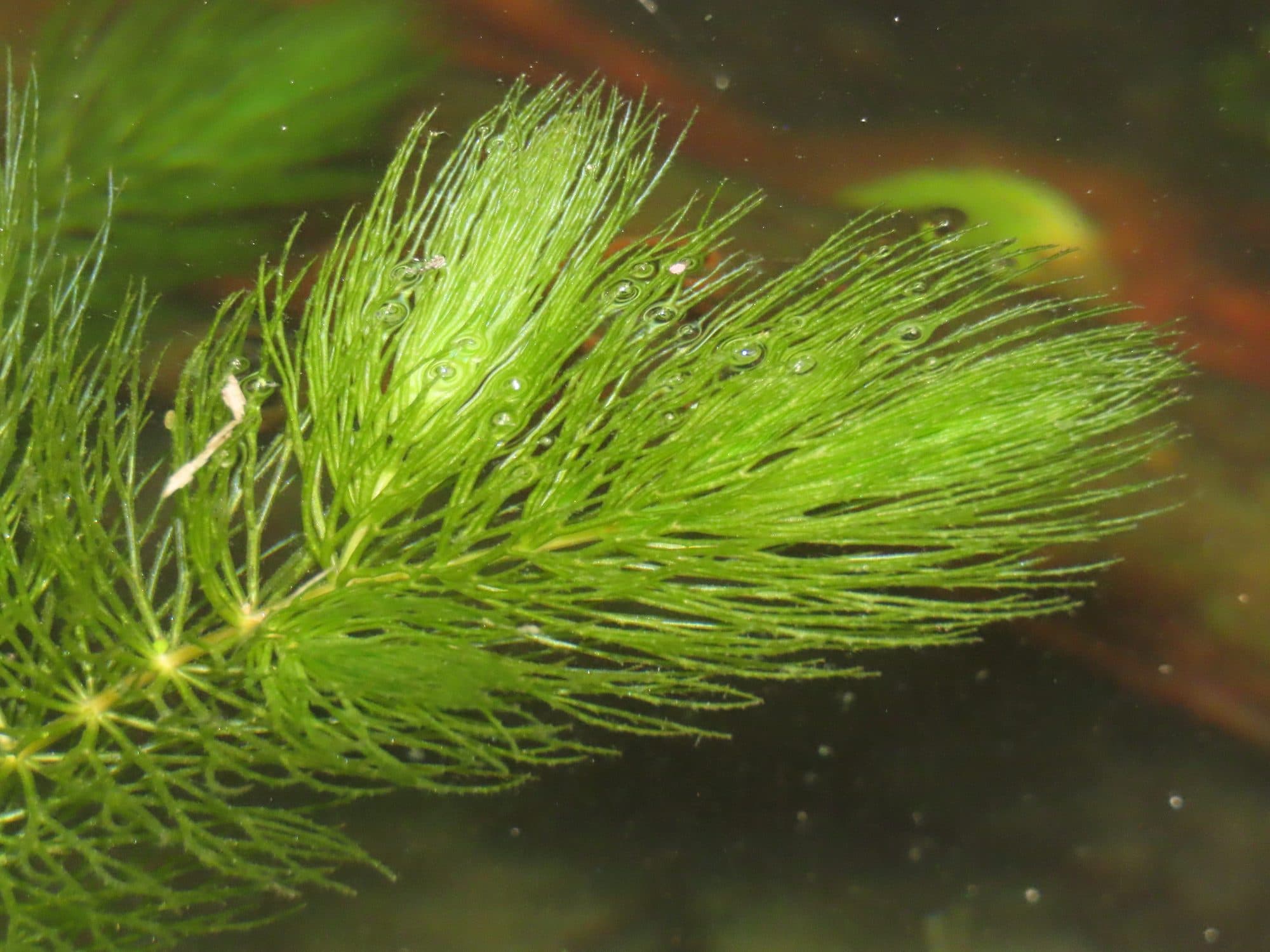
Hornwort
Ceratophyllum demersum L.
5–30 cm
Height in the aquarium
medium to high
Light
low
CO₂ needs
10–30 °C
Ideal temperature
Water parameters
Understand these values- Position
- background, midground, floating
- Propagation
- fragmentation, cuttings
- Uses
- spawning site
- Grows emersed
- no
In the wild
Overview
A rootless plant, extremely well adapted to life underwater: its inconspicuous flowers open submerged, and the pollen drifts through the water to the female flowers. The name actually covers several closely related species, told apart only by the number of spines on their fruit, which do not form in the aquarium.
In temperate regions it spends the winter as short, compact shoots that sink to the bottom, then grows again in spring: it therefore also suits garden ponds.
- Scientific name
- Ceratophyllum demersum L.
- Classification
- Ceratophyllales › Ceratophyllaceae
- IUCN Red List
- Least concern (LC)
Natural habitat
Almost worldwide: still or slow waters of Europe, Africa, Asia and the Americas
Observations (GBIF) and localities Native countries Introduced in Rivers and lakes
- Native countries
- Introduced by people
Outside its native range, in 2 countries:
An aquarium plant must never reach the wild: throwing away cuttings or emptying a tank into a stream can be enough to establish it.
Countries: Kew World Checklist of Vascular Plants (WCVP). Dots: GBIF observations in the native countries.
In the aquarium
Growing in the aquarium
Very easy and very fast-growing, in soft as well as very hard water and over a wide range of temperatures. CO2 is not needed. It absorbs nutrients very quickly, which makes it an ally against algae.
Let it float under the surface, or keep it on the bottom by pushing the base of the stems into the substrate or weighting them. It propagates simply by fragmentation of the stems and must be trimmed often. Its clumps give shrimp hiding places and surfaces to graze, and fish a place to spawn.
Sources:Flowgrow Tropica GBIF POWO (Kew) · Base map: Natural Earth