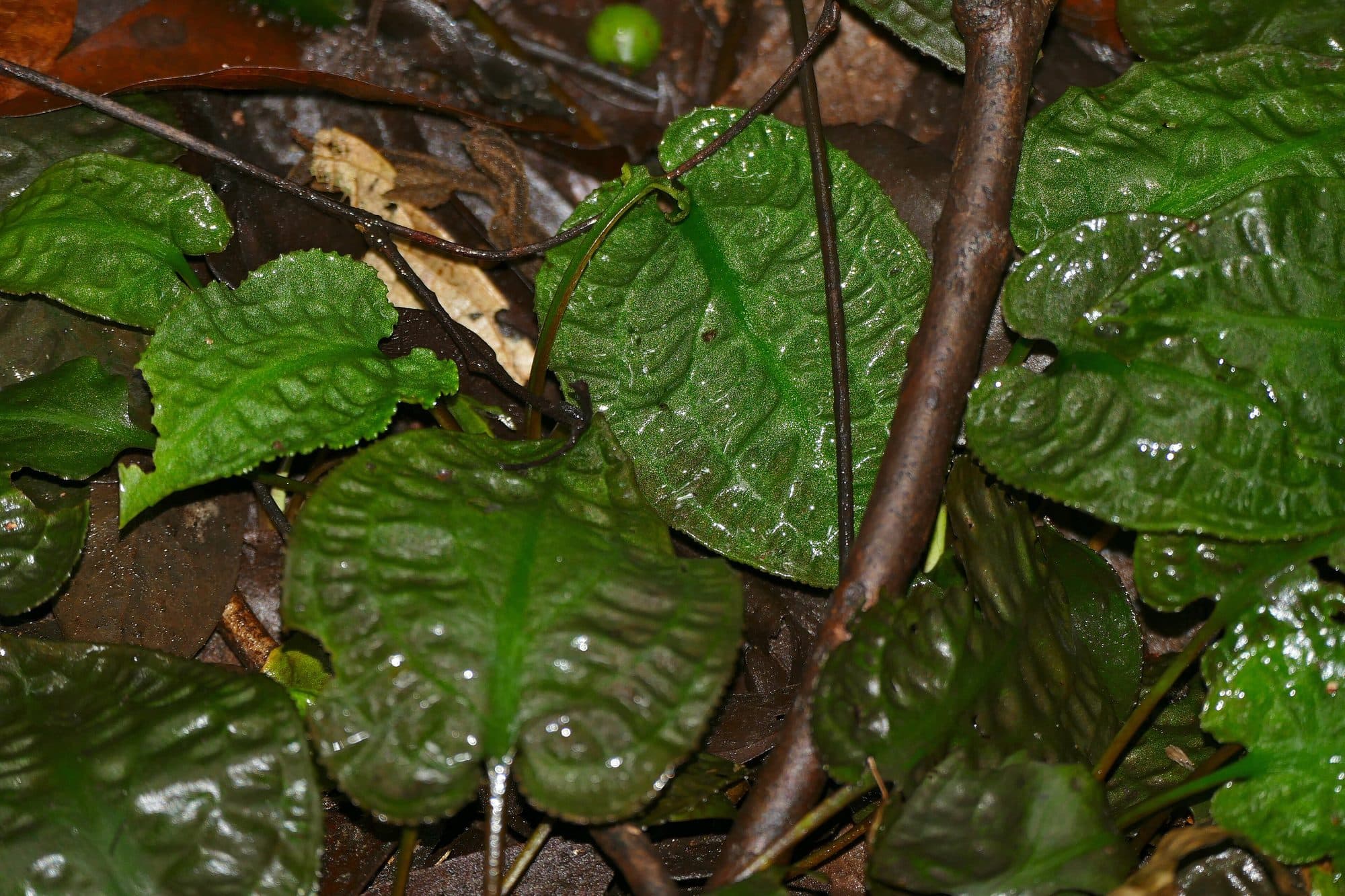
Photo: Bernard DUPONT from FRANCE, CC BY-SA 2.0, via Wikimedia Commons
Cryptocoryne longicauda
Becc. ex Engl.
20–50 cm
Height in the aquarium
low to medium
Light
slow
Growth
26–28 °C
Ideal temperature
Water parameters
Understand these valuesCarbonate hardness (KH): not given by the sources
- Position
- Not known
- Propagation
- runners
- Grows emersed
- yes
In the wild
Overview
An aroid discovered in Sarawak by the Italian naturalist Odoardo Beccari and named in 1879; it was also described as C. caudata (Sarawak) and C. johorensis (Johor), now its synonyms. The plants sold under this name in the 1950s and 1960s actually belonged to another species, C. fusca.
It grows in shallow water in forest streams and rivers with acidic water, where it forms dense stands on mud or sandy loam, both submerged and emersed. Its most striking feature is its spathe: a cup-shaped, dark purple, wrinkled limb extended into a "tail" up to 20 cm long (longicauda, "long-tailed").
- Scientific name
- Cryptocoryne longicauda Becc. ex Engl.
- Classification
- Alismatales › Araceae
- IUCN Red List
- Near threatened (NT)
Natural habitat
Borneo (Sarawak), southern Malay Peninsula (Johor) and Sumatra: acidic forest streams
Observations (GBIF) and localities Native countries Rivers and lakes
- Native countries
- Introduced by people
No introduction reported outside its native range.
Countries: Kew World Checklist of Vascular Plants (WCVP). Dots: GBIF observations in the native countries.
In the aquarium
Growing in the aquarium
Rare in cultivation, it needs soft, acidic water (pH 5 to 6, 2 to 5 °dGH), warmth (26 to 28 °C) and low light. It grows slowly and prefers an old aquarium with a substrate rich in organic matter; crypt enthusiasts often grow it emersed, in pots.
It spreads by runners. Like other crypts, it may lose its leaves after a sudden change before regrowing from the rhizome.
Sources:Flowgrow GBIF POWO (Kew) · Base map: Natural Earth