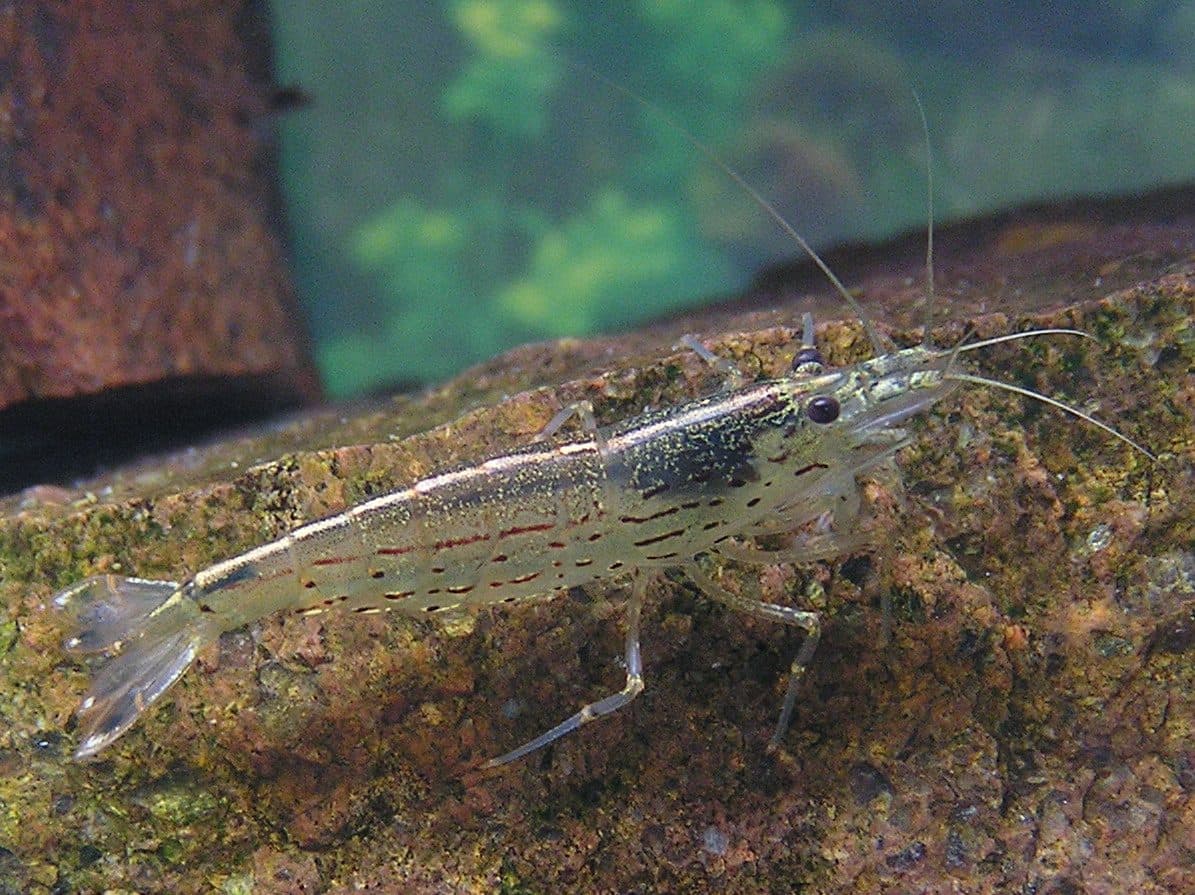
Photo: MdE, CC BY-SA 3.0 de, via Wikimedia Commons
Amano shrimp
Caridina multidentata
5.5 cm
Adult size
60 L
Minimum volume
5
Minimum group
—
Lifespan
Size: body length.
Water parameters
Understand these valuesHardness (GH): not given by the sources
Carbonate hardness (KH): not given by the sources
- Genus
- Caridina
- Diet
- detritivore
- Social life
- colony
- Activity
- diurnal
- Adult habitat
- fresh and brackish water
- Breeding
- larvae in brackish water
In the wild
Overview
The Amano shrimp actively explores plants and decor to pick its food from them. Females grow clearly larger than males, whose abdomen bears a pattern of small dots. It stays peaceful, but its size does not protect it from large predators.
- Scientific name
- Caridina multidentata Stimpson, 1860
- Classification
- Decapoda › Atyidae
- IUCN Red List
- Least concern (LC)
Natural habitat
Japan (including Kyūshū) and Taiwan
Observations (GBIF) and localities Native countries Rivers and lakes
The adults live in fresh water, at 16 to 28 °C, neutral to alkaline (pH 7 to 8.3). The larvae need salt water to develop, before the young return to fresh water.
Behaviour
Peaceful and rather calm, it lives in colonies on the bottom and is active by day, tirelessly exploring plants and decor. Being small, it hides when larger animals are around and ignores other species.
In the aquarium
Care and setup
Keep it in a group in a tank offering plants, roots and refuges for moulting. Avoid fish and crustaceans able to catch it.
Feeding
It eats algae, microorganisms and plant matter, and accepts shrimp food. Do not rely on it alone to clean the tank.
Breeding
The eggs are carried under the abdomen. The larvae need salt water, so eggs laid in fresh water do not guarantee viable young.
Sources:Fishipedia GBIF · Base map: Natural Earth