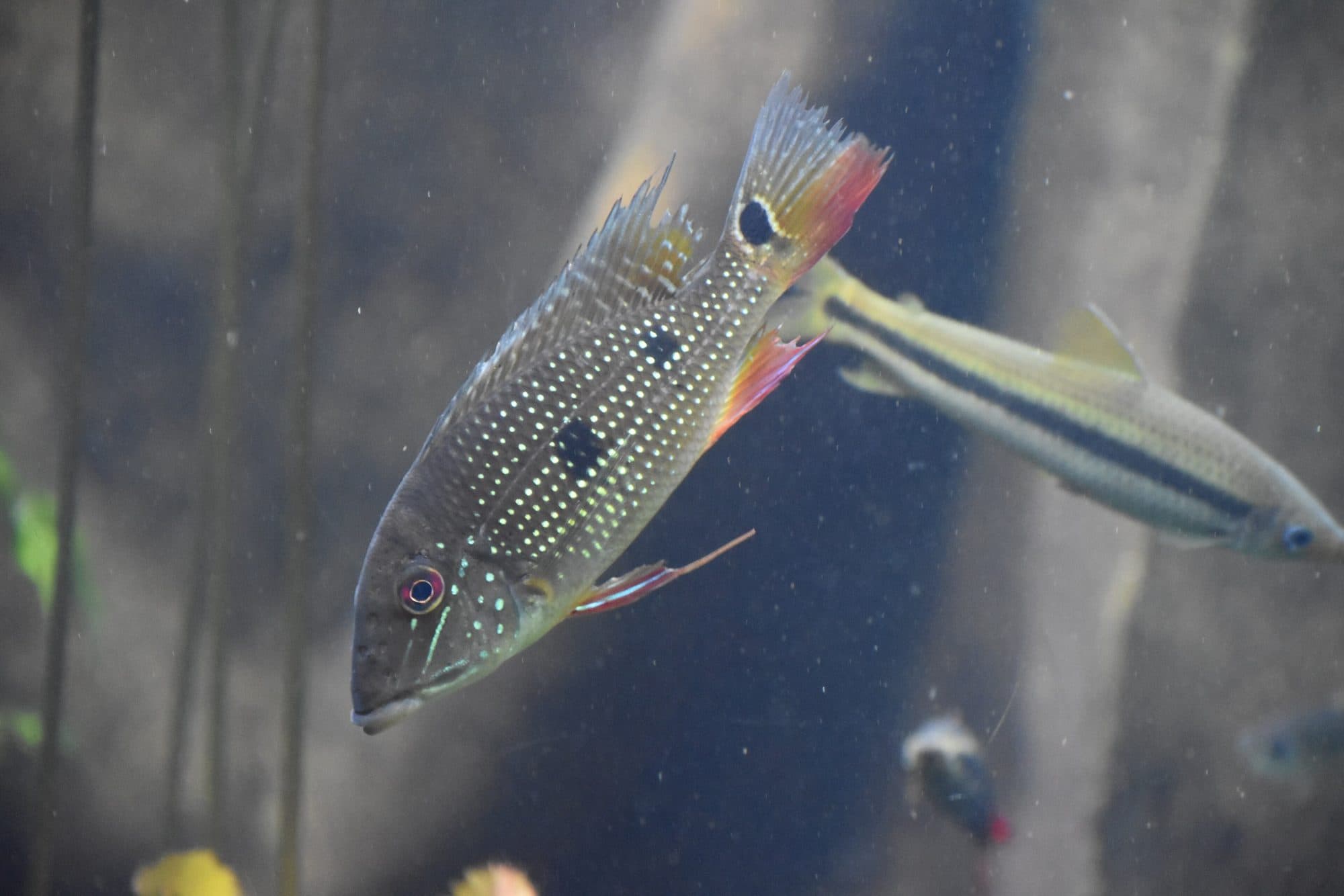
Photo: lwolfartist, CC BY 2.0, via Wikimedia Commons
Threespot eartheater
Satanoperca daemon
25 cm
Adult size
600 L
Minimum volume
5
Minimum group
8 years
Lifespan
Water parameters
Understand these values- Genus
- Satanoperca
- Diet
- carnivore
- Social life
- small group
In the wild
Overview
Described in 1840 by Johann Jakob Heckel, the daemon owes its alarming names (Satanoperca, “Satan's perch”, and daemon) to its strange appearance, not its temperament. It is a slender “eartheater” that reaches 25 to 30 cm, adorned with two dark spots on the flank and an eyespot at the base of the tail.
The genus Satanoperca was long considered a synonym of Geophagus, before being reinstated by Sven Kullander in 1986; the eyespot at the top of the tail base sets it apart from other eartheating cichlids.
- Scientific name
- Satanoperca daemon (Heckel, 1840)
- Classification
- Cichliformes › Cichlidae
- IUCN Red List
- Least concern (LC)
Natural habitat
Rio Negro basin (Brazil), Casiquiare and upper Orinoco (Venezuela, Colombia)
Observations (GBIF) and localities Native countries Rivers and lakes
It lives in the Rio Negro basin in Brazil, the Casiquiare canal and the upper Orinoco in Venezuela and Colombia (Uaupés, Atabapo, Guaviare, Inírida, Ventuari, Cinaruco…). Records elsewhere in Amazonia are misidentifications.
It is a fish of black water, very low in minerals and acidic. In the Río Cinaruco it gathers and breeds in floodplain lagoons and lakes, where there is almost no current, over sand, leaves and branches.
Behaviour
Outside breeding it is surprisingly peaceful and only hunts very small prey. Gregarious, it lives in loose groups in which a hierarchy forms: keep at least 5 to 8, otherwise the weakest are harassed.
It feeds by taking mouthfuls of sand and sifting out the invertebrates, ejecting the rest through its gills: a fine sand substrate is essential. Breeding in the aquarium remains rare; the pair spawns on a hard surface and guards the young.
Sources:FishBase Seriously Fish GBIF · Base map: Natural Earth