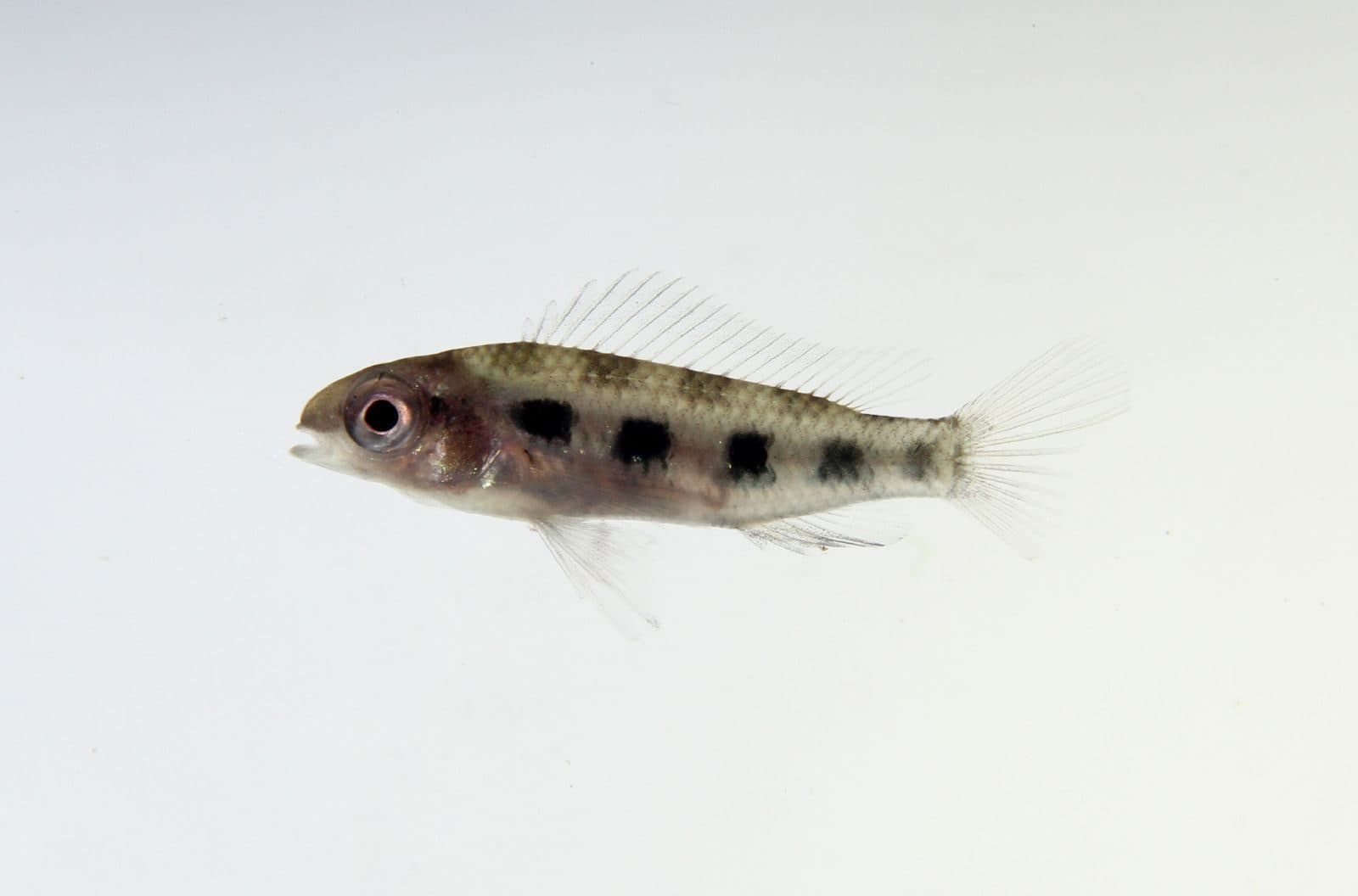
Photo: Clinton & Charles Robertson, CC BY 2.0, via Wikimedia Commons
Chessboard cichlid
Dicrossus filamentosus
6 cm
Adult size
100 L
Minimum volume
2
Minimum group
5 years
Lifespan
Water parameters
Understand these values- Genus
- Dicrossus
- Diet
- carnivore
- Social life
- small group
In the wild
Overview
Described in 1958 by Werner Ladiges, the chessboard cichlid owes its common name to the checkerboard pattern of dark blotches on its flanks. The male has a lyre-shaped tail fin, with lobes extended into filaments (filamentosus), and fins edged in red and blue.
It is a slender, elegant dwarf cichlid, more delicate than the Apistogramma, and remains relatively rare in the trade.
- Scientific name
- Dicrossus filamentosus (Ladiges, 1958)
- Classification
- Cichliformes › Cichlidae
- IUCN Red List
- Least concern (LC)
Natural habitat
Rio Negro basin (Brazil) and Orinoco, from the Inírida (Colombia) to Maripa (Venezuela)
Observations (GBIF) and localities Native countries Rivers and lakes
It lives in Colombia and Venezuela, from the Inírida to Maripa in the Orinoco basin, and in the Rio Negro basin in Brazil.
It is a fish of black water, extremely soft, acidic and warm, over sand and leaf litter.
Behaviour
Fairly peaceful, it is dominated by more aggressive companions but fits in well with calm fish (tetras, pencilfish, corydoras). One male can be kept with one or two females.
It feeds on small prey and accepts sinking pellets, supplemented with frozen food. Breeding requires impeccable water, very soft and acidic (pH close to 4.5): the female spawns on a leaf or stone and guards the eggs alone. Females are smaller and have a rounded tail fin.
Sources:FishBase Seriously Fish GBIF · Base map: Natural Earth