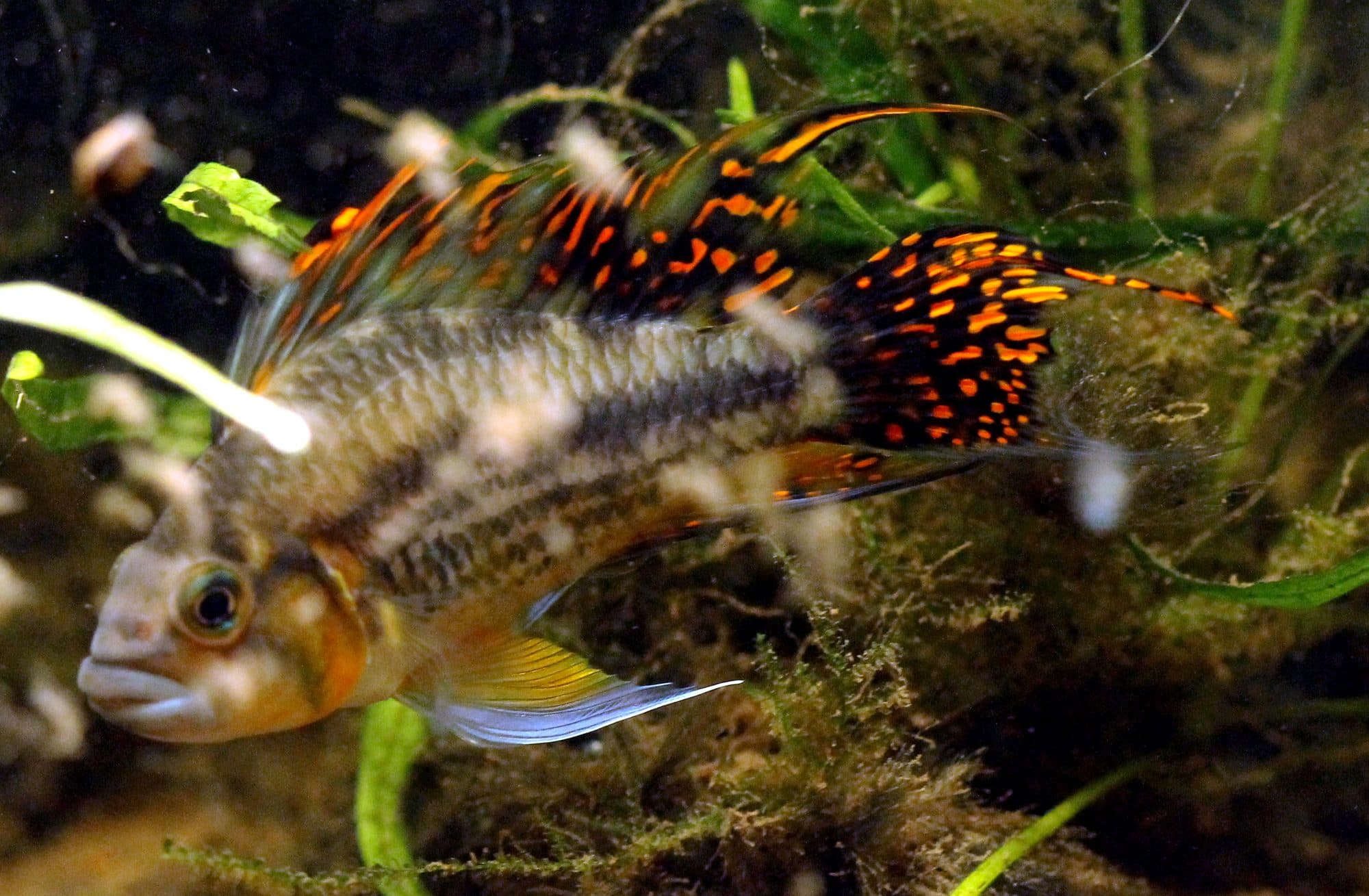
Photo: Waylah, CC BY-SA 3.0, via Wikimedia Commons
Cockatoo dwarf cichlid
Apistogramma cacatuoides
7 cm
Adult size
80 L
Minimum volume
2
Minimum group
5 years
Lifespan
Water parameters
Understand these values- Genus
- Apistograma
- Diet
- carnivore
- Social life
- pair
In the wild
Overview
Described in 1951 by Jan Hoedeman, the cockatoo cichlid owes its name to the first rays of its dorsal fin, very elongated in the male like a cockatoo's crest. Males reach 7.5 cm, females about 5 cm.
The type locality was first wrongly given as Suriname, before being corrected by Sven Kullander. Populations differ in colour according to their origin, and many aquarium forms exist (“double red”, “orange flag”).
- Scientific name
- Apistogramma cacatuoides Hoedeman, 1951
- Classification
- Cichliformes › Cichlidae
- IUCN Red List
- Least concern (LC)
Natural habitat
Upper Amazon basin: Ucayali and Amazon in Peru, Solimões in Brazil, as far as Colombia
Observations (GBIF) and localities Native countries Rivers and lakes
It is widespread in much of the upper Amazon basin, from the Ucayali and Amazon in Peru to the Solimões in Brazil.
It lives in slow tributaries, oxbows and creeks where dead leaves pile up, in black, white or clear water depending on place and season.
Behaviour
Aquarium-bred fish suit a well-planned community aquarium; wild ones do better alone or with small, peaceful shoaling fish such as pencilfish. It is best not mixed with other Apistogramma.
Mainly carnivorous, it hunts small invertebrates on the bottom. The female lays her eggs on the ceiling of a cave, then cares for the eggs and fry alone; in a small tank she can become very aggressive towards the male, who must then be removed. A male can live with several females, each with her own territory.
Sources:FishBase Seriously Fish GBIF · Base map: Natural Earth