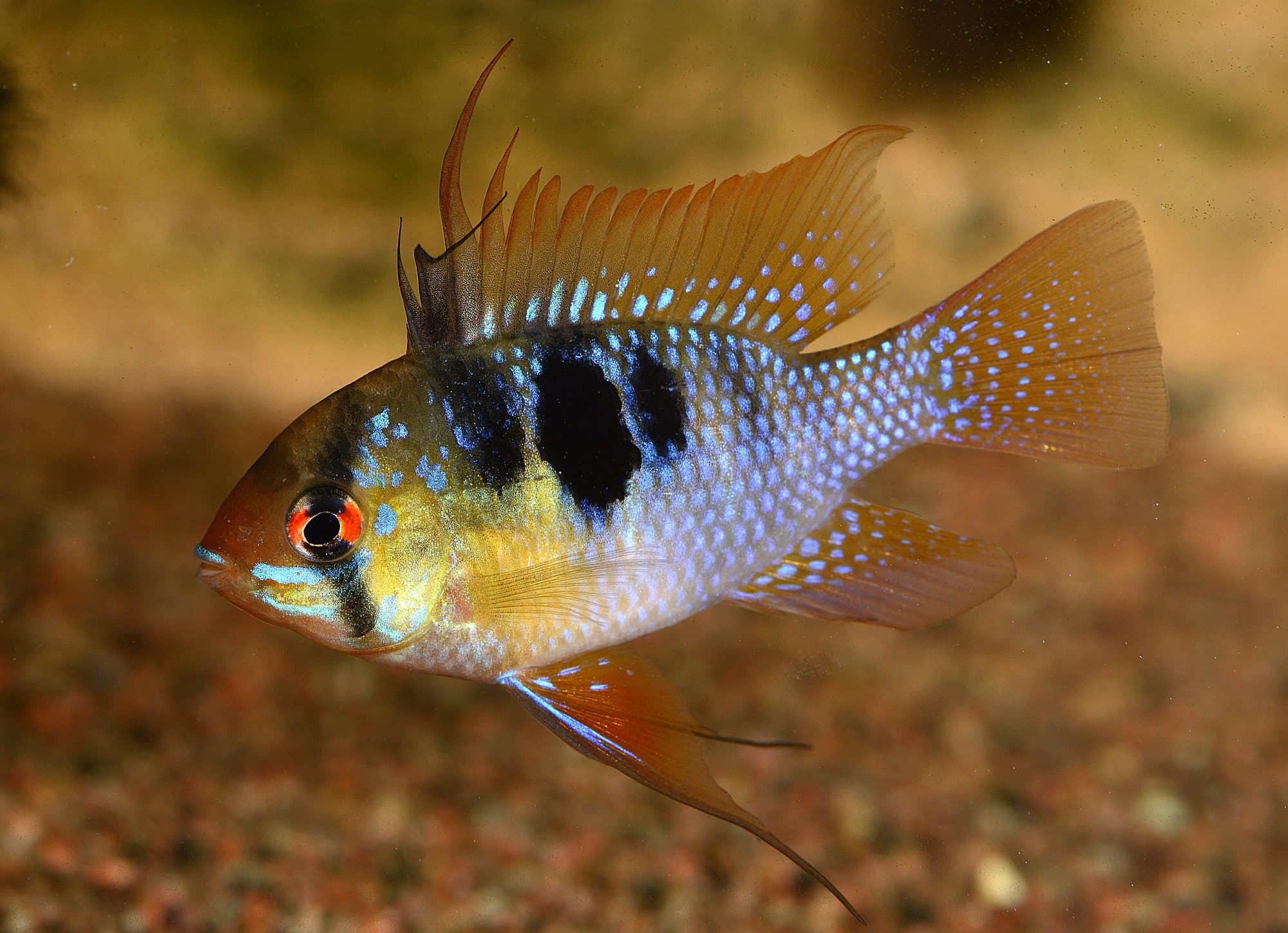
Photo: Sven Kullander, CC BY-SA 4.0, via Wikimedia Commons
Ram cichlid
Mikrogeophagus ramirezi
5 cm
Adult size
80 L
Minimum volume
2
Minimum group
4 years
Lifespan
Water parameters
Understand these values- Genus
- Mikrogeophagus
- Diet
- carnivore
- Social life
- pair
In the wild
Overview
Described in 1948 by George Myers and Robert Harry, the ram (or “butterfly cichlid”) is a dwarf cichlid with electric-blue highlights and black first dorsal rays. The name ramirezi simply took up the one under which it was already being sold. Mikrogeophagus means “little earth eater”.
Intensively bred forms (golden, “electric blue”, “balloon”) are often genetically fragile, prone to disease and short-lived; wild fish are hardier but more demanding about water.
- Scientific name
- Mikrogeophagus ramirezi (Myers & Harry, 1948)
- Classification
- Cichliformes › Cichlidae
- IUCN Red List
- Least concern (LC)
Natural habitat
Llanos of the Orinoco basin (Venezuela, Colombia)
Observations (GBIF) and localities Native countries Rivers and lakes
It lives in the Llanos, a vast region of savannahs, plains and flooded forests of almost 600,000 km² in Venezuela and Colombia, drained by the tributaries of the Orinoco. The climate is hot all year round, with a marked rainy season and dry season.
The water there is warm (27 to 30 °C), soft and acidic.
Behaviour
Often sold as a community fish, it is not really one: it needs impeccable, warm water and is easily outcompeted. Small, peaceful shoaling fish (cardinals, neons) reassure it; avoid territorial species, including most other cichlids.
It feeds by taking mouthfuls of sand and sifting them, ejecting the grains through its gills. The pair spawns on a flat stone or in a pit and guards eggs and fry together. Females often have a pink patch on the belly.
Sources:FishBase Seriously Fish GBIF · Base map: Natural Earth