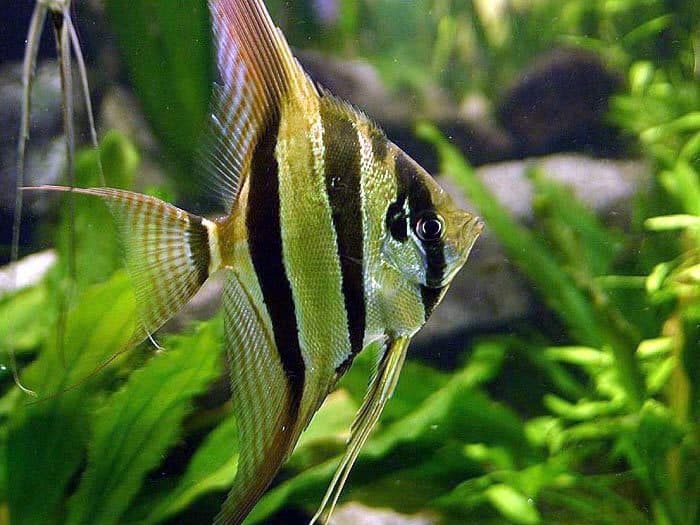
Photo: Konto na chwilę, CC BY-SA 1.0, via Wikimedia Commons
Altum angelfish
Pterophyllum altum
18 cm
Adult size
400 L
Minimum volume
6
Minimum group
9 years
Lifespan
Water parameters
Understand these values- Genus
- Pterophyllum
- Diet
- carnivore
- Social life
- shoal
In the wild
Overview
Described in 1903 by the French zoologist Jacques Pellegrin, the altum angelfish is the largest of the angelfish: it reaches 18 cm long and nearly 20 cm tall, fins included. Its Latin name altum means “tall”.
It is told apart from the common angelfish by a more concave head profile above the mouth, a taller body and more pronounced vertical bands. Almost all specimens sold are wild-caught, as its breeding in captivity remains difficult.
- Scientific name
- Pterophyllum altum Pellegrin, 1903
- Classification
- Cichliformes › Cichlidae
- IUCN Red List
- Least concern (LC)
Natural habitat
Upper Rio Negro and tributaries of the upper Orinoco, including the Inírida and Atabapo (Colombia, Venezuela)
Observations (GBIF) and localities Native countries Rivers and lakes
It is native to Colombia and Venezuela: the upper Rio Negro and tributaries of the upper Orinoco such as the Inírida and Atabapo, down to Puerto Ayacucho.
It lives in blackwater rivers, extremely soft and acidic (pH 4.8 to 6.2) and very warm (27 to 31 °C), among submerged branches and roots.
Behaviour
Peaceful with fish of similar size, it eats anything that fits in its mouth: neons, guppies and small rasboras are prey. It is kept in a group, in a large, tall tank, with large, calm companions.
Wild fish are often hard to feed at first and need live prey. Breeding requires very acidic, soft water; a group of juveniles allows pairs to form. Males develop a small nuchal hump in the breeding season.
Sources:FishBase Seriously Fish GBIF · Base map: Natural Earth