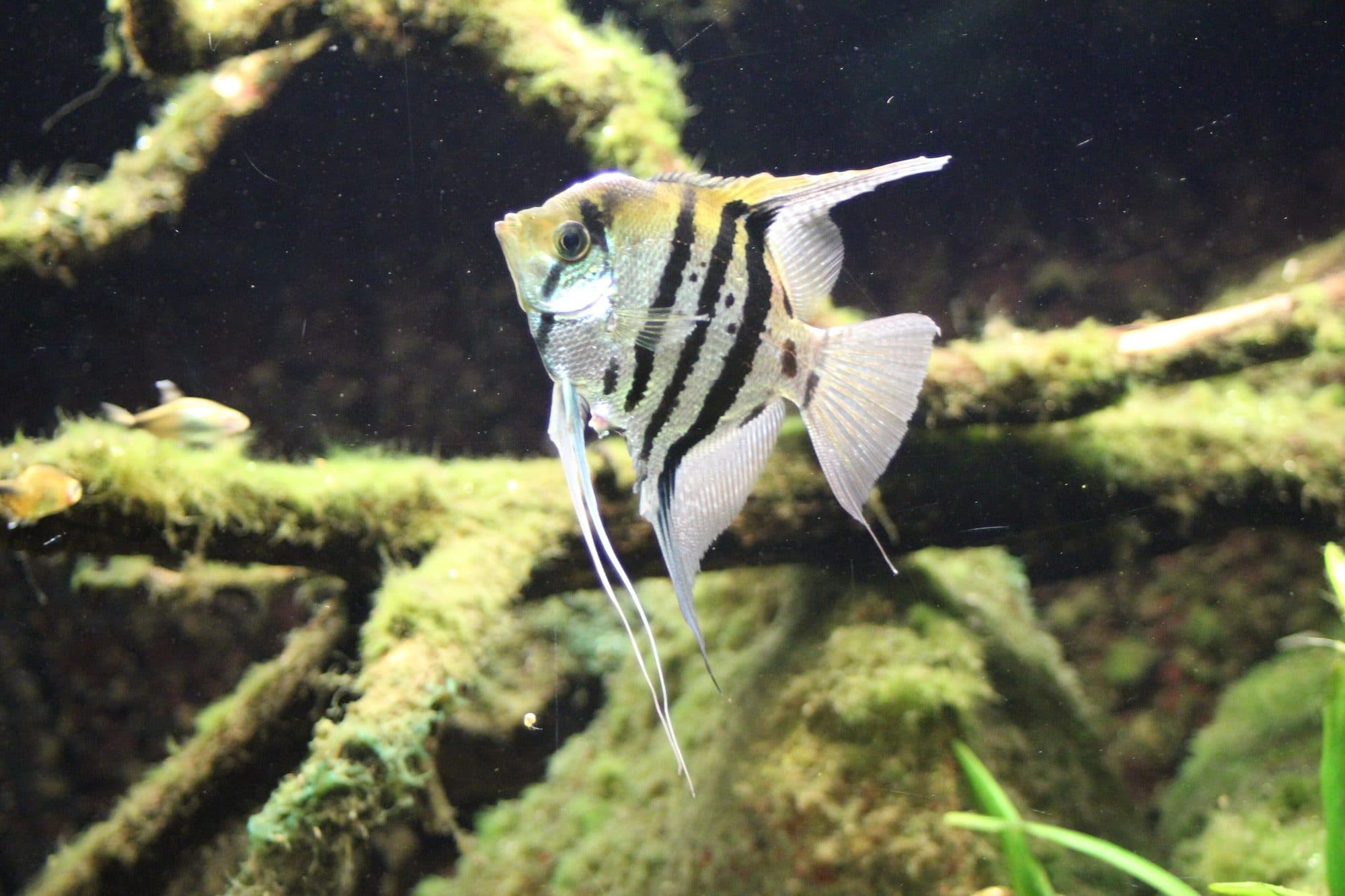
Photo: Tobias Niepel, CC BY 2.0, via Wikimedia Commons
Angelfish
Pterophyllum scalare
15 cm
Adult size
300 L
Minimum volume
6
Minimum group
9 years
Lifespan
Water parameters
Understand these values- Genus
- Pterophyllum
- Diet
- carnivore
- Social life
- shoal
In the wild
Overview
Described in 1823 by the German naturalist Schultze, the angelfish is one of the most famous tropical fish. Its very tall, flattened body, extended by long dorsal and anal fins, lets it slip between the vertical stems and roots of its natural habitat; its dark vertical bands complete the camouflage.
Fish in the trade almost all come from farms in Asia and Eastern Europe, which have produced many varieties (marbled, golden, veil, black). It reaches 15 cm in length and more in height.
- Scientific name
- Pterophyllum scalare (Schultze, 1823)
- Classification
- Cichliformes › Cichlidae
- IUCN Red List
- Least concern (LC)
Natural habitat
Amazon basin (Peru, Colombia, Brazil), rivers of Amapá, Oyapock (French Guiana) and Essequibo (Guyana)
Observations (GBIF) and localities Native countries Rivers and lakes
It is widespread in the Amazon basin in Peru, Colombia and Brazil, along the Ucayali, Solimões and Amazon, as well as in the rivers of Amapá, the Oyapock in French Guiana and the Essequibo in Guyana.
It lives in marshes and flooded areas with dense aquatic and bank vegetation, in clear or silty water; its colour is more intense in clear water. The water is warm (24 to 30 °C), soft and slightly acidic.
Behaviour
Generally peaceful, it may quarrel with its own kind and readily eats small fish such as neons. Young fish live in groups; at maturity pairs form and become territorial when breeding.
It feeds on small crustaceans and aquatic invertebrates. The pair spawns on a vertical surface (broad leaf, stone, glass), then carefully guards the eggs and fry. The sexes are hard to tell apart outside spawning.
Sources:FishBase Seriously Fish GBIF · Base map: Natural Earth