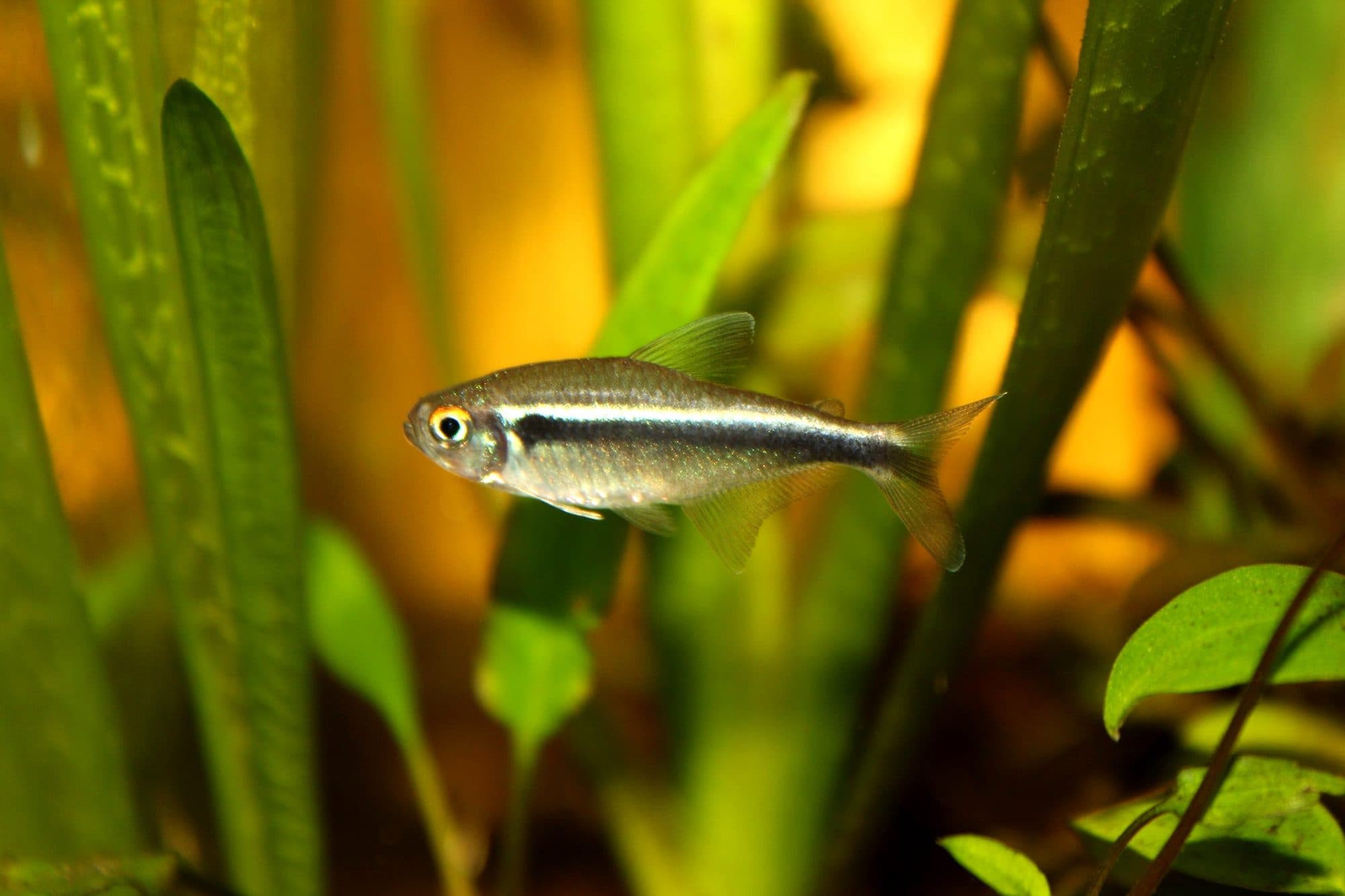
Photo: Juan R. Lascorz, CC BY-SA 3.0, via Wikimedia Commons
Black neon tetra
Hyphessobrycon herbertaxelrodi
4 cm
Adult size
100 L
Minimum volume
10
Minimum group
5 years
Lifespan
Water parameters
Understand these values- Genus
- Hyphessobrycon
- Diet
- carnivore
- Social life
- shoal
In the wild
Overview
Described in 1961 by Jacques Géry, the black neon tetra is named after Herbert R. Axelrod, an American publisher and author of aquarium books. Despite its common name, it is not a Paracheirodon: it is recognised by the double pale-and-black band along its flank and the bright red upper part of its eye.
It belongs to the “H. agulha group”, species whose lower half of the body is dark, especially above the anal fin.
- Scientific name
- Hyphessobrycon herbertaxelrodi Géry, 1961
- Classification
- Characiformes › Acestrorhamphidae
- IUCN Red List
- Least concern (LC)
Natural habitat
Upper Rio Paraguai basin, around the Pantanal (Mato Grosso and Mato Grosso do Sul, Brazil)
Observations (GBIF) and localities Native countries Rivers and lakes
The species seems widespread in the upper Rio Paraguai, both north and south of the Pantanal, Brazil's great tropical wetland. Its type locality is in the upper Rio Taquari basin, near Coxim; it has also been observed in the upper Rio Sepotuba, 700 km further north.
It frequents small tributaries, headwater rivers, oxbows and seasonal floodplains. These streams, a few metres wide, have clear, slightly brownish water and thick bank vegetation, sometimes beds of Echinodorus or Eleocharis.
Behaviour
Very peaceful, it swims in the middle and upper layers of the water and feeds on worms, small crustaceans and plant matter. A mixed group of at least 8 to 10 gives it natural shoaling behaviour.
It spawns in open water, with no parental care; the eggs hatch in 24 to 30 hours. Adult females are deeper-bodied and slightly larger than males.
Sources:FishBase Seriously Fish GBIF · Base map: Natural Earth