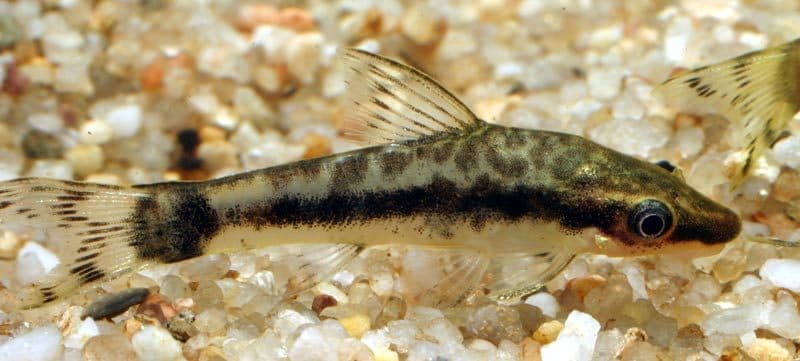
Photo: Rainer Schmitt, 2004, CC BY-SA 3.0, via Wikimedia Commons
Dwarf sucker
Otocinclus macrospilus
4 cm
Adult size
60 L
Minimum volume
6
Minimum group
8 years
Lifespan
Water parameters
Understand these values- Genus
- Otocinclus
- Diet
- herbivore, algae eater
- Social life
- small group
In the wild
Overview
Described in 1942 by Carl Eigenmann and William Ray Allen, Otocinclus macrospilus (“large spot”) has a large, round black spot at the base of the tail. It is probably the best-selling otocinclus in the hobby, often under the generic name “oto”.
Almost all fish in the trade are wild-caught. Delicate on arrival, they often starve during transport: this small grazer needs to eat almost continuously.
- Scientific name
- Otocinclus macrospilus Eigenmann & Allen, 1942
- Classification
- Siluriformes › Loricariidae
- IUCN Red List
- Least concern (LC)
Natural habitat
Upper Amazon in Peru (Morona, Nanay and Marañón basins); reported from Colombia and Ecuador
Observations (GBIF) and localities Native countries Rivers and lakes
It is native to the upper Peruvian Amazon; its type locality is the Río Morona, in the department of Loreto. It is also recorded from the Nanay and Marañón basins, Colombia and Ecuador.
It lives in the dense vegetation along the banks of streams, creeks and rivers, and in large numbers in “floating meadows”, rafts of plants that shelter many fish.
Behaviour
Very shy, it is outcompeted by livelier species: keep it with small peaceful characins, Apistogramma and small corydoras. It seeks the company of its own kind, in a group of at least 6.
It feeds mainly on algae and micro-organisms: a planted, mature aquarium, fresh vegetables and plant-based tablets. It has been bred: the pair adopts the corydoras “T position”, then the eggs are scattered around the tank. Seen from above, females are broader.
Sources:FishBase Seriously Fish GBIF · Base map: Natural Earth