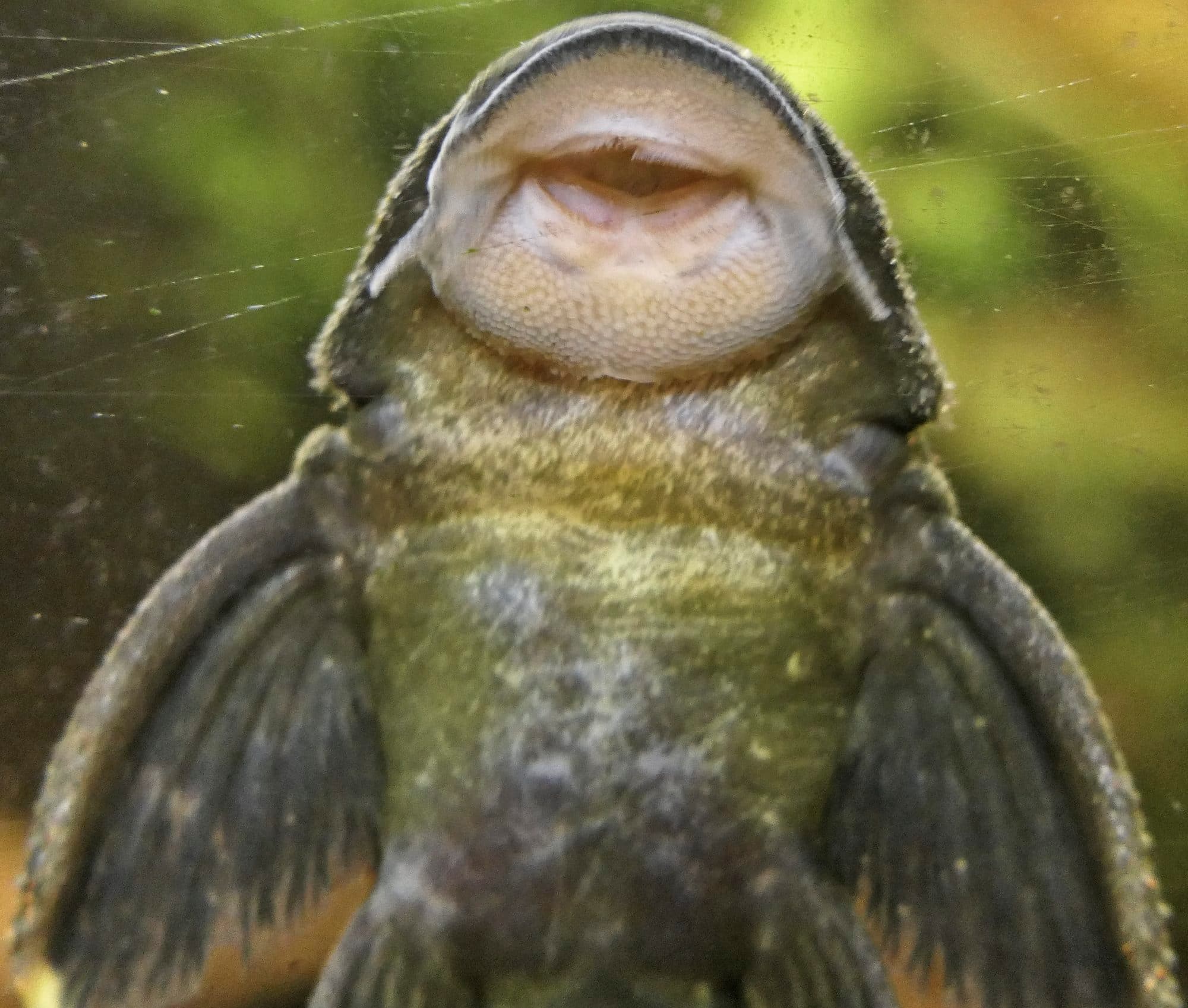
Mango pleco (L047)
Baryancistrus chrysolomus
25 cm
Adult size
400 L
Minimum volume
1
Minimum group
20 years
Lifespan
Water parameters
Understand these values- Genus
- Baryancistrus
- Diet
- omnivore
- Social life
- solitary
In the wild
Overview
Long known under the code L047 or the name “mango pleco”, this loricariid was described in 2011 by Lúcia Rapp Py-Daniel, Jansen Zuanon and Renildo Ribeiro de Oliveira. Its name chrysolomus refers to the golden edge of its fins, on a dark body scattered with yellow dots.
Baryancistrus are recognised by the widened membrane that extends their dorsal fin towards the adipose fin. It reaches nearly 30 cm.
- Scientific name
- Baryancistrus chrysolomus Rapp Py-Daniel, Zuanon & Ribeiro de Oliveira, 2011
- Classification
- Siluriformes › Loricariidae
- IUCN Red List
- Least concern (LC)
Natural habitat
Rio Xingu basin (Pará, Brazil): Volta Grande and upper Rio Curuá
Observations (GBIF) and localities Native countries Rivers and lakes
It is endemic to the Xingu basin: the Volta Grande, just upstream of the Belo Monte falls, and the upper Rio Curuá, a tributary of the Iriri.
Adults live under large slabs of rock lying on the riverbed, where fine sediment builds up; the young shelter under stones at the edges of rapids, in a weak to moderate current. The water is clear, warm (27 to 32 °C) and oxygenated.
Behaviour
Fairly peaceful when young, males become increasingly intolerant of their own kind and of any bottom-dweller seen as a rival. It is best kept with medium to large characins that occupy open water.
Analysis of stomach contents shows a diet mostly of algae (diatoms, Spirogyra) and a few invertebrates: in the aquarium, algae wafers, spirulina and biofilm on stones. Its breeding is not documented; the sexes are very hard to tell apart.
Sources:FishBase Seriously Fish GBIF · Base map: Natural Earth