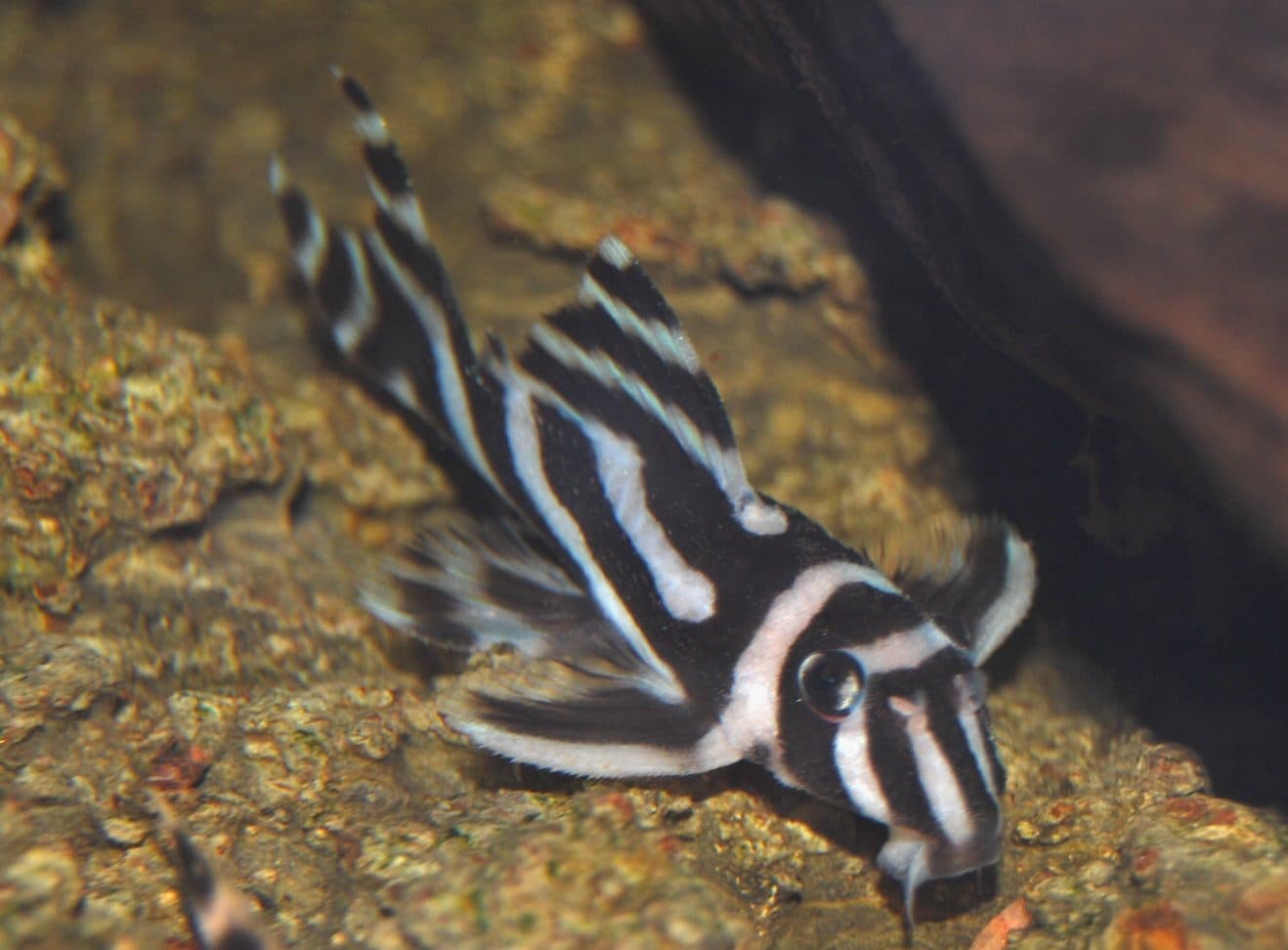
Photo: Birger A, CC BY-SA 3.0, via Wikimedia Commons
Zebra pleco
Hypancistrus zebra
8 cm
Adult size
100 L
Minimum volume
1
Minimum group
15 years
Lifespan
Water parameters
Understand these values- Genus
- Hypancistrus
- Diet
- carnivore and herbivore
- Social life
- solitary
In the wild
Overview
Arriving in Europe in the late 1980s under the code L046, the zebra pleco was described in 1991 by Isaäc Isbrücker and Han Nijssen, who created the genus Hypancistrus for it. Its black and white stripes make it one of the most sought-after loricariids; it does not exceed 8 cm.
The IUCN lists it as critically endangered. Brazil has banned its export since 2004, and the Belo Monte dam has greatly reduced the flow of the Xingu's Volta Grande, its only habitat. The fish sold in Europe today are captive-bred.
- Scientific name
- Hypancistrus zebra Isbrücker & Nijssen, 1991
- Classification
- Siluriformes › Loricariidae
- IUCN Red List
- Critically endangered (CR)
Natural habitat
Endemic to the Volta Grande of the Rio Xingu (Pará, Brazil)
Observations (GBIF) and localities Native countries Rivers and lakes
It is known only from one stretch of the Rio Xingu, the Volta Grande, a great loop of rapids in the state of Pará.
It lives in flowing, warm (26 to 30 °C) and highly oxygenated water, at depth, in crevices and rock piles resting on a sandy bottom.
Behaviour
Peaceful but shy, it is easily beaten to the food: it does best in a species tank, or with small midwater fish that tolerate the same heat (tetras, rasboras, discus, dwarf cichlids). Males are territorial towards each other around caves.
Contrary to the image of an “algae eater”, it is mainly carnivorous: bloodworms, mussels, shrimp and protein-rich tablets. It breeds in caves, the male guarding the eggs; adult males have a broader head and odontodes on the first pectoral fin ray.
Sources:FishBase Seriously Fish GBIF · Base map: Natural Earth