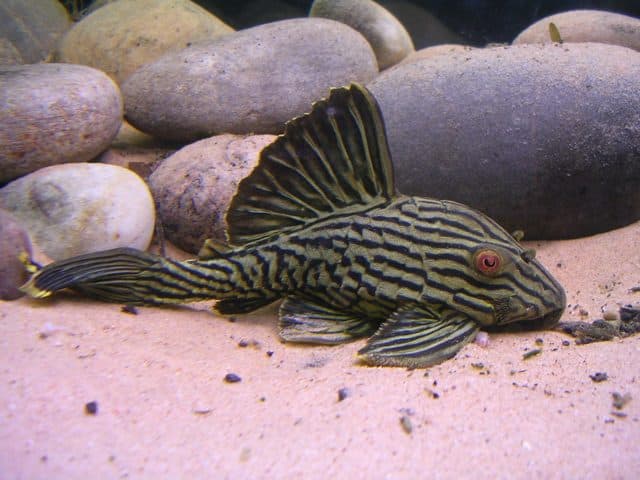
Photo: Neale Monks at en.wikipedia, CC BY-SA 3.0, via Wikimedia Commons
Royal pleco
Panaque nigrolineatus
40 cm
Adult size
400 L
Minimum volume
1
Minimum group
12 years
Lifespan
Water parameters
Understand these values- Genus
- Panaque
- Diet
- herbivore (mange du bois)
- Social life
- solitary
In the wild
Overview
Described in 1877 by Wilhelm Peters, the royal pleco (L190 and related forms) is recognised by its black lines on a grey-green background, its red eyes and its strong spoon-shaped teeth. It exceeds 40 cm.
It is famous for “eating wood”: it constantly rasps submerged roots and logs. Studies have shown, however, that it hardly digests the cellulose in wood, which passes through its gut very quickly; it actually feeds mainly on the biofilm, algae and detritus covering it. Wood nevertheless remains essential to its well-being in the aquarium.
- Scientific name
- Panaque nigrolineatus (Peters, 1877)
- Classification
- Siluriformes › Loricariidae
- IUCN Red List
- Least concern (LC)
Natural habitat
Orinoco basin and southern tributaries of the middle and lower Amazon (Venezuela, Colombia, Brazil)
Observations (GBIF) and localities Native countries Rivers and lakes
It lives in the Orinoco basin, in Venezuela and Colombia, and in the southern tributaries of the middle and lower Amazon, in Brazil.
It frequents rivers where submerged trunks and branches accumulate, in tropical water of low to medium hardness, close to neutral (22 to 26 °C according to FishBase).
Behaviour
Solitary and territorial towards other large plecos, it defends its wooden shelter with its spines; it tolerates robust midwater fish. The rule is one fish per tank.
Its adult size, its longevity and the abundant sawdust it produces call for a large aquarium (over 400 litres) with very good filtration. Feed it vegetables, plant-based tablets and soft wood to rasp at all times.