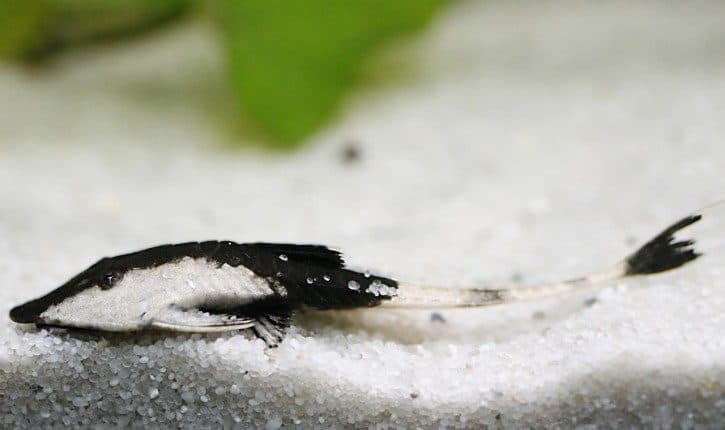
Apithanos whiptail catfish
Pseudohemiodon apithanos
15 cm
Adult size
250 L
Minimum volume
4
Minimum group
10 years
Lifespan
Water parameters
Understand these values- Genus
- Pseudohemiodon
- Diet
- carnivore
- Social life
- small group
In the wild
Overview
Described in 1978 by Isaäc Isbrücker and Han Nijssen, Pseudohemiodon apithanos is a very flattened loricariid of the subfamily Loricariinae, related to the “twig” whiptail catfish. Its species name comes from the Greek apithanos, “improbable”.
It measures up to 14.5 cm without the tail. Its ray-shaped body, beige spotted with brown, blends perfectly with the sand.
- Scientific name
- Pseudohemiodon apithanos Isbrücker & Nijssen, 1978
- Classification
- Siluriformes › Loricariidae
- IUCN Red List
- Least concern (LC)
Natural habitat
Río San Miguel basin, western Amazon basin (Ecuador)
Observations (GBIF) and localities Native countries Rivers and lakes
It is known from the Río San Miguel basin, in the western Amazon basin, in Ecuador.
Pseudohemiodon live on river sandbanks, where they partly bury themselves with only their eyes showing, and sift the substrate for small invertebrates.
Behaviour
Peaceful and discreet, it spends most of its time buried in the sand: a fine, soft sand substrate is essential, as are calm companions that do not steal its food.
It feeds on small prey (larvae, worms, crustaceans) that it seeks in the sand. Like other Loricariinae, the male carries the eggs stuck under his enlarged lower lip until they hatch.