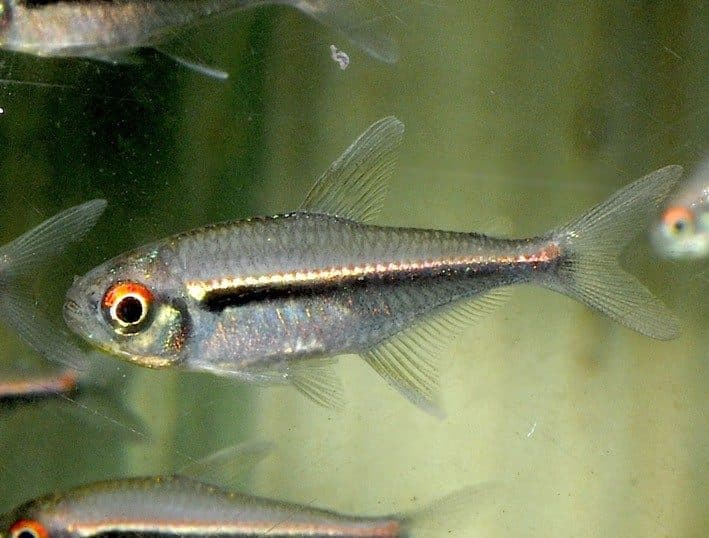
Flag tetra
Hyphessobrycon heterorhabdus
4 cm
Adult size
80 L
Minimum volume
8
Minimum group
5 years
Lifespan
Water parameters
Understand these values- Genus
- Hyphessobrycon
- Diet
- carnivore
- Social life
- shoal
In the wild
Overview
Described in 1894 by Albert Ulrey, the flag tetra (or “Belgian flag tetra”) has a black lateral band edged with gold and red that recalls the three colours of the Belgian flag. Its name comes from the Greek heteros (“other”) and rhabdos (“rod”), probably referring to this stripe.
The name was long applied to similar fish from all over Amazonia, the Orinoco and the Guianas; several of these populations have since been described as separate species (H. amapaensis, H. eschwartzae, H. montagi).
- Scientific name
- Hyphessobrycon heterorhabdus (Ulrey, 1894)
- Classification
- Characiformes › Acestrorhamphidae
- IUCN Red List
- Least concern (LC)
Natural habitat
Eastern Brazilian Amazon: Pará and Maranhão, from the Rio Tapajós to the Atlantic coastal rivers
Observations (GBIF) and localities Native countries Rivers and lakes
In the strict sense, the species lives in the eastern Brazilian Amazon: tributaries and coastal rivers of Pará and Maranhão states, around Belém (Guamá, Acará, Tocantins, Xingu, Gurupi, Pindaré rivers…), as far as the Rio Tapajós.
It has almost always been collected in terra firme igarapés, the small headwater streams that are not flooded every year. Shaded by the forest, they have clear water over sand or mud, with roots, branches and leaf litter, but usually no aquatic plants.
Behaviour
Very peaceful, it feeds on worms, small crustaceans and plant debris. It lives in a shoal: a mixed group of at least 8 to 10, accompanied by other shoaling fish, makes it more confident.
It is an egg scatterer with no parental care; adults in good condition spawn often, and a few fry may appear spontaneously in a well-established aquarium. Adult females are deeper-bodied and slightly larger than males.
Sources:FishBase Seriously Fish GBIF · Base map: Natural Earth