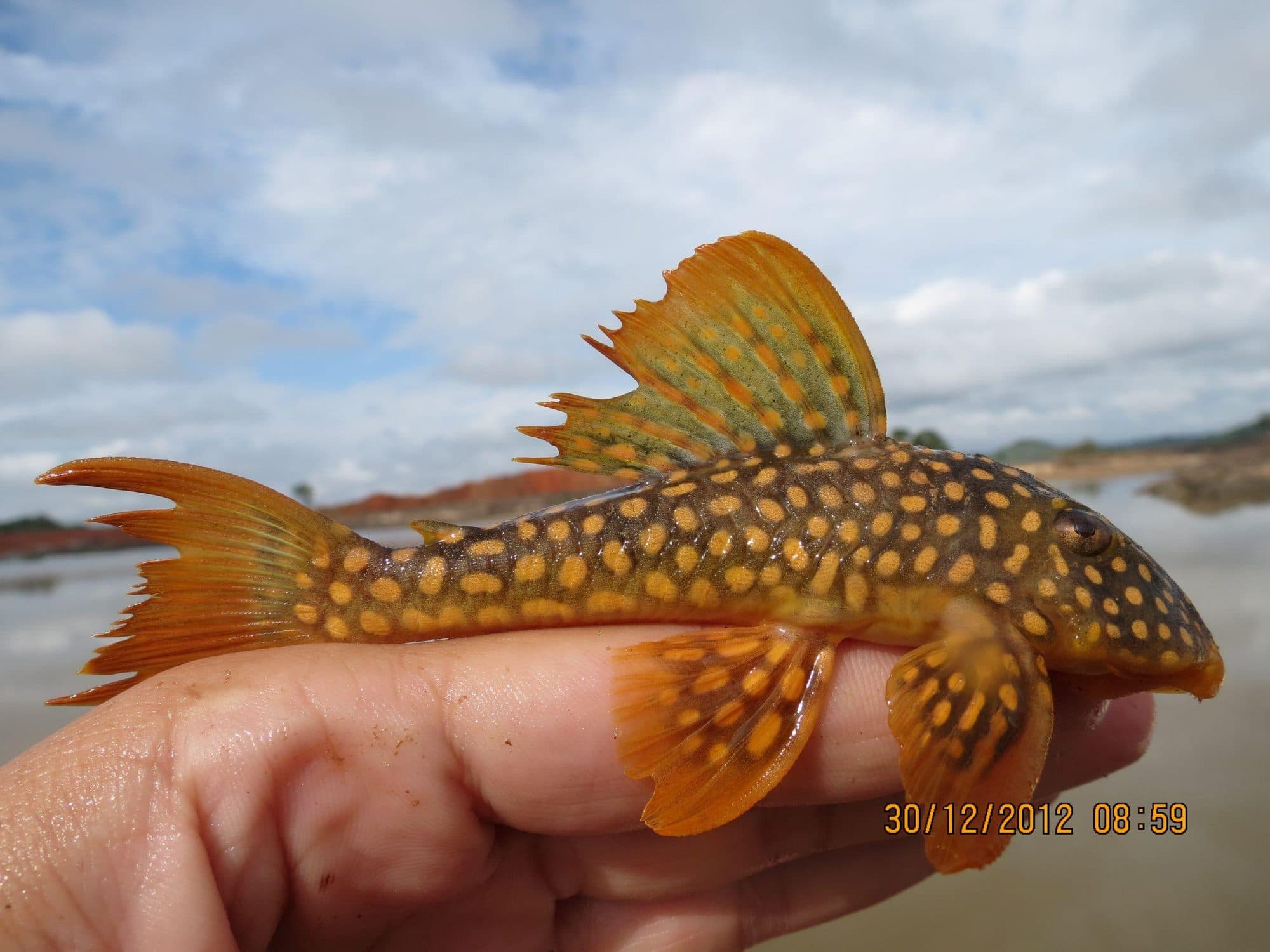
Photo: Gabriel Lelis Togni, CC BY 3.0, via Wikimedia Commons
Sunshine pleco
Scobinancistrus aureatus
25 cm
Adult size
300 L
Minimum volume
1
Minimum group
25 years
Lifespan
Water parameters
Understand these values- Genus
- Scobinancistrus
- Diet
- carnivore and omnivore
- Social life
- solitary
In the wild
Overview
Described in 1994 by Warren E. Burgess, the sunshine pleco (L014) is a large black loricariid studded with golden-yellow dots, with yellow-edged fins, reaching almost 30 cm. Its Latin name aureatus means “golden”.
The IUCN lists it as vulnerable. Like other fish endemic to the Xingu, it is threatened by large-scale river development, in particular the Belo Monte dam, which has profoundly altered the water regime of the Volta Grande since 2016.
- Scientific name
- Scobinancistrus aureatus Burgess, 1994
- Classification
- Siluriformes › Loricariidae
- IUCN Red List
- Vulnerable (VU)
Natural habitat
Endemic to the Rio Xingu basin (Pará, Brazil)
Observations (GBIF) and localities Native countries Rivers and lakes
The species is known only from the Rio Xingu basin, a large clear-water tributary on the right bank of the Amazon, in the state of Pará.
Xingu loricariids live in rocky rapids: clear, warm, highly oxygenated, flowing water, where they shelter in crevices and under rock slabs. In the aquarium, strong water movement and well-oxygenated water are essential.
Behaviour
Solitary and fairly territorial towards other plecos, it tolerates most medium-sized midwater fish. Active mainly at dusk and at night, it spends the day hidden in caves.
An omnivore with carnivorous leanings, it needs protein-rich food (shrimp, mussels, tablets for carnivorous plecos) more than plant matter. Its adult size calls for a large tank, and it can live for more than 20 years.