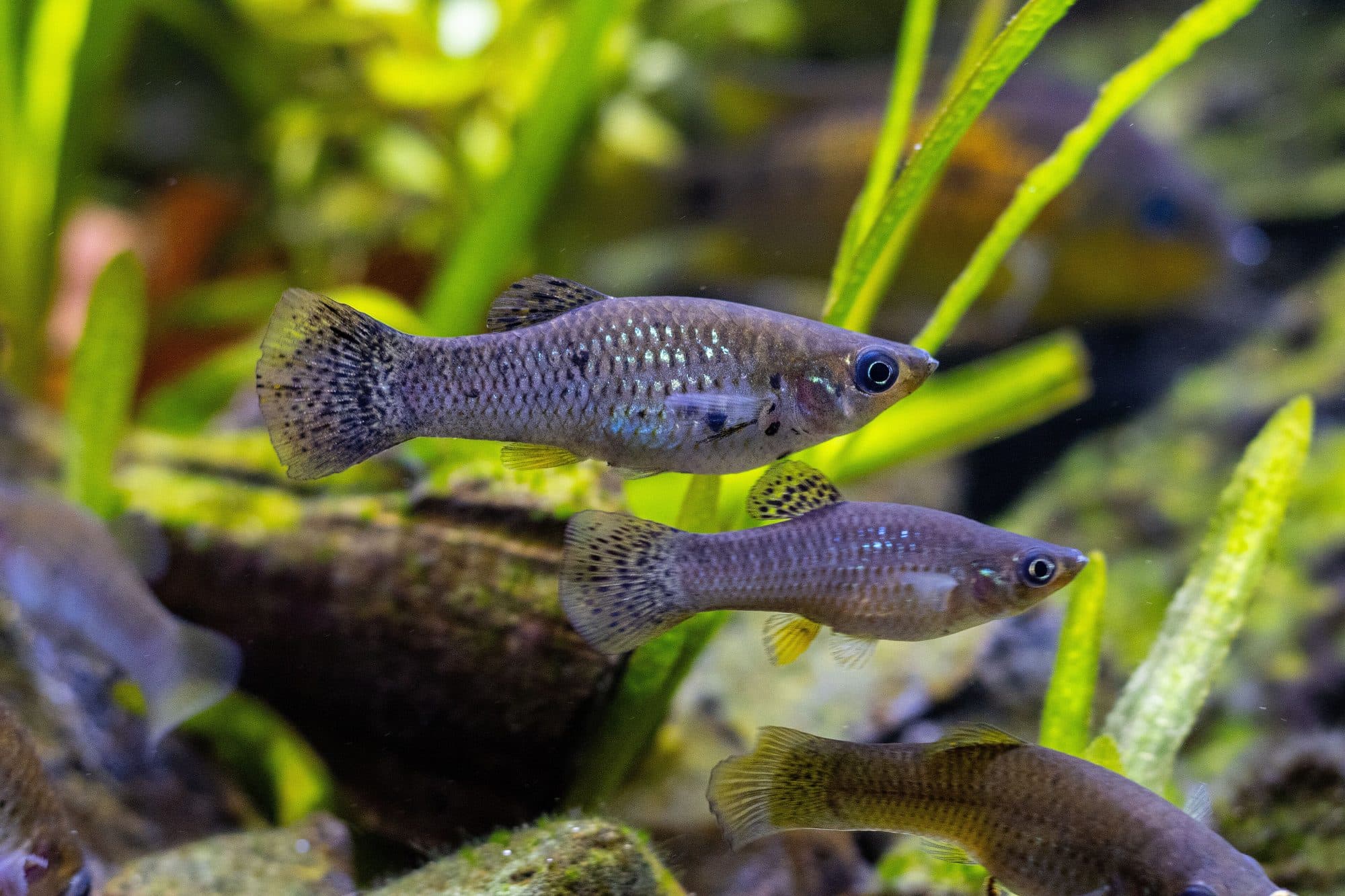
Photo: Dnoerholm, CC BY-SA 4.0, via Wikimedia Commons
Short-finned molly
Poecilia sphenops
7 cm
Adult size
120 L
Minimum volume
4
Minimum group
3 years
Lifespan
Water parameters
Understand these values- Genus
- Poecilia
- Diet
- omnivore à tendance carnivore
- Social life
- harem
In the wild
Overview
Described in 1846 by Achille Valenciennes, the molly (or “short-finned molly”) is the ancestor of many aquarium forms, including the famous black molly, a melanistic variety. It is often confused with Poecilia mexicana, a closely related species.
Decades of intensive production have weakened many farmed strains, which are prone to disease when kept in soft, mineral-poor water. The species is so salt-tolerant that it can live in seawater.
- Scientific name
- Poecilia sphenops Valenciennes, 1846
- Classification
- Cyprinodontiformes › Poeciliidae
- IUCN Red List
- Least concern (LC)
Natural habitat
From Mexico to Colombia and Venezuela, with a few populations in the Caribbean
Observations (GBIF) and localities Native countries Rivers and lakes
Its natural range extends from Mexico to Colombia and Venezuela, with isolated populations on some Caribbean islands. Introduced populations exist in the United States, Japan, Singapore and Eastern Europe.
It lives in fresh and brackish water alike, in hard, alkaline water, between 18 and 28 °C.
Behaviour
Peaceful, it only suits fish that tolerate the same hard, even slightly salty water: other Poecilia, rainbowfish, hard-water barbs and tetras.
An omnivore, it eats small invertebrates and detritus, but its diet must include plenty of plant matter; it grazes green algae. A livebearer, it breeds easily after a gestation of about two months; several females per male limit harassment.
Sources:FishBase Seriously Fish GBIF · Base map: Natural Earth