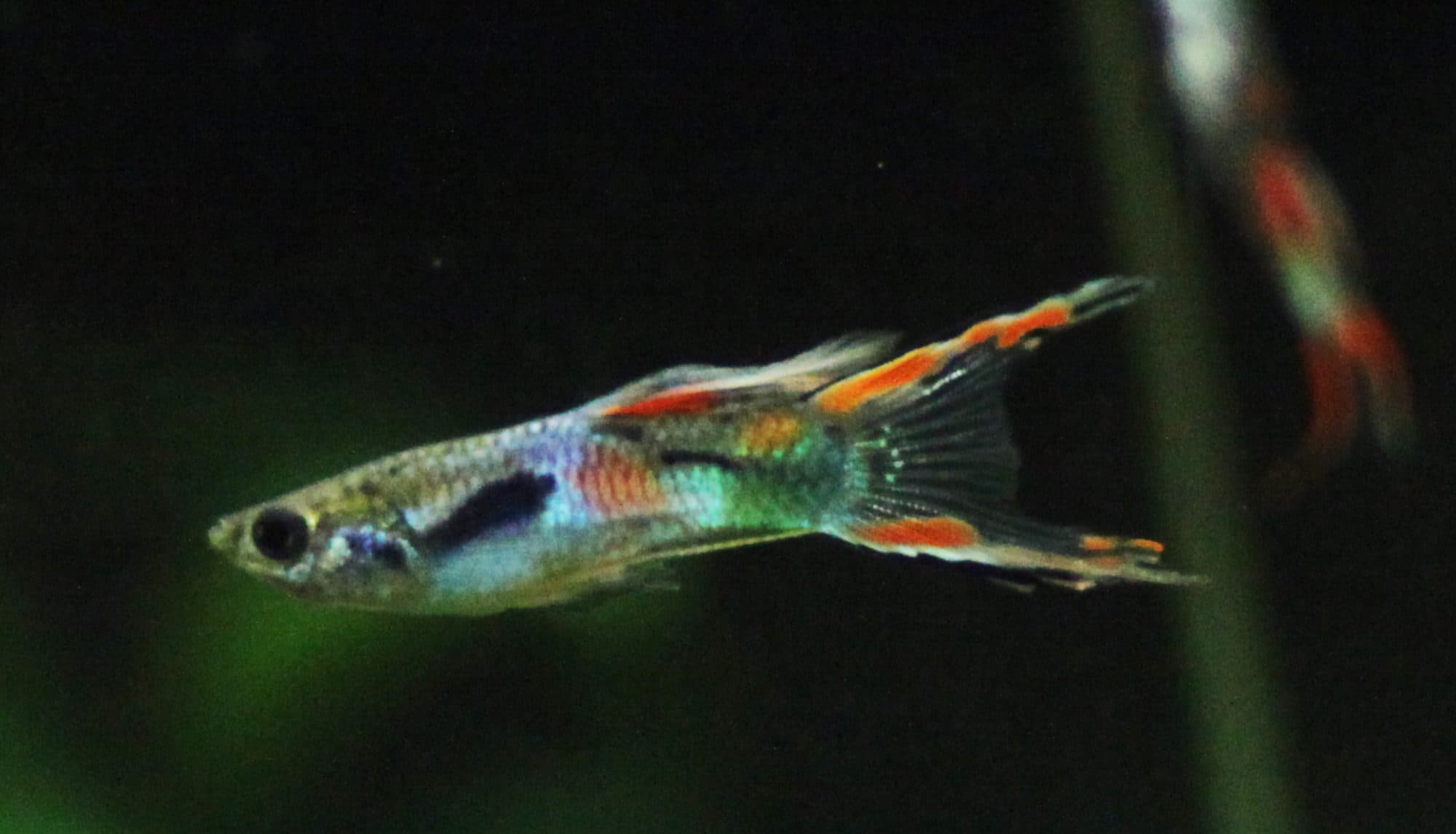
Photo: Marrabbio2, CC BY-SA 3.0, via Wikimedia Commons
Endler's guppy
Poecilia wingei
2 cm
Adult size
50 L
Minimum volume
4
Minimum group
3 years
Lifespan
Water parameters
Understand these values- Genus
- Poecilia
- Diet
- carnivore
- Social life
- harem
In the wild
Overview
Endler's guppy was discovered in 1937 by Franklyn Bond, then rediscovered in 1975 by the biologist John Endler in the Laguna de Patos, Venezuela. It was only described in 2005 by Fred Poeser, Michael Kempkes and Isaäc Isbrücker, who named it after the Danish geneticist Øjvind Winge, a pioneer in the study of colour and sex determination in guppies.
Its species status has been debated, since it hybridises with the guppy and produces fertile offspring; a 2009 genetic study confirmed it as a valid species. The IUCN lists it as endangered.
- Scientific name
- Poecilia wingei Poeser, Kempkes & Isbrücker, 2005
- Classification
- Cyprinodontiformes › Poeciliidae
- IUCN Red List
- Endangered (EN)
Natural habitat
Campoma and Buena Vista lagoons, near Carúpano (north-eastern Venezuela)
Observations (GBIF) and localities Native countries Rivers and lakes
It lives in coastal lagoons in north-eastern Venezuela, near Carúpano. The Laguna de Patos, its type locality, was originally a brackish lake cut off from the sea by a sandbar, which became fresh over time.
When it was rediscovered, the water there was very warm, hard and green with algae. The population there is now thought to be extinct, after a rubbish dump was set up beside the lake.
Behaviour
Peaceful, it is too small for a classic community aquarium: keep it with tiny, calm species (dwarf corydoras, Pseudomugil, small tetras). Males tolerate each other, but females can be territorial towards one another.
Very prolific, it breeds continuously. It should not be kept with guppies, to avoid hybrids that threaten the purity of the lines. An omnivore, it eats small invertebrates, detritus and plant matter.
Sources:FishBase Seriously Fish GBIF · Base map: Natural Earth