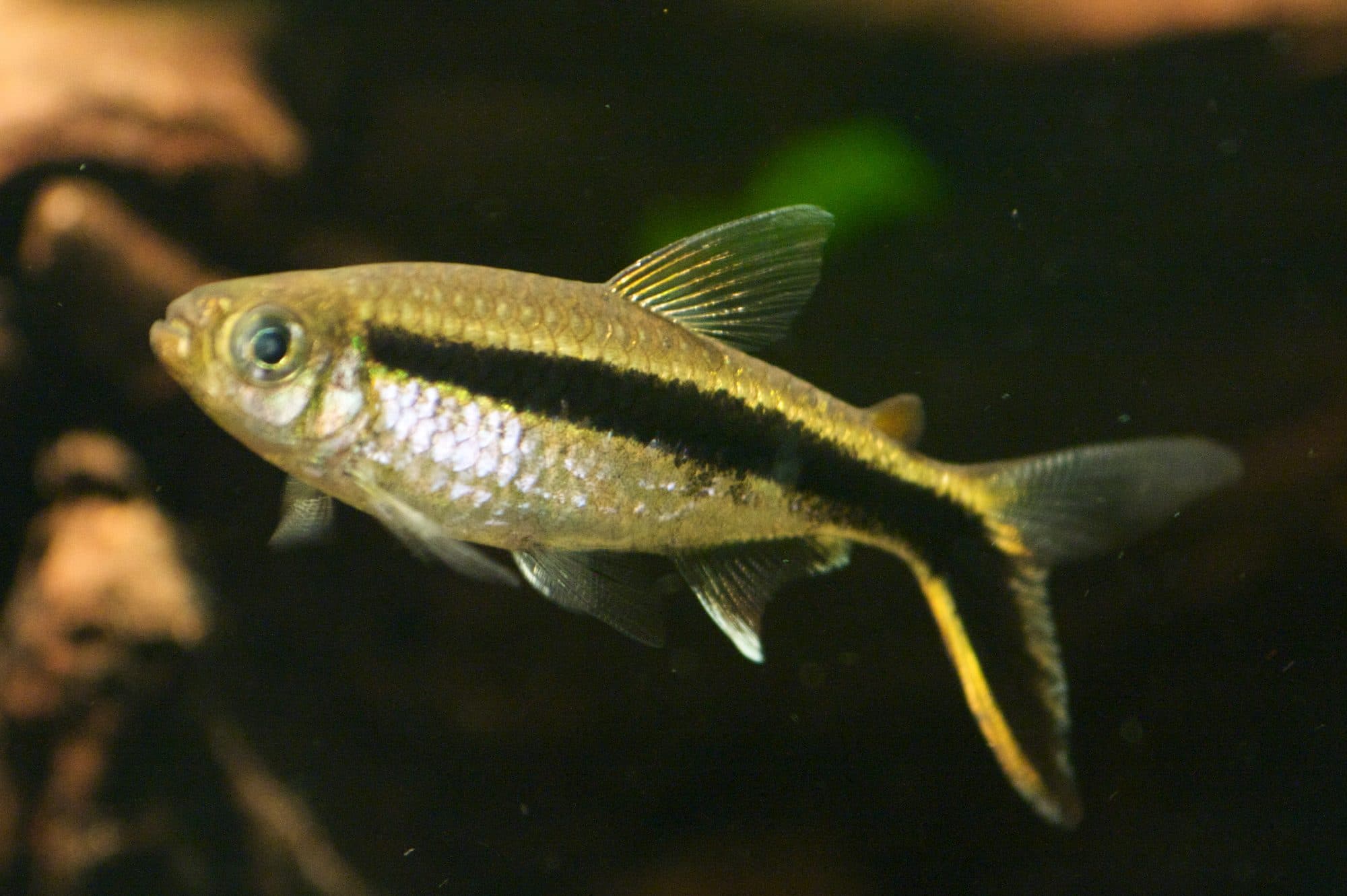
Penguin tetra
Thayeria boehlkei
5 cm
Adult size
120 L
Minimum volume
8
Minimum group
5 years
Lifespan
Water parameters
Understand these values- Genus
- Thayeria
- Diet
- carnivore
- Social life
- shoal
In the wild
Overview
Described in 1957 by Stanley Weitzman, the penguin tetra is the best known of the Thayeria. It owes its nickname to its posture: it holds its body tilted, head up, and a broad black band runs down the flank to the tip of the lower lobe of the tail, like a “tailcoat”.
It measures about 3.5 cm without the tail and can reach 6 cm in total length in the aquarium. The tetra classification revised in 2024 places it in the family Acestrorhamphidae.
- Scientific name
- Thayeria boehlkei Weitzman, 1957
- Classification
- Characiformes › Acestrorhamphidae
- IUCN Red List
- Least concern (LC)
Natural habitat
Upper Amazon in Peru and Rio Araguaia basin in Brazil
Observations (GBIF) and localities Native countries Rivers and lakes
Its range seems limited to the upper Peruvian Amazon basin and the Rio Araguaia, in Brazil. The Araguaia, which crosses several Brazilian states, receives a multitude of tributaries: the species probably occupies varied habitats there, from wetlands rich in submerged plants to forest streams lined with dense vegetation but poor in aquatic plants.
The waters it frequents are tropical (22 to 28 °C), of low to medium hardness.
Behaviour
Peaceful and gregarious, it is a micropredator that hunts insects, worms and small crustaceans. It is kept in a group of at least 6, ideally 10: the fin nipping it is blamed for appears mainly in fish kept in too small numbers, which take out their squabbles on other species.
It breeds fairly easily in a separate, dimly lit tank: the female lays a large number of eggs among fine vegetation, which hatch in 20 to 24 hours. Adult females have a rounder belly and slightly less vivid colours.
Sources:FishBase Seriously Fish GBIF · Base map: Natural Earth