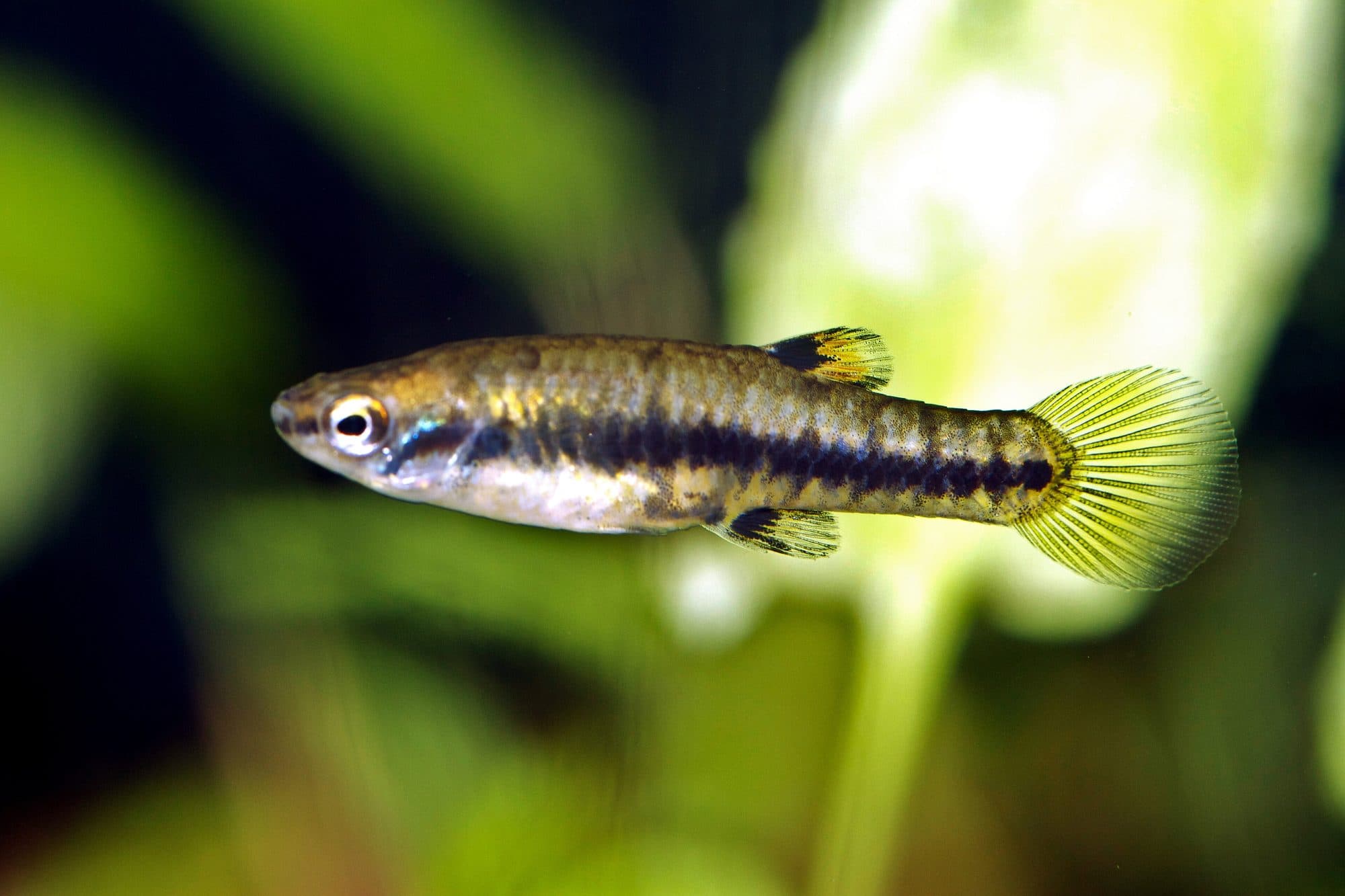
Photo: Brian Gratwicke, CC BY 2.0, via Wikimedia Commons
Least killifish
Heterandria formosa
3 cm
Adult size
40 L
Minimum volume
5
Minimum group
5 years
Lifespan
Water parameters
Understand these values- Genus
- Heterandria
- Diet
- carnivore, omnivore and planktivore
- Social life
- small group
In the wild
Overview
Described in 1859 by the French zoologist Charles Girard, who worked at the Smithsonian, Heterandria formosa is the smallest known livebearer and one of the smallest fish in the world: adult males measure about 1.5 cm, females just over 3 cm.
It interests biologists because of the way it reproduces: the female nourishes her embryos during gestation and carries several broods at different stages at the same time (superfetation), so that she gives birth to a few young almost every day. It is sometimes confused with mosquitofish, which are far more aggressive.
- Scientific name
- Heterandria formosa (Girard, 1859)
- Classification
- Cyprinodontiformes › Poeciliidae
- IUCN Red List
- Least concern (LC)
Natural habitat
Southeastern United States, from North Carolina (Cape Fear basin) to southern Louisiana
Observations (GBIF) and localities Native countries Rivers and lakes
It is endemic to the southeastern United States, from North Carolina to Louisiana; the type localities are Charleston (South Carolina) and Palatka (Florida).
It lives in still or slow, shallow and heavily vegetated water: marsh margins, ponds, ditches, sometimes brackish water. The subtropical climate means it tolerates cooler water in winter.
Behaviour
Very peaceful but tiny, it is not a community fish: many common species would eat it. It does best in a small colony, alone or with very small, calm species (pencilfish, dwarf corydoras, Otocinclus, shrimp).
An omnivore, it enjoys small live or frozen prey and grazes algae. It breeds without difficulty in a densely planted tank; the much smaller males have an outsized gonopodium.
Sources:FishBase Seriously Fish GBIF · Base map: Natural Earth