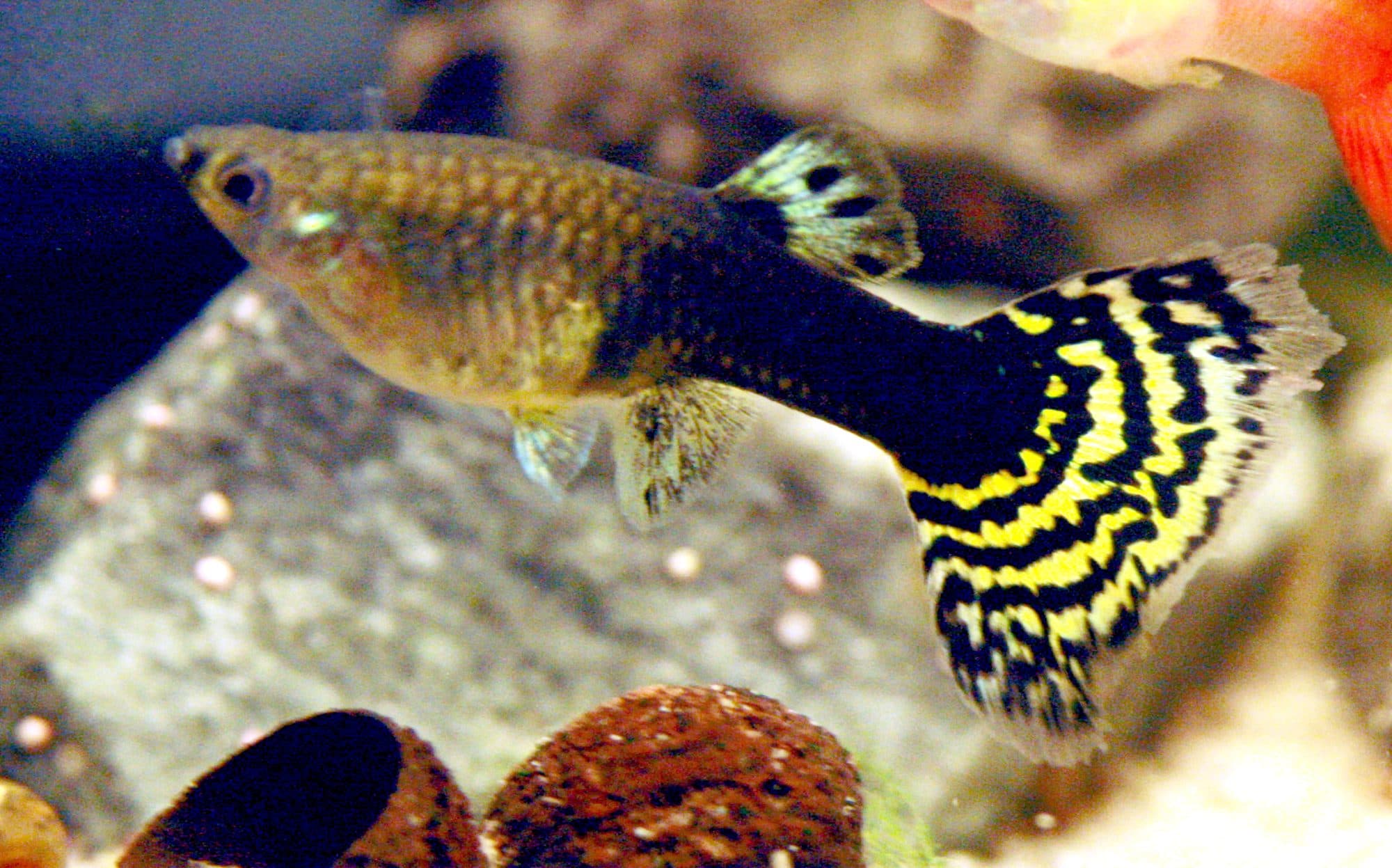
Photo: Marrabbio2, CC BY-SA 4.0, via Wikimedia Commons
Guppy
Poecilia reticulata
5 cm
Adult size
60 L
Minimum volume
4
Minimum group
3 years
Lifespan
Water parameters
Understand these values- Genus
- Poecilia
- Diet
- carnivore and detritivore
- Social life
- harem
In the wild
Overview
Described in 1859 by the German zoologist Wilhelm Peters from fish from the Río Guaire, in Caracas, the guppy owes its common name to Robert Lechmere Guppy, who sent specimens from Trinidad to the British Museum in 1866.
It is one of the most popular aquarium fish, with countless captive-bred varieties with outsized fins. It is also a famous model in evolutionary biology: in the rivers of Trinidad, populations exposed to different predators have evolved, within a few generations, distinct colours, sizes and breeding strategies.
- Scientific name
- Poecilia reticulata Peters, 1859
- Classification
- Cyprinodontiformes › Poeciliidae
- IUCN Red List
- Least concern (LC)
Natural habitat
North-eastern South America and the southern Caribbean (Venezuela, the Guianas, Trinidad and Tobago, Barbados)
Observations (GBIF) and localities Native countries Rivers and lakes
Its native range covers Venezuela, Guyana, Suriname, French Guiana, Trinidad and Tobago, Barbados, Antigua and the Netherlands Antilles. It has been introduced to some fifty countries, often to control mosquitoes: with little effect on them, but with negative impacts on local fish.
Incredibly adaptable, it lives everywhere from mountain torrents to murky pools and ditches, and even in brackish water, but prefers calm water rich in algae and vegetation.
Behaviour
Very peaceful, it suits a calm community aquarium; avoid fin nippers (tiger barbs, serpae tetras). Males constantly chase females: several females per male are recommended.
A livebearer, the female gives birth to fully formed fry about every four weeks, which adults readily eat: dense vegetation and floating plants protect them. It feeds on zooplankton, small insects and detritus.
Sources:FishBase Seriously Fish GBIF · Base map: Natural Earth