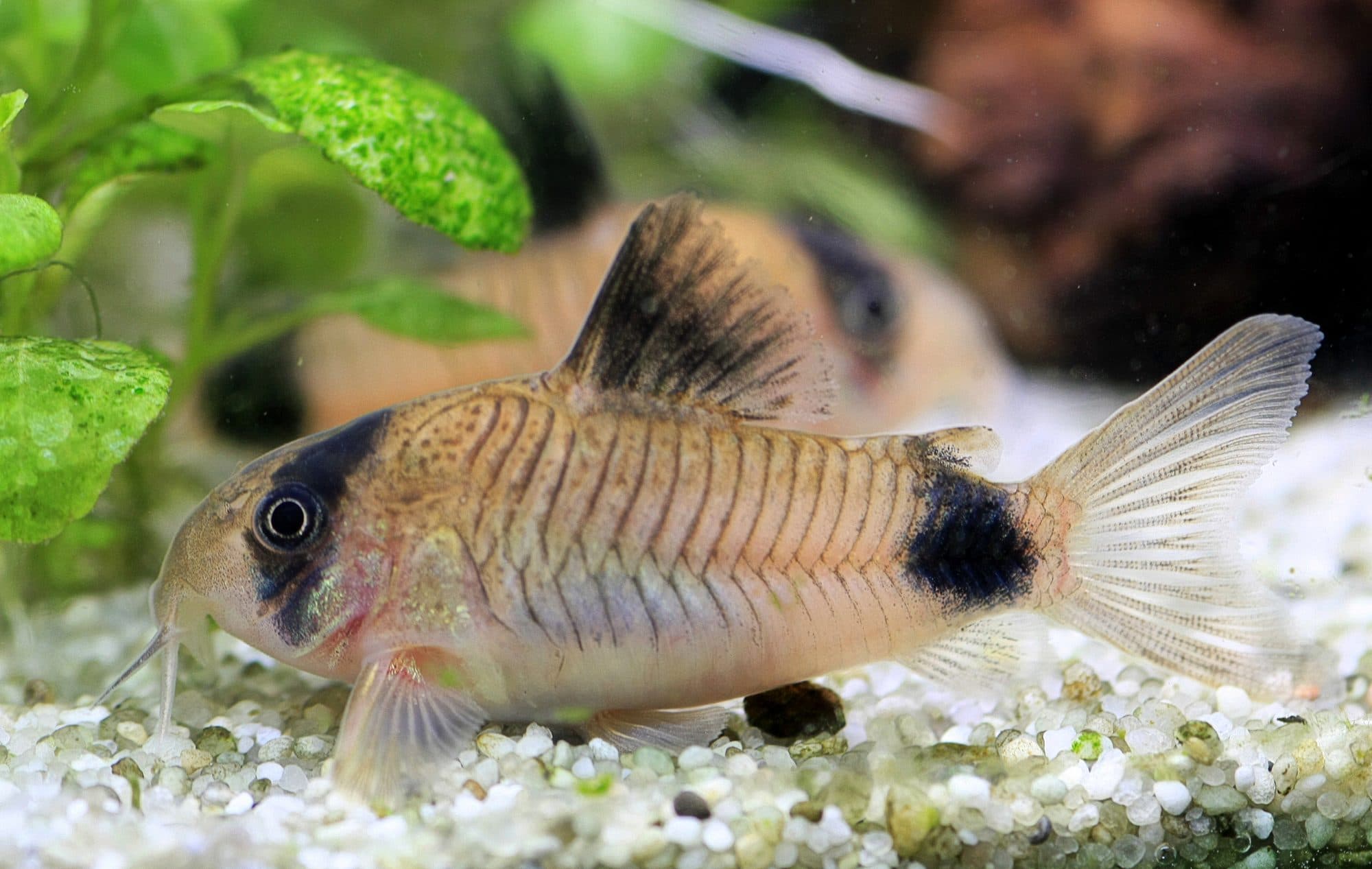
Photo: PRODornenwolf, CC BY 2.0, via Wikimedia Commons
Panda corydoras
Corydoras panda
6 cm
Adult size
80 L
Minimum volume
8
Minimum group
5 years
Lifespan
Water parameters
Understand these values- Genus
- Corydoras
- Diet
- carnivore and detritivore
- Social life
- shoal
In the wild
Overview
Described in 1971 by Han Nijssen and Isaäc Isbrücker, the panda corydoras owes its name to the black patches over its eye, on its dorsal fin and at the base of its tail, on a pinkish-white body, which recall the giant panda.
The IUCN lists it as near threatened. FishBase now places it in the genus Hoplisoma. Almost all fish in the trade come from farms in Eastern Europe and Asia, and are hardier than wild ones.
- Scientific name
- Hoplisoma panda (Nijssen & Isbrücker, 1971)Current valid name; in the hobby: Corydoras panda
- Classification
- Siluriformes › Callichthyidae
- IUCN Red List
- Near threatened (NT)
Natural habitat
Upper Peruvian Amazon (Ucayali basin)
Observations (GBIF) and localities Native countries Rivers and lakes
It is native to the upper Amazon basin in Peru. It lives in clear-water or blackwater streams and tributaries, often over sand.
Some of these streams receive Andean snowmelt at certain times: the current strengthens and the temperature can drop to around 19 °C. It therefore likes rather cool water for a tropical fish (20 to 25 °C).
Behaviour
Very peaceful, it suits many community aquariums, with small tetras, cyprinids, anabantoids and dwarf cichlids, avoiding large or aggressive fish. It is much more confident and active in a group of at least 6.
An omnivore, it feeds on sinking pellets and live or frozen prey. It breeds like other corydoras, in a sand-bottomed tank with Java moss. Seen from above, females have a rounder belly.
Sources:FishBase Seriously Fish GBIF · Base map: Natural Earth