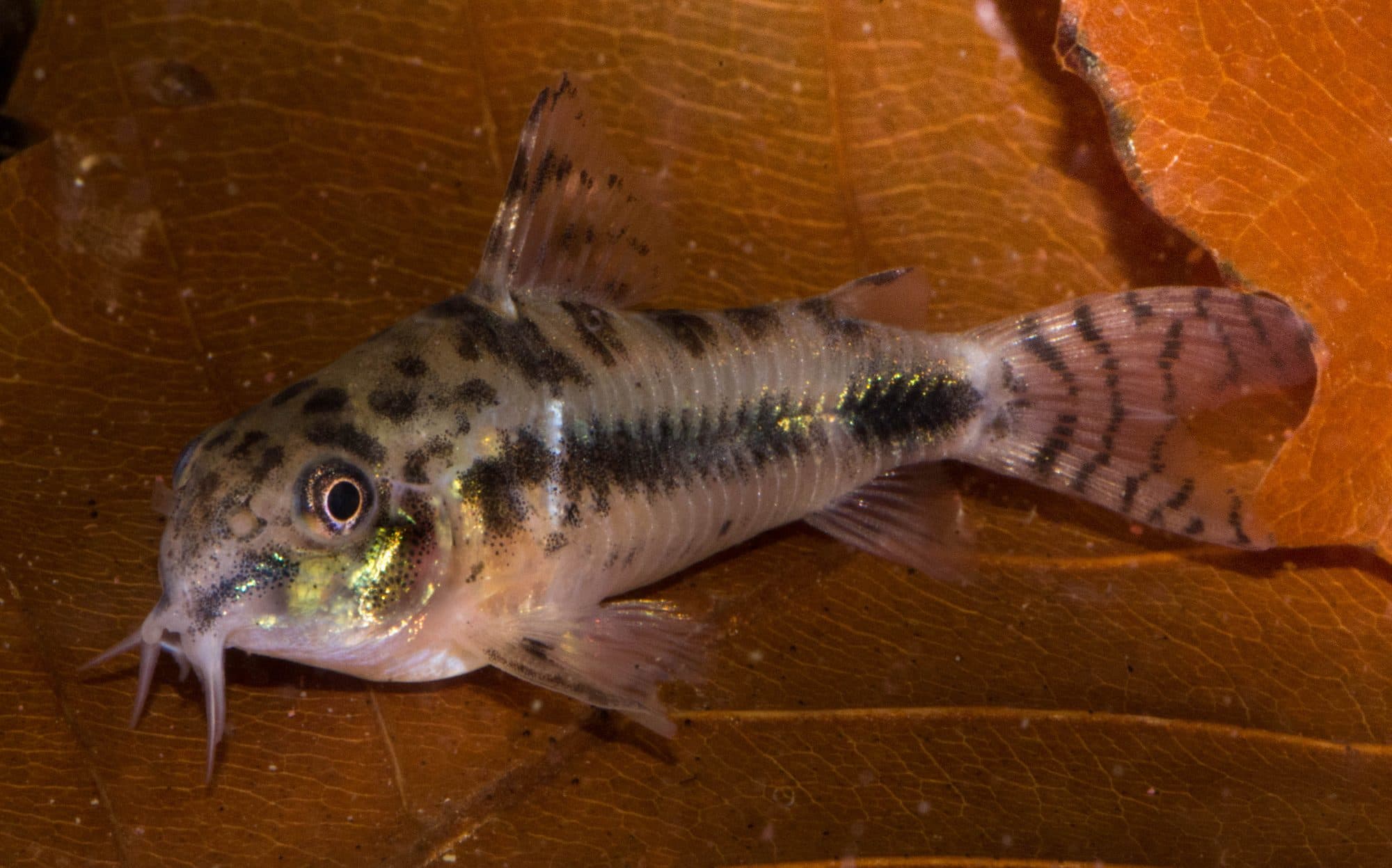
Salt and pepper corydoras
Corydoras habrosus
3 cm
Adult size
50 L
Minimum volume
8
Minimum group
5 years
Lifespan
Water parameters
Understand these values- Genus
- Corydoras
- Diet
- carnivore
- Social life
- shoal
In the wild
Overview
Described in 1960 by Stanley Weitzman, Corydoras habrosus (from the Greek habros, “graceful, delicate”) is a dwarf corydoras of about 2.5 cm, with a beige body marked by two or three dark blotches along the flank, which sets it apart from C. cochui.
It is sold as the “salt and pepper cory” or “Venezuelan pygmy cory”. FishBase now places it in the genus Hoplisoma. The IUCN lists it as near threatened.
- Scientific name
- Hoplisoma habrosum (Weitzman, 1960)Current valid name; in the hobby: Corydoras habrosus
- Classification
- Siluriformes › Callichthyidae
- IUCN Red List
- Near threatened (NT)
Natural habitat
Upper Orinoco, left-bank tributaries in the Llanos (Venezuela, Colombia)
Observations (GBIF) and localities Native countries Rivers and lakes
It lives in the upper Orinoco basin, mainly the Río Apure basin in Venezuela, and in Colombia in the Arauca and Casanare rivers. Its type locality is the Río Salinas, near El Baúl.
It is a fish of the Llanos, vast grassy plains flooded in the rainy season. It prefers lagoons, small tributaries, flooded forest and grassland and margins with little current, and gathers near submerged vegetation, branches or roots.
Behaviour
Peaceful and gregarious, it is kept in a group of at least 6, ideally 10. Its small size calls for calm companions of similar size.
It sifts the substrate for small prey: fine sinking food, bloodworms, tubifex. For breeding, a change of soft, cooler water mimics the rainy season; the females, broader, stick their eggs to the glass or to plants.
Sources:FishBase Seriously Fish GBIF · Base map: Natural Earth