Photo: Kai Schreiber, CC BY-SA 2.0, via Wikimedia Commons
Leopard corydoras
Corydoras julii
6 cm
Adult size
100 L
Minimum volume
8
Minimum group
5 years
Lifespan
Water parameters
Understand these values- Genus
- Corydoras
- Diet
- omnivore
- Social life
- shoal
In the wild
Overview
Described in 1906 by Franz Steindachner, the leopard corydoras is named after a certain “Julius” whose identity remains a mystery. FishBase now places it in the genus Hoplisoma.
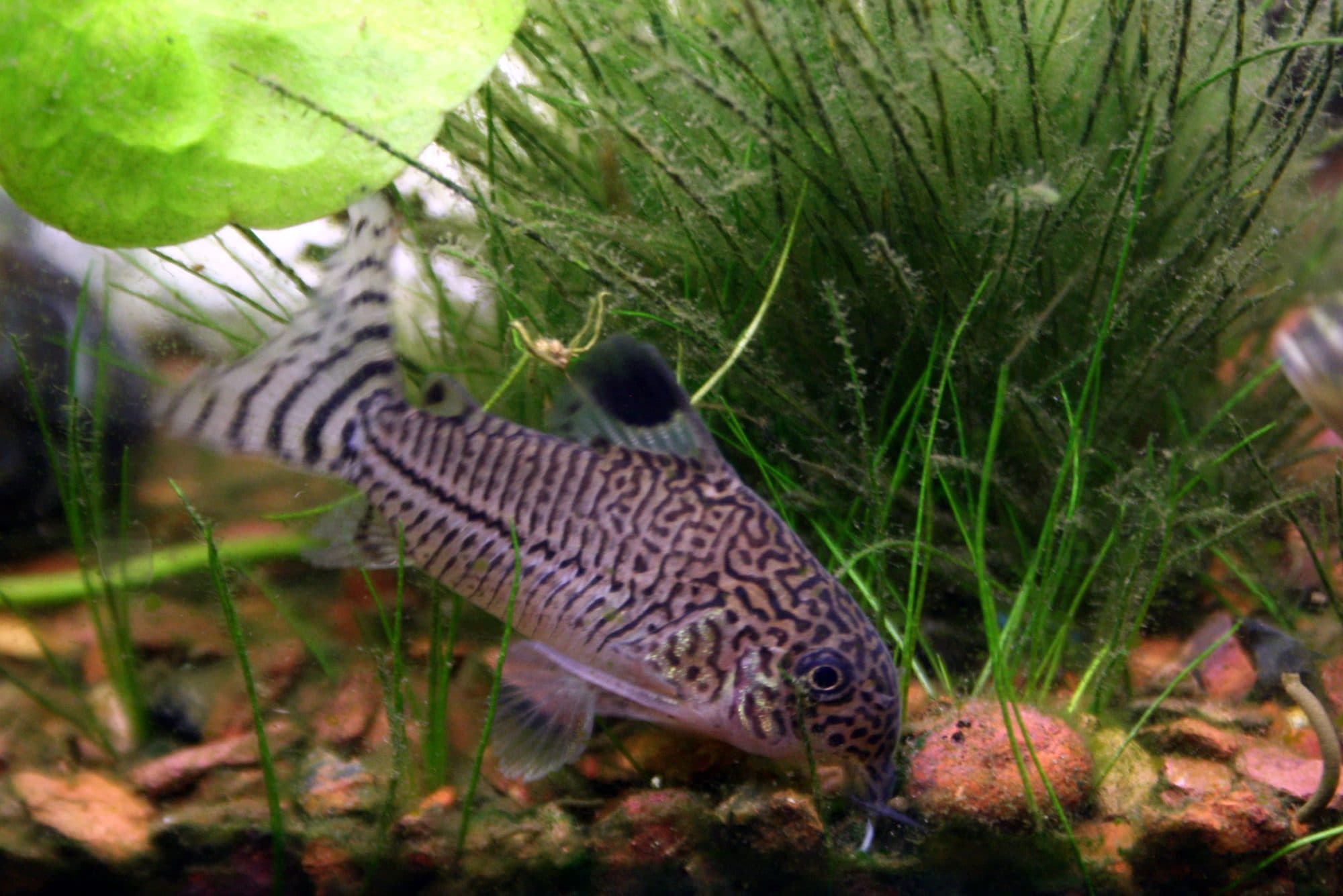
Many fish sold under this name are actually C. trilineatus, a very similar species from the upper Amazon that is caught for the trade more often. They are traditionally told apart by the head, covered with small clear dots in C. julii and with wormlike markings in C. trilineatus; but some trilineatus are dotted too.
- Scientific name
- Hoplisoma julii (Steindachner, 1906)Current valid name; in the hobby: Corydoras julii
- Classification
- Siluriformes › Callichthyidae
- IUCN Red List
- Least concern (LC)
Natural habitat
Lower Amazon and coastal rivers of north-eastern Brazil (Parnaíba basin)
Observations (GBIF) and localities Native countries Rivers and lakes
It lives in the lower Amazon and the coastal rivers of north-eastern Brazil. Its type locality is a stream flowing into the Rio Parnaíba, near Alto Parnaíba.
Like other corydoras, it frequents the bottom of small sandy streams, in soft to moderately hard water between 20 and 26 °C.
Behaviour
Peaceful and gregarious, it is kept in a group of at least 6 and sifts the substrate for worms, crustaceans, insects and plant debris.
It breeds like most corydoras: a large change of cool water triggers spawning, the eggs being stuck to the glass or to plants. Females are larger and broader than males.
Sources:FishBase Seriously Fish GBIF · Base map: Natural Earth