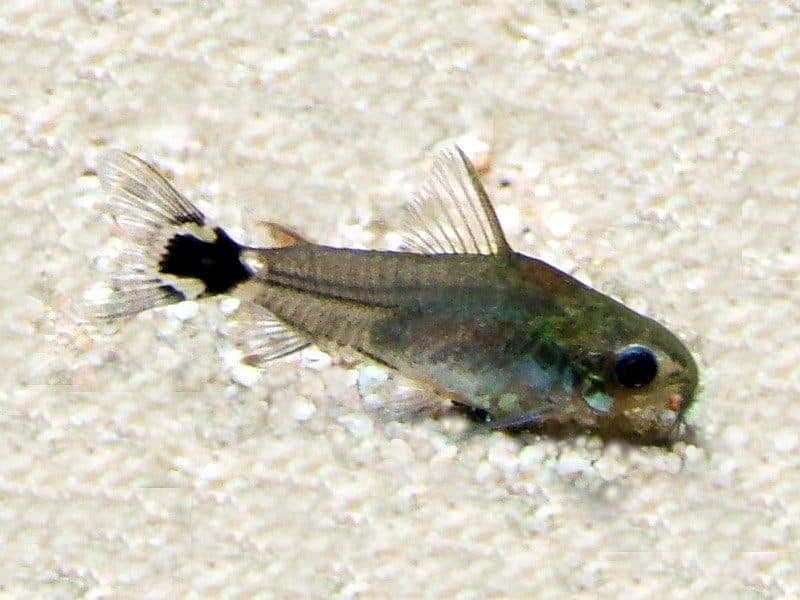
Photo: AquariaNR, CC BY-SA 3.0 de, via Wikimedia Commons
Dwarf corydoras
Corydoras hastatus
3 cm
Adult size
50 L
Minimum volume
8
Minimum group
5 years
Lifespan
Water parameters
Understand these values- Genus
- Corydoras
- Diet
- omnivore
- Social life
- shoal
In the wild
Overview
Described in 1888 by Carl and Rosa Eigenmann, an American couple of ichthyologists, the dwarf corydoras owes its name hastatus (“armed with a spear”) to the dark diamond- or arrow-shaped spot on its caudal peduncle.
It measures under 3 cm. Less common in the hobby than C. pygmaeus and C. habrosus, it is often confused with the former. Since the 2024 revision, FishBase places it in the genus Gastrodermus.
- Scientific name
- Gastrodermus hastatus (Eigenmann & Eigenmann, 1888)Current valid name; in the hobby: Corydoras hastatus
- Classification
- Siluriformes › Callichthyidae
- IUCN Red List
- Least concern (LC)
Natural habitat
Amazon, Madeira and Paraguay basins (Brazil, Bolivia, Paraguay, Argentina)
Observations (GBIF) and localities Native countries Rivers and lakes
It has a wide range for a corydoras: the type locality is on the Amazon between Santarém and Manaus, and it is also known from the Madeira basin in Bolivia and the whole Río Paraguay system, down to north-eastern Argentina.
It lives in side channels, oxbows, marshes, floodplain lakes and small tributaries, in shallow, clear to turbid water over mud or clay, sometimes among weed beds or floating plants (water hyacinths and water lettuce).
Behaviour
Unlike most corydoras, it often swims in open water, in small shoals among the plants. In Paraguay it mixes with shoals of small silvery characins with a tail spot, which it seems to imitate: a resemblance that may protect it from predators.
Peaceful and gregarious, it is kept in a group of at least 6, ideally 10, with small species. It feeds partly in open water, on small prey. Females are larger and broader than males.
Sources:FishBase Seriously Fish GBIF · Base map: Natural Earth