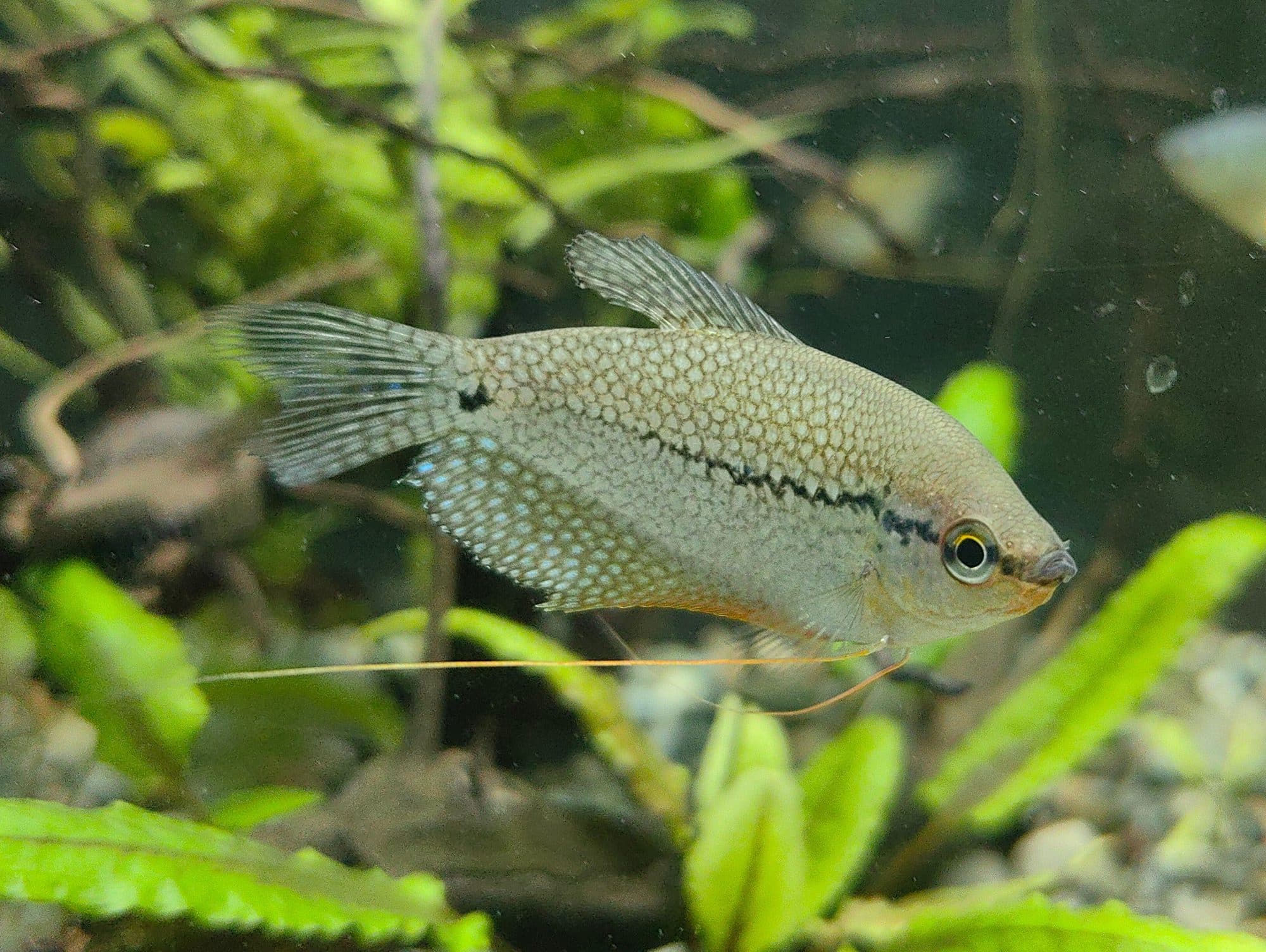
Photo: Александр Сигачёв, CC0, via Wikimedia Commons
Pearl gourami
Trichopodus leerii
13 cm
Adult size
200 L
Minimum volume
5
Minimum group
8 years
Lifespan
Water parameters
Understand these values- Genus
- Trichopodus
- Diet
- omnivore
- Social life
- small group
In the wild
Overview
Described in 1852 by Pieter Bleeker, the pearl gourami is covered in a scattering of pearly dots, hence its name. The adult male develops an orange to bright red throat and dorsal and anal fins extended into filaments.
The IUCN lists it as near threatened: the lowland coastal peat swamps and marshes where it lives are being converted to plantations. Almost all fish in the trade come from farms in Asia and Eastern Europe.
- Scientific name
- Trichopodus leerii (Bleeker, 1852)
- Classification
- Anabantiformes › Osphronemidae
- IUCN Red List
- Near threatened (NT)
Natural habitat
Thailand, Peninsular Malaysia, Sumatra and Borneo
Observations (GBIF) and localities Native countries Rivers and lakes
It is native to Thailand, Malaysia and the islands of Borneo and Sumatra; introduced populations exist in Singapore and Colombia.
It lives in lowland marshes and streams, often near the coast, among dense vegetation, in acidic water. Like other gouramis, it must breathe air at the surface.
Behaviour
It is one of the most peaceful gouramis and an excellent community fish, provided aggressive or overly lively companions, which make it fearful, are avoided. Males are territorial towards each other and can be rough with females before spawning: hiding places are essential.
Undemanding, it accepts most foods. The male builds a large bubble nest, up to 25 cm across, among floating plants, in shallow, calm water.
Sources:FishBase Seriously Fish GBIF · Base map: Natural Earth