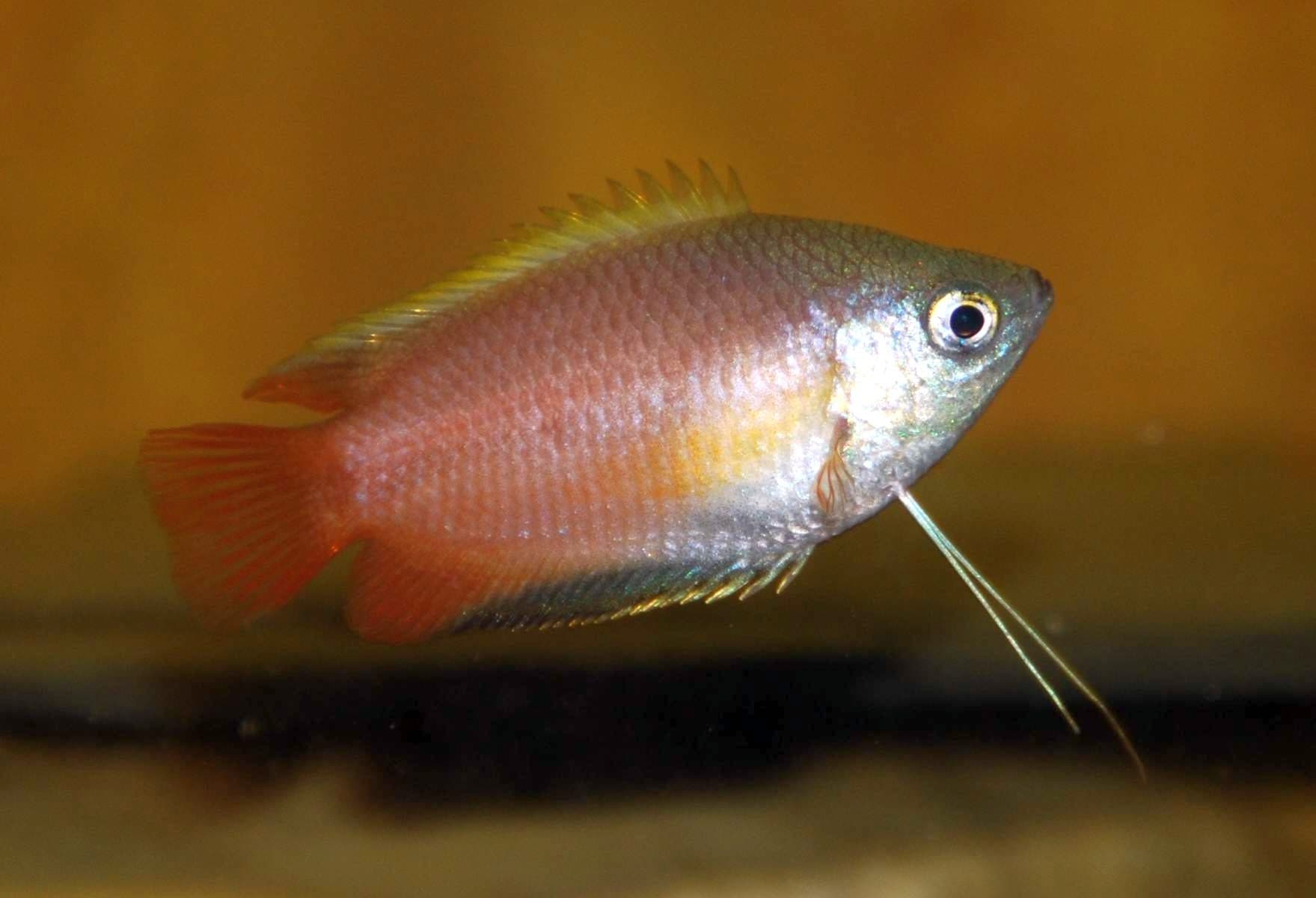
Photo: Made be Uploader, CC BY-SA 3.0, via Wikimedia Commons
Honey gourami
Trichogaster chuna
6 cm
Adult size
60 L
Minimum volume
2
Minimum group
4 years
Lifespan
Water parameters
Understand these values- Genus
- Trichogaster
- Diet
- omnivore
- Social life
- pair
In the wild
Overview
Described in 1822 by Francis Hamilton, the honey gourami owes its common name to the honey-yellow colouring of displaying males, which then develop a blue-black throat. Trichogaster means “hairy belly”, for its pelvic fins transformed into long tactile filaments; chuna comes from a local name.
Like all anabantoids, it has a labyrinth, a respiratory organ that lets it use air taken at the surface. Fish in the trade almost all come from farms.
- Scientific name
- Trichogaster chuna (Hamilton, 1822)
- Classification
- Anabantiformes › Osphronemidae
- IUCN Red List
- Least concern (LC)
Natural habitat
Ganges and Brahmaputra basins (northern India, Bangladesh, Nepal)
Observations (GBIF) and localities Native countries Rivers and lakes
It lives in the Ganges, its floodplain and its delta in Bangladesh, as well as in the Brahmaputra system (Assam, Manipur, Meghalaya, Arunachal Pradesh), with records from Nepal.
It frequents slow, heavily vegetated lowland water: pools, ditches, beels (floodplain lakes), flooded fields. These habitats change in volume, chemistry and turbidity with the monsoon, from June to October.
Behaviour
Slow and peaceful, it is easily intimidated or outcompeted by livelier companions: small, calm cyprinids and discreet loaches suit it. Without forming a shoal, it enjoys the company of its own kind; in a group of 4 to 6 a hierarchy forms.
In the wild it is said to knock down insects resting on leaves by spitting drops of water at them. The male builds a bubble nest under floating plants and forms a temporary pair with the larger, brownish female.
Sources:FishBase Seriously Fish GBIF · Base map: Natural Earth