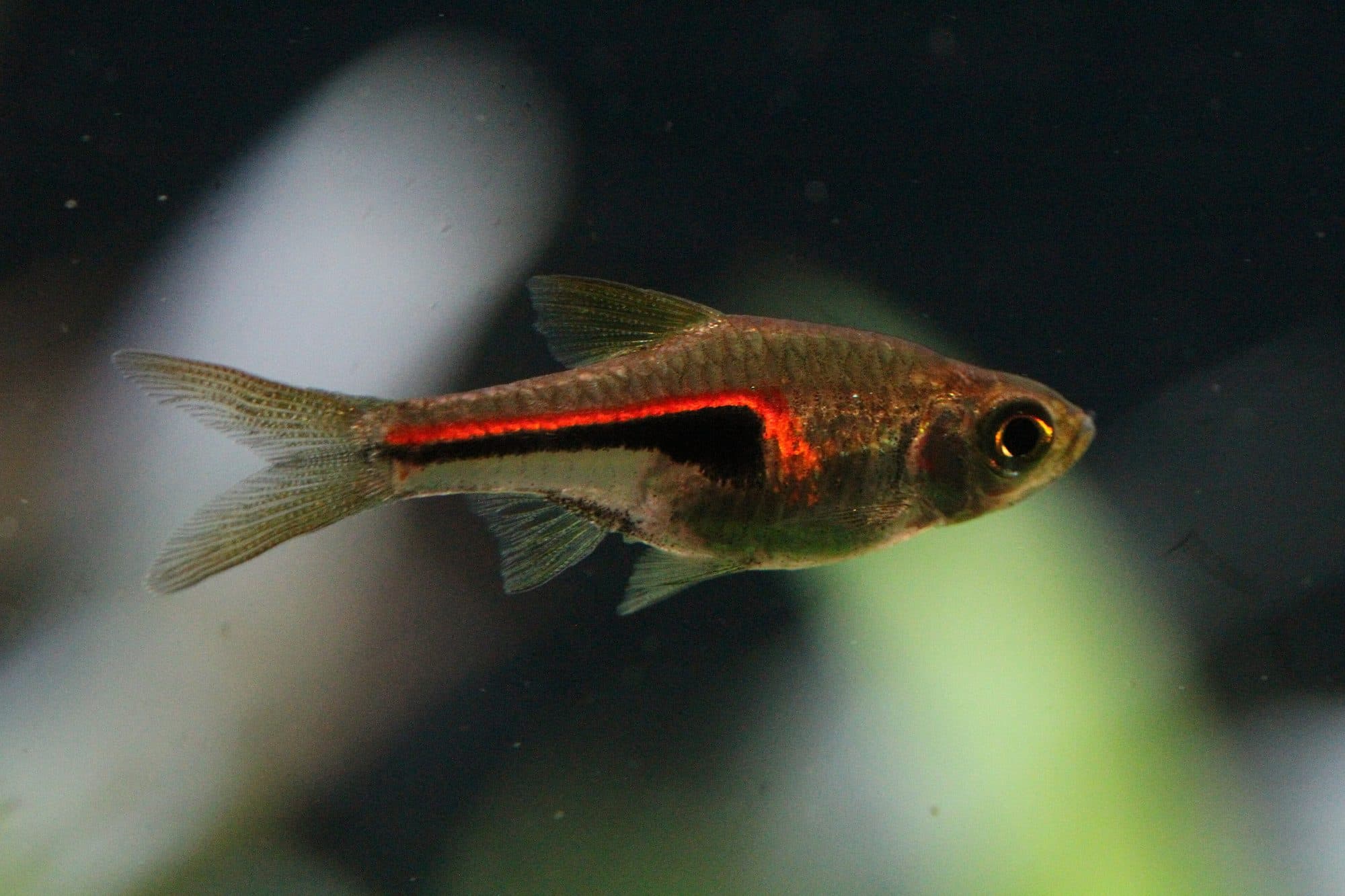
Photo: -serwacy01-, CC BY-SA 4.0, via Wikimedia Commons
Glowlight rasbora
Trigonostigma hengeli
3 cm
Adult size
40 L
Minimum volume
10
Minimum group
6 years
Lifespan
Water parameters
Understand these values- Genus
- Trigonostigma
- Diet
- carnivore
- Social life
- shoal
In the wild
Overview
Described in 1956 by Hermann Meinken, Hengel's rasbora is the smallest of the Trigonostigma, a genus split from Rasbora in 1999. Its black “lambchop” patch is edged with a bright orange glow along the top and front, on an almost colourless greyish body.
This sets it apart from T. espei, coppery with a thinner mark, and from the larger T. heteromorpha. The type specimens come from the Tambesi River, a tributary of the Batang Hari on Sumatra.
- Scientific name
- Trigonostigma hengeli (Meinken, 1956)
- Classification
- Cypriniformes › Danionidae
- IUCN Red List
- Least concern (LC)
Natural habitat
Sumatra (Jambi province) and probably western Borneo (Indonesia)
Observations (GBIF) and localities Native countries Rivers and lakes
Its range is limited to the Greater Sunda Islands: it has been collected in Jambi province on Sumatra, and apparently in West Kalimantan, on Borneo.
It frequents the calm parts of forest streams where beds of Cryptocoryne grow, in soft, slightly acidic to neutral water, sometimes stained by tannins, under light filtered by the canopy.
Behaviour
Very peaceful, it suits a community aquarium of small, quiet fish well. A shoaling fish, it is kept in a group of at least 8 to 10; the slimmer, more colourful males then compete for the females.
A micropredator, it feeds on small insects, worms and zooplankton. Like the harlequin, it sticks its eggs under broad leaves rather than scattering them, with no parental care.
Sources:FishBase Seriously Fish GBIF · Base map: Natural Earth