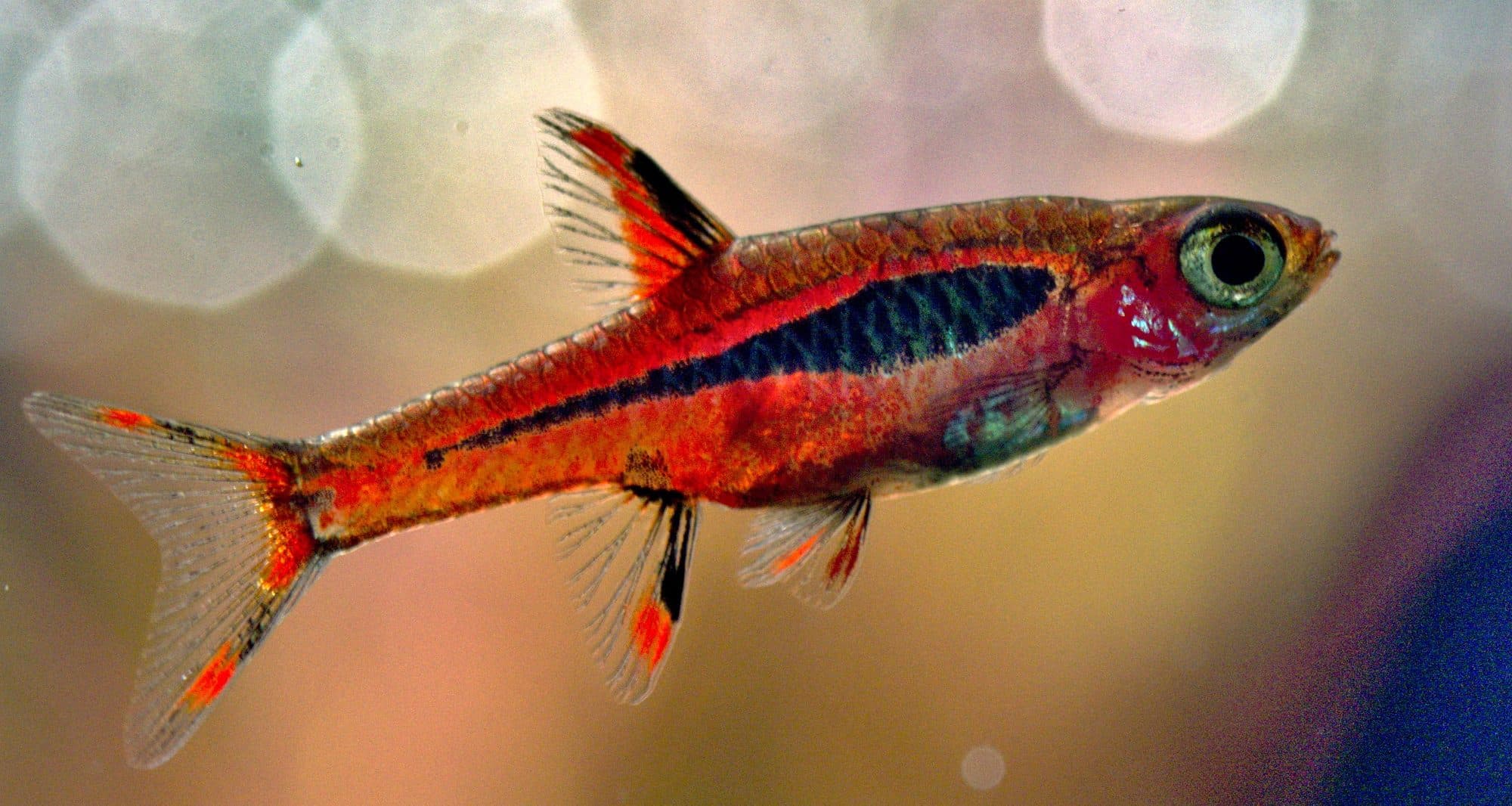
Photo: JoKrimmel, CC BY-SA 4.0, via Wikimedia Commons
Chili rasbora
Boraras brigittae
2 cm
Adult size
40 L
Minimum volume
10
Minimum group
8 years
Lifespan
Water parameters
Understand these values- Genus
- Boraras
- Diet
- carnivore
- Social life
- shoal
In the wild
Overview
Described in 1978 by Dieter Vogt, who named it after his wife Brigitte, the “chili rasbora” barely exceeds 2 cm. The genus Boraras, created in 1993, is an anagram of Rasbora: it alludes to the reversed ratio between abdominal and caudal vertebrae in these fish.
It is often confused with B. urophthalmoides, sometimes sold under its name. B. brigittae differs by a slightly larger adult size, a short and often broken lateral stripe and a more uniform red colouring. The IUCN lists it as data deficient.
- Scientific name
- Boraras brigittae (Vogt, 1978)
- Classification
- Cypriniformes › Danionidae
- IUCN Red List
- Data deficient (DD)
Natural habitat
Southern Borneo, Kalimantan (Indonesia)
Observations (GBIF) and localities Native countries Rivers and lakes
It lives in southern Borneo, in the blackwater streams and pools of ancient peat swamp forests. The brown, very acidic water (pH down to 4) has virtually no hardness; the bottom is strewn with leaves, twigs and branches, and the light is filtered by the canopy.
Throughout Southeast Asia these biotopes are threatened by rubber and oil palm plantations and by urbanisation.
Behaviour
Very peaceful but tiny and shy, it is happy alone or with other dwarf species (microrasboras, small corydoras, Otocinclus), discreet anabantoids or shrimp in a planted tank. It lives in a shoal: a group of at least 8 to 10 makes it less fearful and pushes the dominant males to show their best colours.
A micro-predator, it hunts small insects, worms and zooplankton. It spawns continuously, a few eggs a day, with no parental care; fry may appear on their own in a well-planted tank.
Sources:FishBase Seriously Fish GBIF · Base map: Natural Earth