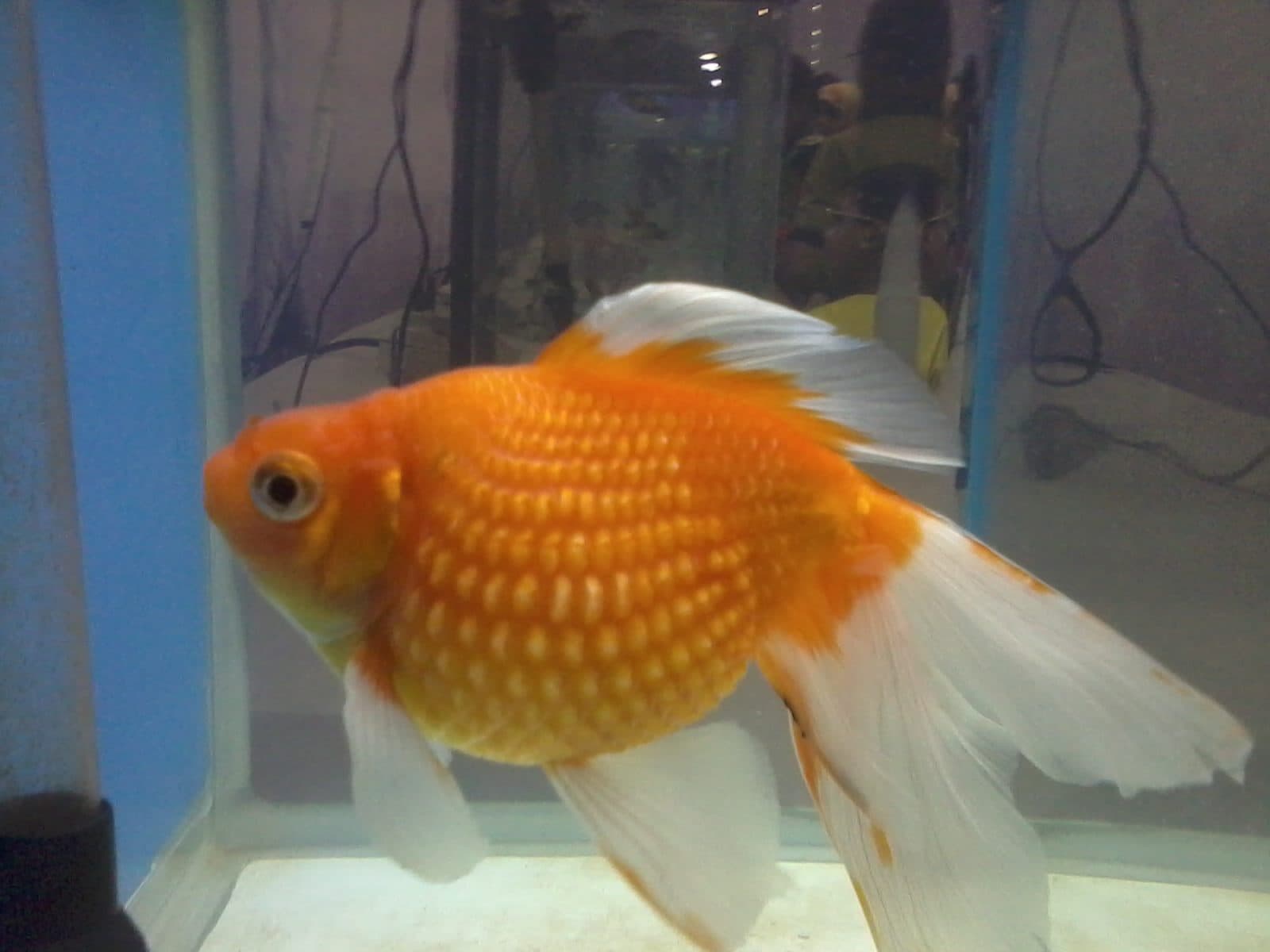
Photo: Sivahari, CC BY-SA 3.0, via Wikimedia Commons
Pearlscale goldfish
Carassius auratus 'Pearlscale'
20 cm
Adult size
150 L
Minimum volume
2
Minimum group
15 years
Lifespan
Water parameters
Understand these values- Genus
- Carassius
- Diet
- omnivore
- Social life
- small group
In the wild
Overview
The pearlscale is named after its domed scales with pale centres, which look like pearls all over the body. Its body is almost spherical, with a double tail; some lines carry a small wen.
Its round body, one of the most extreme among goldfish, makes it prone to buoyancy problems: sinking food and a varied diet matter.
- Scientific name
- Carassius auratus (Linnaeus, 1758)Current valid name; in the hobby: Carassius auratus 'Pearlscale'
- Classification
- Cypriniformes › Cyprinidae
- IUCN Red List
- Least concern (LC)
Natural habitat
Captive-bred form of Carassius auratus (a species native to China)
As a captive-bred form it has no natural habitat: the wild form of the species lives in calm, well-vegetated rivers, lakes and ponds in China.
It is a coldwater fish that needs no heater: ideal water is 15–23 °C, neutral to alkaline (pH 7–8) and moderately hard. Allow 100 L for one adult plus 50 L for each extra fish, so 150 L for two, with strong filtration but a gentle current, as these varieties are poor swimmers. Use decor without sharp edges; soft plants will be eaten.
Behaviour
Peaceful and sociable, it lives in a small group with other fancy goldfish. Avoid common goldfish and comets, which are faster, steal its food and nip its fins.
It does not mix with tropical fish: it needs cooler water, produces a lot of waste and swallows small fish and shrimp. A tank of its own is best. An omnivore and a glutton, it should be fed sinking pellets: gulping air at the surface can upset its buoyancy.
Sources:OATA Fishkeeper FishBase Wikipédia · Base map: Natural Earth