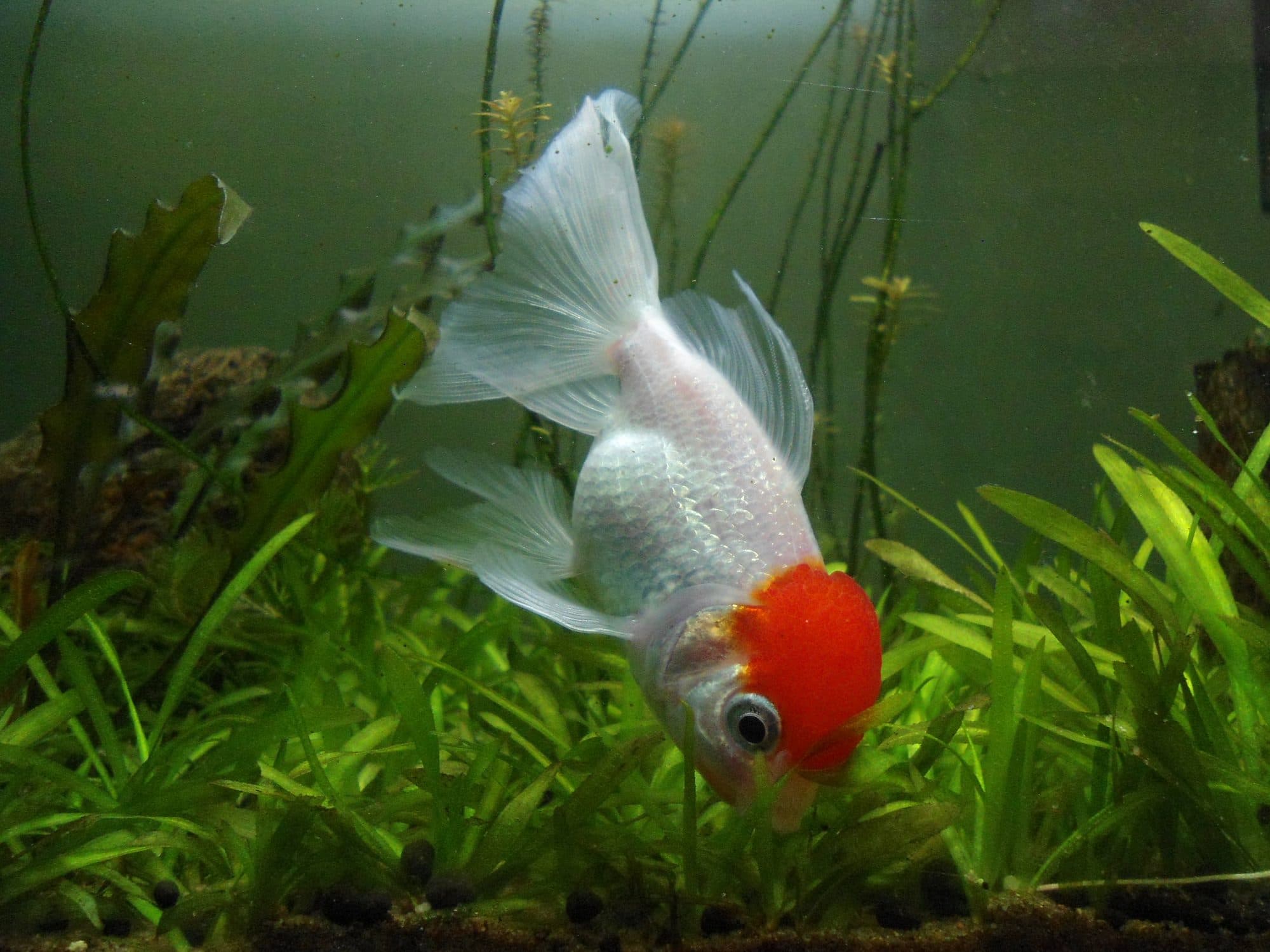
Photo: Adityamadhav83, CC BY-SA 3.0, via Wikimedia Commons
Oranda
Carassius auratus 'Oranda'
30 cm
Adult size
150 L
Minimum volume
2
Minimum group
15 years
Lifespan
Water parameters
Understand these values- Genus
- Carassius
- Diet
- omnivore
- Social life
- small group
In the wild
Overview
The oranda carries a fleshy growth on top of its head, the “wen”; when it also covers the gill plates the fish is called a Dutch oranda. Its tail is long and double.
It is one of the largest varieties: well fed in a big tank it can exceed 20 cm. It comes in red, black, blue, chocolate, calico and “red cap” (white with a red wen).
- Scientific name
- Carassius auratus (Linnaeus, 1758)Current valid name; in the hobby: Carassius auratus 'Oranda'
- Classification
- Cypriniformes › Cyprinidae
- IUCN Red List
- Least concern (LC)
Natural habitat
Captive-bred form of Carassius auratus (a species native to China)
As a captive-bred form it has no natural habitat: the wild form of the species lives in calm, well-vegetated rivers, lakes and ponds in China.
It is a coldwater fish that needs no heater: ideal water is 15–23 °C, neutral to alkaline (pH 7–8) and moderately hard. Allow 100 L for one adult plus 50 L for each extra fish, so 150 L for two, with strong filtration but a gentle current, as these varieties are poor swimmers. Use decor without sharp edges; soft plants will be eaten.
Behaviour
Peaceful and sociable, it lives in a small group with other fancy goldfish. Avoid common goldfish and comets, which are faster, steal its food and nip its fins.
It does not mix with tropical fish: it needs cooler water, produces a lot of waste and swallows small fish and shrimp. A tank of its own is best. An omnivore and a glutton, it should be fed sinking pellets: gulping air at the surface can upset its buoyancy.
Sources:OATA Fishkeeper FishBase Wikipédia · Base map: Natural Earth