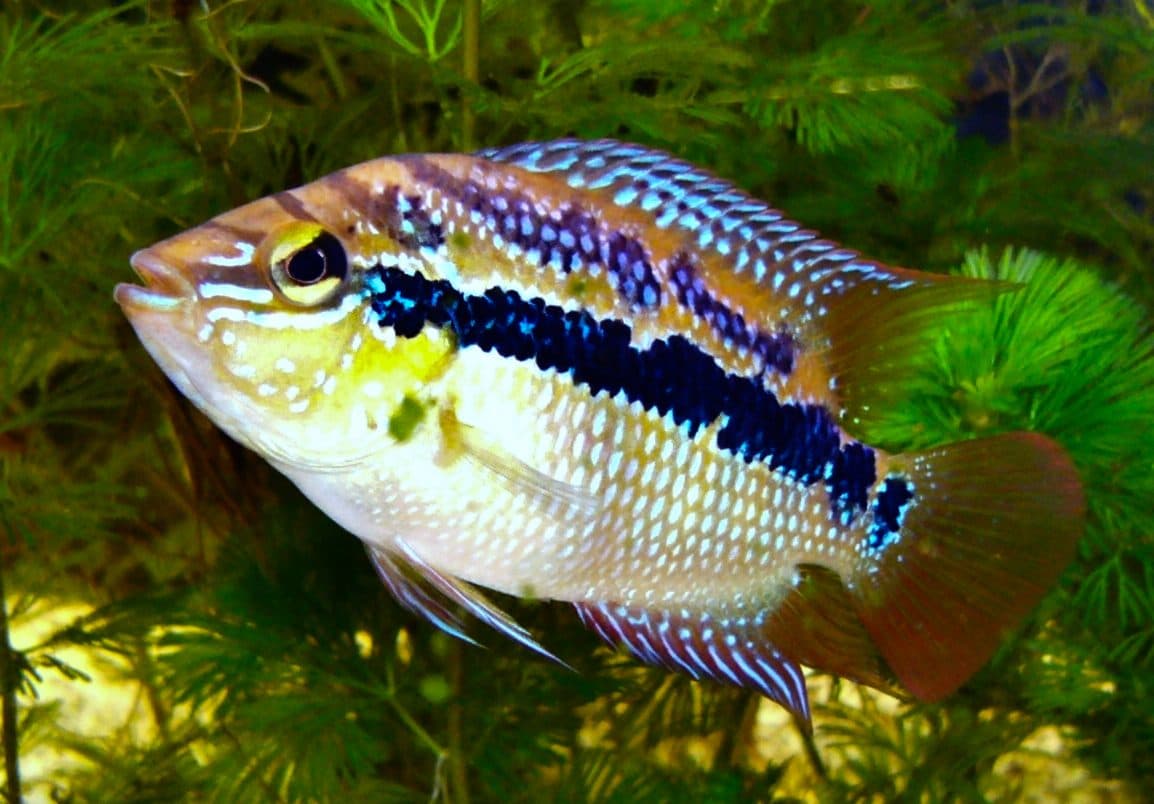
Photo: Banteo, Public domain, via Wikimedia Commons
Salvin's cichlid
Trichromis salvini
15 cm
Adult size
130 L
Minimum volume
2
Minimum group
12 years
Lifespan
Water parameters
Understand these values- Genus
- Trichromis
- Diet
- omnivore à tendance carnivore
- Social life
- pair
In the wild
Overview
The only member of the genus Trichromis, created in 2015; genetic studies show it is a close relative of the firemouth cichlids (Thorichthys). It honours the British naturalist Osbert Salvin, who explored Guatemala in the 19th century.
Its yellow body carries two rows of black, blue-ringed blotches, and its belly is red, especially in females ready to spawn. The smaller female also has a dark spot in the middle of the dorsal fin and another at the bottom of the gill cover; the male has longer, more pointed fins.
- Scientific name
- Trichromis salvini (Günther, 1862)
- Classification
- Cichliformes › Cichlidae
- IUCN Red List
- Least concern (LC)
Natural habitat
Atlantic slope of southern Mexico, Guatemala and Belize (including the Usumacinta basin); introduced in southern Florida
Observations (GBIF) and localities Native countries Rivers and lakes
It lives in lowland rivers and coastal lagoons and prefers the moderate to fast currents of the lower and middle river valleys. Unlike many cichlids of the region, it readily hunts in the open channel.
It preys on aquatic invertebrates and small fish, which it catches near the bottom.
Behaviour
Aggressive for its size and very territorial, especially when breeding, it eats any fish that fits in its mouth. Keep it only with Central American cichlids of the same size and temperament, with plenty of hiding places and open swimming space over sand.
A pair forms best by raising a group of juveniles. The female lays up to 500 eggs on cleaned stones and both parents guard the fry for a long time. It accepts all foods, from pellets to live and frozen prey.
Sources:FishBase Seriously Fish GBIF · Base map: Natural Earth